Eduardo González
As expected, the appearance this Thursday of Foreign Minister José Manuel Albares before the Congress to report on Spain’s position regarding the situation in Venezuela, just two weeks after the US military attack on Caracas and the subsequent capture of President Nicolás Maduro, became a new chapter in the extreme polarization gripping Spanish politics.
The minister’s first intervention before the plenary session began with a plea for respect for international law and the sovereignty of all states, because “peace and democracy never come against international law; chaos does.” “For democrats, the means also legitimize the end. Either you are free, or you are not. Either you defend sovereignty, or you defend interference,” he warned.
With this starting point, Albares recalled that the “Government never recognized the results of the July 28, 2024 elections” in Venezuela, nor did it support “unilateral military actions contrary to international law that violate basic principles, such as the sovereign equality of States and the obligation to peacefully resolve international disputes.”
“No solution for Venezuela can be imposed from the outside, much less by force,” he continued. “The only viable solution today, as always, must be Venezuelan, negotiated, peaceful, and democratic, respecting the will of the Venezuelan people and their sovereignty over their natural resources, which are also part of the sovereignty of every country. This is important for Venezuela and it is important for the entire region, which would be seriously affected by Venezuelan destabilization,” he warned.
According to Albares, “no government in the world has done as much for the brotherly people of Venezuela as this government.” “This government acts for Venezuela, for Venezuelans, for democracy and human rights, always with respect for international law, because the alternative to the rule of law is horror, the dominance of brute force,” he stated.
The government’s foreign policy, he asserted, “has always defended and actively worked for the same things in Venezuela: democracy, respect for human rights, justice and social progress, and that the future of the Venezuelan people be built exclusively by Venezuelans themselves through dialogue, democratically and by peaceful means.” In this context, according to Albares, Spain’s role should be “to build bridges and unite the government and the opposition.”
“Last Thursday we learned some good news: the release of Spanish citizens by Venezuela, which we consider a positive step in this new stage the country is in, and which must continue to take decisive steps in that same direction,” he recalled. “Five Spaniards were released in the first group and are now happily back in Spain,” and four other Spaniards “have also been released, one of whom is already in Spain, while the rest remain in Venezuela of their own volition,” he specified. “The Ministry of Foreign Affairs and the Spanish Embassy in Caracas have worked intensively from the outset to secure their release.”
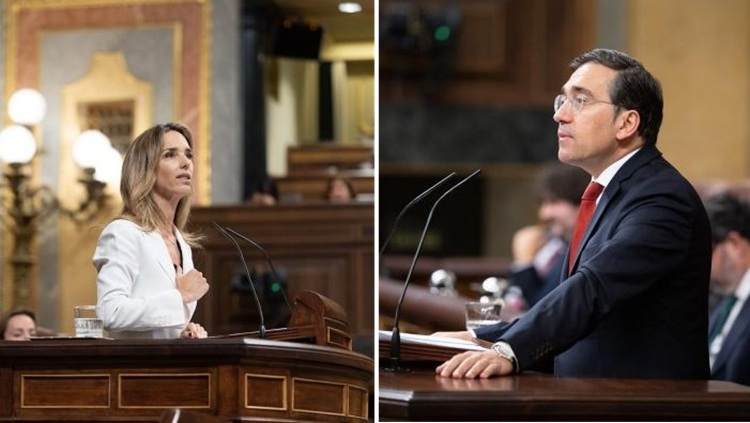
Cayetana Álvarez de Toledo (PP)
As expected, the response from Cayetana Álvarez de Toledo, of the People’s Party (PP), was particularly harsh and included her party’s repeated accusations against former President José Luis Rodríguez Zapatero’s role in Venezuela.
According to the PP MP, “Trump has not kidnapped a legitimate president, he has put an end to the impunity of a criminal,” which represents “the beginning of the end of Venezuelan captivity and hopefully also Cuban captivity” and, therefore, “a real opportunity for democracy.”
“You emphatically state that the law of the jungle should not prevail in international law. Why didn’t you say the same about Maduro’s jungle? And why didn’t you appeal to the UN?” the PP MP continued. “A year ago, this plenary session urged the Government to support the case against Maduro before the International Criminal Court. What did you do? You voted against it and then completely ignored the mandate of Congress,” she recalled.
“The reality is that you despise international law just as you despise Spanish and European law. Or what was the sanctioned Delcy doing profiting with the strongman of the Government one night at Barajas Airport?” Álvarez de Toledo asked, referring to the then Vice President and current acting President, Delcy Rodríguez. While “Trump removed the usurper of the presidency from Venezuela,” the Government mounted “an operation to remove the legitimate president (the opposition leader Edmundo González) from Venezuela,” she added.
According to Álvarez de Toledo, the true objective of the Spanish Government in Venezuela is to defend “a Lampedusian transition, in which everything changes so that everything stays the same: the business and the impunity.” “Delcy Rodríguez is not a moderate, she is not the Venezuelan Adolfo Suárez you portray her to be, and she is certainly not the president of Venezuela, as Trump himself has reminded us,” she warned.
Furthermore, she warned, “María Corina Machado is not just another leader; she is the undisputed leader of Venezuela.” Despite this, she denounced, “Sánchez was unable to congratulate María Corina Machado on the Nobel Peace Prize, and it was so easy, a simple tweet.”
The government’s policy in Venezuela “can be summed up in two words: immoral and ineffective, boundless cynicism, and zero benefits, unless by benefits you mean the perpetuation of the dictatorship,” she stated. “The minister says they have never been equidistant, and it’s true, they have always played into the hands of the dictatorship,” she proclaimed.
Regarding the released prisoners, Álvarez de Toledo denounced that “the government rails against the American intervention, but at the same time claims credit for its effects.” “Zapatero, liberator of prisoners: if it weren’t obscene, it would be comical. How many prisoners has Zapatero freed, and how many has he helped to imprison?” she asked. “Zapatero has been the great whitewasher of the Chavista tyranny,” he denounced. “Do you want to know what leading Venezuelans of the democratic forces think of Rodríguez Zapatero? Antonio Ledezma called him Maduro’s puppet master, Leopoldo López called him the dictatorship’s mouthpiece,” she added.
Albares’s response
“In your speech, you have been praising Donald Trump and criticizing Delcy Rodríguez, but I want to remind you of one thing: Delcy Rodríguez is not where she is now because of the Spanish government, but because of the United States’ military intervention,” Albares stated in his response to Álvarez de Toledo.
“I regret to inform you that the President of the United States does not agree with your remarks. He publicly stated yesterday that he had a long conversation with Delcy Rodríguez, that she is a fantastic person, and that he is prepared to work with her long-term,” he asserted.
He also recalled that former Prime Minister Mariano Rajoy, of the People’s Party (PP), “the archives are there to show, thanked former Prime Minister Rodrigo Zapatero for his efforts in securing the release of Leopoldo López,” and that “his then-Minister of Foreign Affairs endorsed the European Union’s appointment of former Prime Minister Rodrigo Zapatero as Special Representative for Venezuela.” “You were in government, with a government of exactly the same political persuasion, with the same president, and I never heard you say anything—no talk of a dictatorship, no talk of political prisoners, nothing at all, which is the most important thing,” he added.
“You talks a lot about political prisoners and what the government is doing and what former President Zapatero is doing,” he continued. “The first communication I sent to the new acting president of Venezuela, when she was sworn into office, was precisely to request the release of all Spaniards,” because “this is the government that has systematically denounced all human rights violations and has requested the release of all political prisoners,” he asserted. “And with respect to former President Zapatero, from Leopoldo López, the first political prisoner released, to Rocío San Miguel, recently freed, all of them have thanked him for his work,” he added.
“You don’t care about the fate of Venezuelans. What you want is to import the division and polarization of Venezuela to Spain, not export unity to Venezuela, which is what Spain should be doing,” she denounced.
María José Rodríguez de Millán (Vox)
On behalf of the far-right Vox party, María José Rodríguez de Millán described Maduro’s fall as “good news” because “today Venezuela is better off than it was three weeks ago, and that is absolutely indisputable.”
“In response to this, the Spanish government’s most prominent statement on January 3rd was that Spain never recognized the Maduro regime, attempting to place itself above good and evil, when the reality is that you have consistently sided with evil,” she denounced. “No European government has done more for Maduro’s tyranny than Spain, and that is the only truth,” she proclaimed.
“No European government has done more for Maduro’s tyranny than Spain’s, and that is the only truth,” she declared. “The problem for you is not the violation of international law, but the ideological model, the model you live by and the one you intend to establish here in Spain: the model of ruin, repression, groupthink, corruption, and profiting from crime. In other words, turning Spain into the Venezuela of Europe, which is what you would like,” she stated.
Santos Maraver (Sumar)
For his part, Agustín Santos Maraver, of the Plurinational Parliamentary Group Sumar (a minority member of Pedro Sánchez’s governing coalition), denounced in his speech that “the Trump Administration has blockaded Venezuela, carried out extrajudicial killings, kidnapped its sitting president, Nicolás Maduro, and bombed the country, resulting in more than one hundred victims.”
According to Santos Maraver, this is “a blatant violation of international law and humanitarian law that has turned Venezuela, under the threat of violence, into a Trump protectorate, expropriating its oil and deciding how to sell it in flagrant violation of the UN Charter.”
This armed intervention, he continued, represents a revival of “the Monroe Doctrine” by President Trump, “who already intends to install Marco Rubio as president of a pseudo-Cuban republic while tightening the noose around UN resolutions” and who aspires to “unilaterally replace the multilateral UN system, a system born from the defeat of fascism and decolonization, representing 196 states, with a division of multipolar spheres of influence based on the nuclear threat.” “This is the climate in which we will have to prepare for the Ibero-American Summit in Madrid in November 2026, if Trump does not prevent it,” he warned.