
The Diplomat
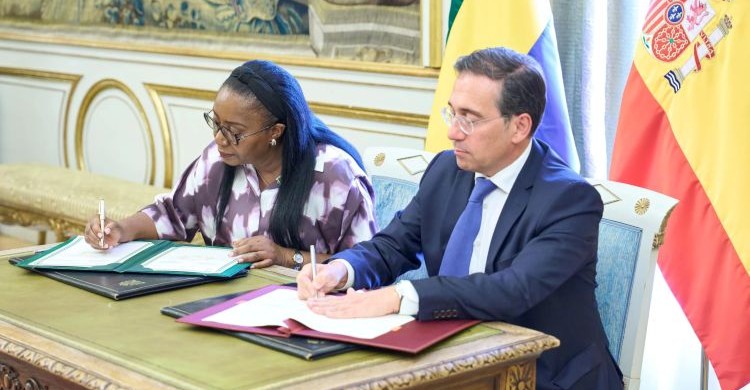
Foreign Minister José Manuel Albares met with Gabon’s Minister of Foreign Affairs and Cooperation, Marie-Édith Tassyla-Ye-Doumbeneny, on Thursday, July 16, and signed an agreement on political consultations.
The meeting took place at the Ministry headquarters in the Palacio de Viana and served to “deepen bilateral relations with the country, which has been reflected in the signing of an agreement on political consultations in order to institutionalize and strengthen high-level contacts between both countries,” according to a press release from the Ministry of Foreign Affairs. The topics for consultation include political, economic, cultural, and consular matters. They also discussed international and regional issues.
“The close bilateral relationship has clear potential in areas such as the green transition, infrastructure, renewable energy, and the teaching of Spanish,” the Ministry continued, noting that “Gabon is the fifth country in Sub-Saharan Africa with the highest number of students of the language.”
During the meeting, the Foreign Minister highlighted the Spain-Africa Strategy 2025-2028 as “a fundamental instrument with the aim of moving beyond the old donor-beneficiary relationship and building a new relationship based on respect and mutual benefit with our African partners.”
Albares also congratulated his counterpart on the success of the political transition in Gabon. Since the coup d’état of August 2023, which ended the presidency of Ali Bongo (son of Omar Bongo, president from 1967 to 2009), Gabon entered a period of transition under the leadership of General Brice Clotaire Oligui Nguema, former head of the Republican Guard. This led to the reform of the Constitution, approved by referendum on November 16, 2024, with 91.64 percent of the vote in favor, and to the holding of presidential elections in April 2025, which Oligui himself won. This marked the beginning of the Fifth Republic, which brought the transition period to a close and was followed by legislative and local elections between September and November of that same year, in which Oligui’s party, the Democratic Union of Builders, emerged victorious.