
Eduardo González
The Senate plenary session has once again referred the Treaty of Friendship and Cooperation between Spain and France to the Constitutional Court, again at the request of the People’s Party (PP), just as happened in the Government’s first attempt to pass a text that would elevate bilateral relations to the highest possible level.
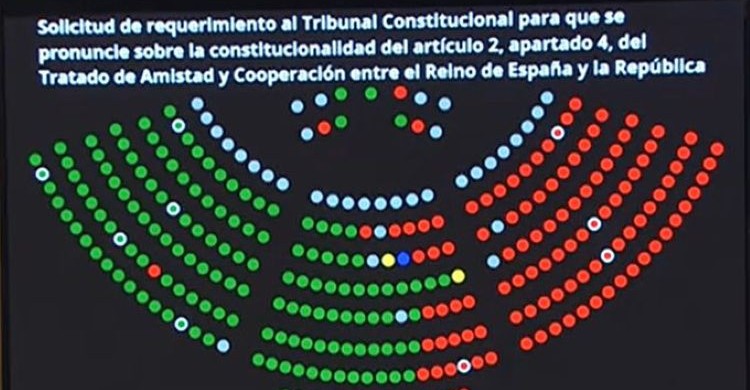
The plenary session of the Upper House was scheduled to hold two votes on the Treaty this Thursday; the first, on a request to the Constitutional Court to rule on the constitutionality of the agreement (presented by the PP), and the second, on the text itself.
Finally, the request to the Constitutional Court was approved with 146 votes in favor, 112 against, and two abstentions. As a result, the processing of the treaty has been suspended until the Constitutional Court’s decision, and the next item on the agenda has therefore been dropped. The outcome was more than predictable because the People’s Party (PP) holds an absolute majority in the Senate.
This is the PP’s second constitutional challenge against the Treaty. The first was filed in February 2025 and was also supported by the Senate. Under those circumstances, the text was rejected by the Congress on May 15, 2025, pending the Constitutional Court’s decision. In December 2025, the Court opted not to rule on the challenge, considering that the parliamentary “no” vote had prevented the text’s validation.
The People’s Party (PP) opposition to the Treaty is related to the controversial Article 2.4, which stipulates that “a member of the Government of one of the Parties shall be invited to the Council of Ministers of the other Party at least once every three months on a rotating basis.” According to Feijóo’s party, this clause is incompatible with the Constitution.
Therefore, and in an attempt to salvage the Treaty, the Minister of Foreign Affairs, José Manuel Albares, and his French counterpart, Jean-Noël Barrot, agreed, through letters exchanged on April 6 and 10, 2026, on “the interpretation of Article 2.4 of the Treaty,” according to which the invitation to members of the other Party is not to participate in the Council of Ministers, but rather to “participate on the sidelines of said Council of Ministers in a separate meeting.”
With these changes, the Treaty was again sent to Parliament and approved in mid-June by the Congress with 175 votes in favor, 170 against, and one abstention. Should the text be voted on in the Senate (obviously pending the Constitutional Court’s decision) and rejected by the Upper House, it will return to the Congress for a final vote, in which, unlike the previous one, an absolute majority (176 votes) will be required.
Following the vote, Albares accused the People’s Party (PP), via social media, of having boycotted “the first Treaty of Friendship and Cooperation with France: our friend and largest trading partner.” “It attacks 330,000 Spaniards in France, one million cross-border workers, and 56 billion euros in annual exports. It goes against our position in Europe and good neighborliness,” he added.
The debate
During the Senate debate, Miguel Ángel Jerez, of the People’s Party (PP), defended referring the Treaty to the Constitutional Court because, “when there are well-founded doubts about the constitutionality of an international treaty,” the mechanism provided by the Constitution itself to resolve them should be used.
Instead of “what should be an exercise based on the most basic logic,” he denounced, the Government has opted for “an irrational and reckless attitude.” “Any sensible government, faced with doubts that might arise in the drafting of its treaties, would consider the scope of their constitutionality; but no, this Government has chosen another path: not to amend the treaty, not to clear up the doubts, but to ask Parliament and our group for an act of faith,” he continued. “We are being told to ignore the Constitution and to believe what a piece of paper, a letter, or an email between ministers says. This is not serious,” he warned.
He also questioned “what it means that a French government minister can participate in the margins of the Council of Ministers,” because “the Constitution does indeed perfectly recognize what the Council of Ministers is, it regulates it, it protects it,” but “what the Constitution neither regulates nor protects are the margins of the Council of Ministers, because it doesn’t know what they are, because it doesn’t define them, it doesn’t attribute any legal significance to them, and certainly it doesn’t foresee that the configuration of the Council of Ministers can be altered through an exchange of roles between two foreign ministers.”
For her part, Senator Concepción Andreu, of the PSOE (Spanish Socialist Workers’ Party), denounced, “on behalf of all reasonable people in Spain, including within her own group in the People’s Party,” the “boycott” that the main opposition party is “waging against Spain’s trade, cultural, and cooperation relations with its neighboring country.”
“Today we should be celebrating that our country, Spain, the country you claim to love so much, is establishing a sister-country relationship with its neighbor France to benefit the 300,000 Spaniards living in France, or to benefit the 500,000 Spanish workers employed by French companies in Spain, or to help and ensure equal treatment for the nearly 1.5 million Spaniards living in the cross-border area,” but the members of the People’s Party “don’t want Spain to celebrate anything, not even a friendship treaty,” because “they believe that any celebration in Spain benefits the Spanish government or Pedro Sánchez,” she lamented.
For this reason, she asserted, the People’s Party “doubts the constitutionality of an extraordinary treaty already approved by France and by the Spanish Congress, a treaty that allows us to strengthen our friendly relationship.” According to Andreu, the letter of interpretation “is an official, formal document, included in many friendship treaties, and this is one of them. It specifies something you may not understand, but I believe that others who work in diplomacy do: that under no circumstances will any French minister be on the Council of Ministers; they will be separate.” This formula, he asserted, is “absolutely standard practice” in diplomacy.
The Treaty of Friendship and Cooperation between the Kingdom of Spain and the French Republic was signed on January 19, 2023, in Barcelona by the Prime Minister, Pedro Sánchez, and the President of France, Emmanuel Macron, during the 27th Spanish-French Bilateral Summit. It is the first agreement of its kind between the two countries and elevates bilateral relations to the highest possible level, comparable to the relationship Spain has had with Portugal since the Trujillo Summit in October 2021. France has already ratified the text, but Spain has not yet been able to do so.