Eduardo González
Foreign Minister José Manuel Albares chose on Thursday not to comment on the statements made by US President Donald Trump, who in a matter of hours went from calling Spain a “terrible ally” to acknowledging that “Spain has been very generous” in its military spending.
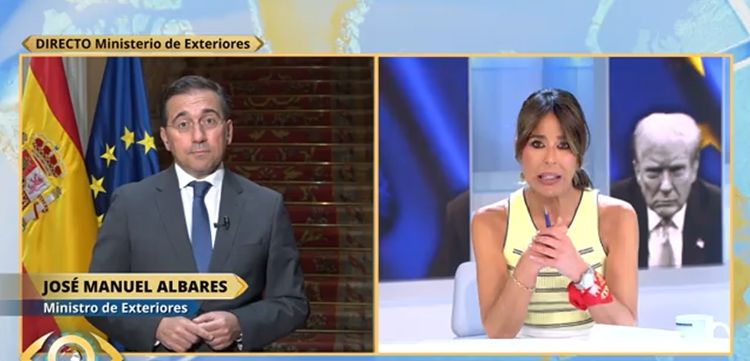
“Well, he made some completely different statements afterward, we’re not going to be commenting on comments forever,” Albares said on the Telecinco program “La Mirada Crítica,” a day after accompanying Prime Minister Pedro Sánchez to the NATO Summit in Ankara.
Before the Summit began, Trump declared—during a joint press conference with NATO Secretary General Mark Rutte—that “Spain is a lost cause” and a “terrible partner in NATO” for its refusal to increase its defense spending to five percent and that Washington doesn’t want “to do any more business with Spain.” “I don’t want anything to do with Spain, cut off all trade with Spain, please, even visits,” he insisted. According to Reuters, the U.S. Treasury Department, the Office of the U.S. Trade Representative, and the Department of Commerce are preparing a list of Spanish products that could be subject to a trade embargo.
Just 24 hours after those initial remarks, Trump changed his tone aboard Air Force One, returning from the United States: “I must “I have had problems with Spain, and I still do, but today Spain has completely redeemed itself.” “Spain has been very generous today; they have agreed to a significant payment request, and if they hadn’t, we wouldn’t have even spoken to them,” he added. It is unknown whether this new attitude will affect the trade threats against Spain.
These words from Trump came after the Council of Ministers authorized a credit transfer of more than 6.2 billion euros on Tuesday to finance various programs in the Ministry of Defense budget, especially in the investment section.
When asked if Trump’s new attitude could be due to the Council of Ministers’ decision, Albares simply replied that “only he could explain why he made those comments.” “His political style, which is well known, is to comment on different countries at different times; he spoke about Spain, but he spoke about many other countries,” he noted.
“Therefore, I cannot know; Spain, of course, fulfills its commitments (…), it’s not just how much we spend, but how we spend it and what we spend it on,” he asserted. According to the minister, the NATO Secretary General himself has acknowledged, “and the figures prove it,” that “Spain has delivered all the capabilities requested of it.” In fact, Mark Rutte himself made a brief allusion to Spain during his joint press conference with Trump. “They took a big step last year,” he affirmed. “There are problems we have to solve, but Spain has reached two percent,” he added.
Furthermore, Albares insisted that Spain and the United States maintain a “mutually beneficial” relationship, even “especially beneficial for the United States,” which has “a trade surplus with us and is one of the major destinations for Spanish investment.” Moreover, “we have a treaty governing the joint use of bases, which is also beneficial for the United States,” he added. “Therefore, our relationship at this time is good economically, good commercially, and also good in other sectors such as culture.” “Education, university exchanges, and we are a very important ally, I would say fundamental, at this time for Euro-Atlantic security,” he insisted.