
Eduardo González
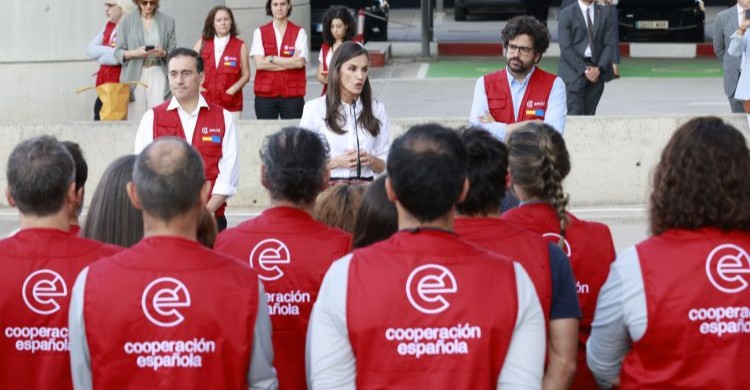
A team from the START (Spanish Technical Aid Response Team) field hospital of the Spanish Agency for International Development Cooperation (AECID), made up of 44 volunteer healthcare professionals, logistics specialists, and cooks, departed this Wednesday from Adolfo Suárez Madrid-Barajas Airport to help the victims of the double earthquake of June 24 in Venezuela, which, according to the latest figures, has caused the death of at least 1,943 people, including 19 Spanish citizens.
The volunteers’ departure was presided over by Queen Letizia, who highlighted “the importance” of the work the volunteers will do in Venezuela and “the effective response that Spain has to the protection of international aid by Venezuela.”
“Spanish cooperation and humanitarian aid, regardless of how it is managed and coordinated, has something we have been witnessing in recent years: the way you extend a helping hand to those who are suffering. You do so with professionalism, rigor, and great compassion,” she continued in her brief speech. “Spanish society is very aware of this and thanks you,” concluded the Queen, who was accompanied by the Minister of Foreign Affairs, José Manuel Albares, and the Director of AECID, Antón Leis.
For his part, Albares thanked the volunteers for their “enormous collaboration and solidarity in responding to this health crisis” and warned that, in the face of a tragedy of this magnitude, the response can only be collective. “The international community, through the United Nations system, the European Union, and all humanitarian actors, has activated emergency mechanisms that only confirm the importance of effective multilateralism, cooperation between states, and humanitarian action guided by the principles of humanity, neutrality, impartiality, and independence,” he continued.
The minister also announced that an additional shipment of Spanish aid worth €300,000 will be sent soon. According to the Ministry of Foreign Affairs, in the first 24 hours after the earthquakes, AECID mobilized €1 million in emergency aid to Venezuela, channeled through the International Red Cross and Red Crescent Movement. AECID also worked closely with Civil Protection to deploy 63 personnel and nine rescue dogs, along with its own team dedicated to assessing and identifying the most urgent health needs on the ground.
The deployment
The deployment of START includes the mobilization of an initial team of 44 healthcare professionals, logistics personnel, and cooks from different autonomous communities, local entities, and collaborating NGOs (CESAL and Doctors of the World). In total, 90 professionals will be mobilized in the two initially planned rotations, which will change after fifteen days.
The company Repsol has chartered two flights for the START deployment. The first flight, operated by Iberia, is carrying 44 healthcare and logistics professionals, cooks from the NGO CESAL, staff from TRAGSA and AECID (including its director, Antón Leis), and representatives from NGOs working on the ground. A second flight, departing this Wednesday from Torrejón, where the AECID hangar is located, will transport the START infrastructure, along with more than 150 pallets of humanitarian aid and urgent supplies.
The START deployment operation is being carried out in coordination with Venezuelan national authorities, as well as with international response mechanisms, such as the European Civil Protection Mechanism and the World Health Organization’s (WHO) Emergency Medical Teams (EMT) initiative.
START
START is one of the most emblematic projects of Spanish humanitarian action. Launched in 2016 by the Humanitarian Action Directorate of the Spanish Agency for International Development Cooperation (AECID), the START project, known as the “Red Vests,” has enabled Spain to have a top-tier medical team ready to deploy to any humanitarian emergency worldwide. This hospital is operational within 36 hours, has advanced surgical capabilities, and boasts a highly specialized team.
The START project was classified by the World Health Organization as a specialized team in 2018. It is also integrated within the EERC (European Emergency Response Capacity), a mechanism organized by the European Commission to coordinate and increase the effectiveness of the European humanitarian response within the framework of the European Civil Protection Mechanism. Therefore, a significant portion of the START project is funded with European funds. START was present in other recent humanitarian crises, such as the earthquake in Türkiye (2023), the hurricane in Jamaica (2025) or Cyclone Idai in Mozambique (2019).