
Eduardo González
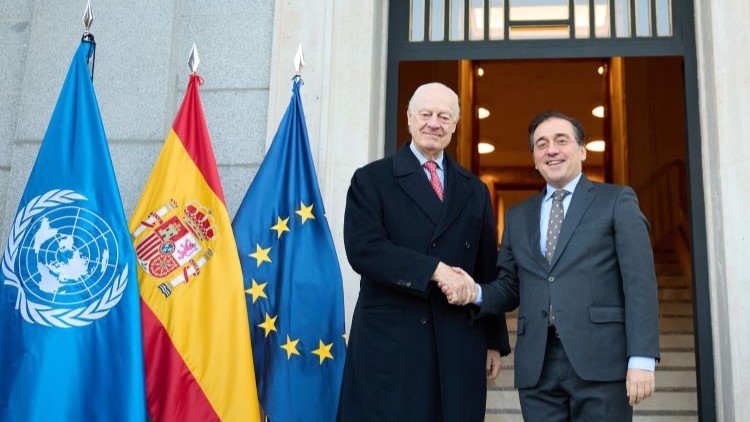
The Ministry of Foreign Affairs has limited itself to expressing its “support for the efforts of the UN Special Envoy,” Staffan de Mistura, to avoid questions from Sumar, a minority member of Pedro Sánchez’s coalition government, regarding “Moroccan attacks against civilians” using “drones of Israeli origin.”
On May 11, Sumar submitted a written parliamentary question reminding the government that “the Spanish Government, through the Ministry of Foreign Affairs, publicly condemned via social media the recent impact of three projectiles on the outskirts of the city of Esmara, located in the northern part of Western Sahara, with no fatalities, an attack claimed by the Sahrawi People’s Liberation Army.”
“Since November 13, 2020, when Morocco broke the ceasefire signed with the Polisario Front in 1991 and declared a state of war, Morocco has committed numerous atrocities both in the occupied territories through the murder of civilians and the use of Israeli-made drones against non-combatant populations,” Sumar continued.
“It should be remembered that the action condemned by the Ministry of Foreign Affairs in its statement does not conflict with the norms of international humanitarian law, following the ‘ceasefire.’ In other words, it was an attack against a military installation within the context of an armed conflict, respecting the principles of proportionality, precaution, and distinction, without any impact on the civilian population,” warns the political group led by Yolanda Díaz.
“In contrast, the vast majority of Moroccan attacks have not been condemned by the Ministry of Foreign Affairs, which reveals a painful and damaging bias for the well-being and future of the Sahrawi people and the only legitimate representative of their interests, the Polisario Front,” it adds.
Furthermore, Sumar warns that, “after the reestablishment of diplomatic relations between Morocco and Israel, the latter has become one of Morocco’s most important suppliers of military equipment and technology, including attack, surveillance, and reconnaissance drones, even suicide drones,” for which Rabat “relies on the traditional financial support of Arab monarchies, which are allegedly covering the costs of these purchases.”
Therefore, Sumar asks the Government “how many times has the Ministry of Foreign Affairs condemned Morocco’s attacks against the civilian population,” including those carried out with “drones of Israeli origin.” It also asks for the opinion of the Department headed by José Manuel Albares on “the military cooperation between Morocco and Israel, a country against which it maintains an arms embargo and which it frequently condemns.”
Sumar also asks the Ministry of Foreign Affairs “what justifies the different positions it maintains regarding similar events, such as attacks on the civilian population, concerning Israel versus Morocco,” and whether, “in keeping with its statements on the genocide perpetrated by Israel,” Spain also stands “with the UN Charter regarding Morocco’s violations thereof.”
“If so, what actions will it take against Morocco for its repeated violations of International Law and the aforementioned Charter? When will the Spanish Government support the calling of a referendum on the self-determination of Western Sahara, in accordance with the United Nations census?” it concludes.
The response from the Ministry of Foreign Affairs, registered on June 10 and published this Tuesday, June 23, in the Official Gazette of the Spanish Parliament, can be summarized in a short sentence: “Spain supports the efforts of the UN Special Envoy in line with the latest Resolution.”
Albares in Congress
The situation in Western Sahara is the main point of international friction between the two components of the coalition government since Prime Minister Pedro Sánchez’s decision to endorse the autonomy plan proposed by Rabat.
Albares will have to answer a parliamentary question this Wednesday in the plenary session of Congress regarding Spain’s position on the recent deaths of three members of the Polisario Front during a Moroccan attack.
The attack, carried out on June 7 by the Moroccan Armed Forces, which resulted in the deaths of three Polisario Front members, including Lehbib Mohamed Abdelaziz, son of former president Mohamed Abdelaziz, coincided with a visit by the UN Secretary-General’s Personal Envoy for Western Sahara, Staffan de Mistura, to the Sahrawi refugee camps in Tindouf, Algeria.
As a result of these events, Sumar denounced Morocco’s “violations of the ceasefire,” which ignore UN Security Council Resolution 2797/2026, and the death of the three Polisario Front militants during a “Moroccan drone attack,” and demanded that the Moroccan ambassador, Karima Benyaich, be summoned to ask for explanations about these events.