
Eduardo González
The Prime Minister, Pedro Sánchez, has called in Brussels for a Multiannual Financial Framework “much more ambitious than the current one” because “it is unreasonable to ask Europe to do more with fewer economic resources.” He also asserted that the outsourcing of migration policy “is an absolutely ineffective response” and warned, regarding the diplomatic efforts of the President of the European Council, António Costa, with Russia, that Europeans can never be “mediators” in potential peace negotiations because “they are a party” and are in favor of Ukraine.
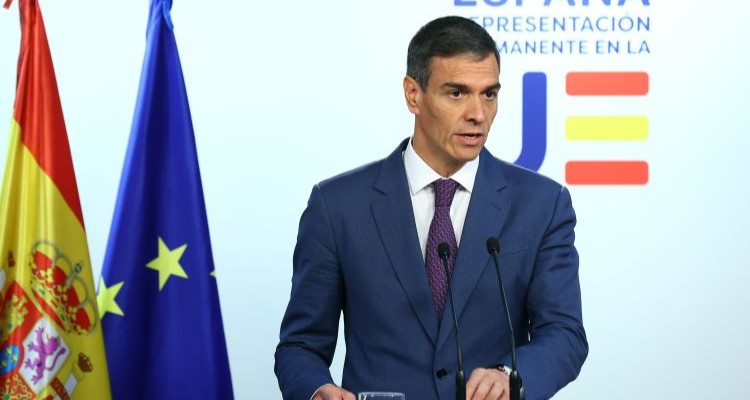
“Spain’s position is firm and clear: Europe will not be a geoeconomic power if we lack the financial muscle to become one, and therefore we must build that financial sovereignty,” Sánchez declared at the press conference following the European Council meeting, which addressed, among other issues, the Multiannual Financial Framework (MFF 2028-2034). This discussion was based on the negotiating framework presented by the Cypriot Presidency on June 11, which includes slight increases for both agricultural policy and cohesion policy compared to the Commission’s initial proposal, but continues to give greater weight to priorities such as competitiveness, security, and defense.
“The Multiannual Financial Framework,” he continued, “must be much more ambitious than it currently is,” because “it is unreasonable to ask Europe to do more with fewer financial resources.” “We need more of our own economic resources; we also need to continue issuing joint debt to finance European public goods,” he affirmed. “Security can be one, defense too, but there are many other policies, such as climate leadership and digital leadership, that must be funded with Next Generation EU funds in the coming years,” he added.
“It is clear that we need to open the debate on more ambitious budgets, budgets with more resources for policies that are very characteristic of Europe: the Common Agricultural Policy, of course the Cohesion Policy, but, without a doubt, everything related to competitiveness linked to the digital transformation and the ecological transition,” he warned.
Migration
On another note, Sánchez reiterated Spain’s opposition to the outsourcing of migration policy through the creation of detention and deportation centers in third countries. “Spain has been unequivocal from the beginning: we believe that it will not bring any solution, that it is an absolutely ineffective response, a smokescreen, if you will,” he asserted.
This system, he warned, “will simply waste economic resources, and Europe doesn’t have many,” and at the same time, “sends the wrong message to the countries of origin and transit, with which we need to collaborate, cooperate, and empathize, because these countries are also suffering from irregular migration, and therefore need this collaboration and cooperation from Europe, not the message of saying: this is your problem, we’re washing our hands of it.”
“We have already made our position clear, we voted against it, and therefore, if a majority of countries agree to implement it, then we will be in the minority,” but “there have been rulings from the European Court of Justice specifically addressing the minimum standards of respect for human rights and the conditions that migrants in these centers should have,” he added.
Ukraine
Regarding the contacts between the President of the European Council, António Costa, and high-ranking Russian officials, Sánchez asserted that “what he has done is open a diplomatic channel,” but “he has not initiated any peace talks or any peace negotiations.”
“We are not mediators, because we have indeed been supporting Ukraine for more than four years, supporting its defense of territorial integrity and its right to exist and not be invaded, in this case, by an aggressor force such as Putin’s Russia,” he warned. “Therefore, the role that Europe should eventually play in these peace negotiations is not that of mediator,” he continued. “We are not mediators, we are a party to the conflict, because we are not only talking about Ukraine, but also about the European security architecture,” he insisted.
In this context, “Europe would not participate as a mediator, but as a representative of the member states, because we are concerned about our security architecture and logically also about the countries that want to belong to Europe and with which we have already opened this enlargement process, such as Moldova and Ukraine,” he added.