
The Diplomat
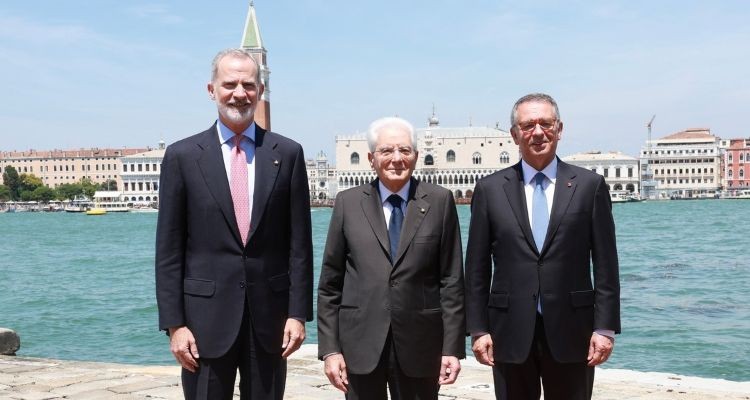
King Felipe VI attended the 18th COTEC Europe Summit in Venice this Wednesday, along with the President of Italy, Sergio Mattarella, and the President of Portugal, António José Seguro. There, he warned that Europe’s digital future cannot be built “by ignoring our laws and freedoms” and called for digital transformation to become “a driver of freedom, inclusion, and quality of life for all.”
The meeting took place at the Giorgio Cini Foundation headquarters on the island of San Giorgio Maggiore in Venice and brought together representatives from industry, academia, and research under the theme “Rethinking Work in the Age of AI: Transformation, Opportunity, Governance,” to discuss Artificial Intelligence in the world of work, the skills of the future, and the economic and employment dynamics of European countries.
During the opening session, in which Christine Lagarde, President of the European Central Bank, participated as a guest speaker, the King delivered remarks in which he warned that Artificial Intelligence can “place new areas of knowledge at the service of effectiveness and efficiency” and “enhance our capabilities to unimaginable limits,” but it can also, “without the proper regulatory and institutional frameworks, work in the opposite direction: degrading work, concentrating wealth, and widening inequalities.”
“His Holiness Pope Leo XIV, whom we had the honor of welcoming to our country last week, reminded us of this just a few weeks ago,” he continued. “His first encyclical, Magnifica Humanitas, urges that all automation remain at the service of human dignity and the common good. This is a particularly relevant reflection in this forum,” he added.
“We need AI to adapt to who we are and accompany us in what we aspire to be.” And this presents us with a dilemma: on the one hand, we cannot build Europe’s digital future by ignoring our laws, our freedoms, and our humanist tradition, and this calls us to reflection and caution; on the other hand, we cannot afford to be late, because in a world like today’s, being late means depending on decisions made by others. This calls us to action and boldness,” he warned.
According to the King, “the history of civilization is marked by the encounters and clashes between ethics and innovation.” “There were also those then who viewed a transformative technology like the printing press with suspicion, and it is revealing that many of those criticisms have reached us precisely because they were printed,” he continued. “Isn’t something similar happening today with digital transformation? Change can be reined in or modulated, but not stopped, because we live within it,” he warned. “Let us transform the reality in which we already live into a vector of freedom, inclusion, and quality of life for all; “In which we can all participate, through education and knowledge,” he concluded.
The Foundation for Technological Innovation (COTEC) was established in 1990 at the initiative of King Juan Carlos with the purpose of promoting innovation as an economic and social driver. The summit, which has been held in a different country each year on a rotating basis since 2005, brings together the heads of state of Spain, Portugal, and Italy, the three countries where the Foundation is established (of which the King is Honorary President), along with authorities, business leaders, and prominent figures in the field of research, development, and innovation (R&D&I) in Europe. This is the first COTEC Europe Summit for the current President of Portugal, António José Seguro, who assumed office on March 9, succeeding Marcelo Rebelo de Sousa.
Since 2017, each meeting has focused on a specific theme. Spain has hosted the event six times, the first four in Madrid (2006, 2009, 2012, and 2017). 2017), the 2021 edition in Málaga, and the 2024 edition in Las Palmas de Gran Canaria. The last edition was held in Coimbra in May 2025 and was dedicated to the challenges for competitiveness and economic growth in the European Union.
In this edition, the Summit’s objective was “to identify shared strategies for governing the new world of work in an ethical, effective, and sustainable manner, in line with the provisions of the European Union’s Artificial Intelligence Law,” according to the organizers.