
Eduardo González
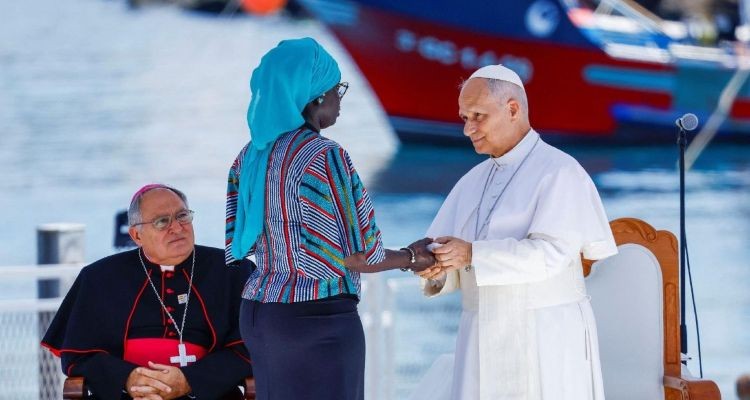
Pope Leo XIV visited the Arguineguín dock in Gran Canaria this Thursday, a point of arrival for thousands of people in recent years. There, he warned that migrants “are not numbers or files, you are people with families and homes you have left behind.” He affirmed that “human dignity does not lose value when crossing a border,” warned against the “monsters that lurk in these seas,” referring to the “mafias that traffic in desperation,” and stated that “Europe cannot proclaim human dignity and become accustomed to the Mediterranean and the Atlantic being cemeteries without headstones.”
The Pope arrived this Thursday at the Gando Air Base in Gran Canaria, where he was received by the Prime Minister, Pedro Sánchez. The objective of Leo XIV’s visit to the Canary Islands (which will include Tenerife this Friday), the first by a Pope to the archipelago, is to learn firsthand about the reality of migration, something his predecessor, Francis, was unable to do. In October 2024, Pedro Sánchez invited the former Pope to visit the Canary Islands in 2025 to “learn about the reality of the Canarian people” in light of the influx of migrants. Francis himself later confessed his desire to travel to the Canary Islands, but was never able to do so.
During his visit to the Arguineguín dock, where he was accompanied by the Prime Minister, Leo XIV stated that “human dignity does not lose value when crossing a border” and warned that welcoming migrants cannot be delegated solely to a few volunteers: “we cannot ‘turn a blind eye’ to the canoes and small boats.” “The Church cannot turn a blind eye to these waters or to any place where hunger, thirst, violence, fear, or exile continue to wound human dignity,” the Pope declared.
He also warned that the greatest danger for migrants is not only the ocean, but those who exploit their vulnerability: “Even today, monsters lurk in these seas: mafias that traffic in desperation, traffickers who enslave women and children, and the indifference of many who allow the poor to be swallowed up by exploitation or oblivion.”
Furthermore, the Pope addressed the women who are victims of human trafficking: “If others put a price on your body, God has never stopped seeing you as invaluable. If they tried to confine you to a painful past, God continues to speak a promise of a future to you. If you were treated as an object, the Church wants to tell you today: you are a daughter and a sister, you are a blessing.” “Your life does not belong to those who harmed you; your body does not belong to those who took advantage of you; your days do not belong to those who sought to chain them to fear; your life belongs to God and retains a dignity that cannot be taken from you,” he added.
Leo XIV also called for a global and coordinated response to protect migrants: “This tragedy must become a moment of reflection: for the nations of origin, which must create conditions of peace, justice, and development; for the nations of transit, called to protect and not abandon the vulnerable to criminal networks; and for Europe, which cannot proclaim human dignity and become accustomed to the Mediterranean and the Atlantic being cemeteries without headstones.”
Migrants, he continued, “are not numbers or files; you are people with families and homes left behind.” “Do not surrender your lives to those who traffic in them. Do not believe those who promise easy paradises in exchange for your body, your money, your silence, or your freedom. These false promises are siren songs, they are industries of death,” he affirmed, addressing the migrants.
Likewise, the Pope addressed civil authorities, parliaments, governments, and international organizations: “It is not enough to manage arrivals, distribute figures, reinforce borders, or lament deaths once they have occurred. Each boat that arrives brings not only migrants, but also a question: what kind of world have we built if so many of our brothers and sisters have to risk death in search of life?” “We cannot become accustomed to counting the dead, nor can we think that ‘human dignity loses value when crossing a border,’” he insisted.
The Pope’s arrival in the Canary Islands coincided with the eve of the entry into force of the Pact on Migration and Asylum in all EU member states. Adopted in May 2024, the Pact establishes, for the first time in the European Union, a comprehensive framework for migration and asylum that combines the protection of external borders with “fair and firm asylum rules” and a “balance between solidarity and responsibility.”