Eduardo González
Spanish Prime Minister Pedro Sánchez was received this Friday, June 5, by the Prime Minister of Montenegro, Milojko Spajić, with whom he attended the signing of a bilateral cooperation protocol on economic and financial matters.
The meeting took place in the Montenegrin town of Tivat within the framework of the 8th Summit between the European Union and the Western Balkans, according to Moncloa Palace. During the meeting, the two leaders attended the signing of an agreement on the prevention of tax evasion and double taxation and a protocol on economic and financial cooperation between the two governments.
The first agreement eliminates the risk of double taxation for citizens and companies doing business between the two countries, facilitates cross-border investment and trade, and establishes additional mechanisms to prevent tax evasion and aggressive tax planning.
Separately, the protocol on economic and financial cooperation between the two governments will apply primarily to sectors such as transport, mining, telecommunications, and cybersecurity, among others. According to the official website of the Government of Montenegro, the signing of this agreement with Spain is part of a broader policy by the Montenegrin Executive to strengthen international economic cooperation, attract quality investments, and create a regulatory framework that fosters growth, competitiveness, and sustainable development.
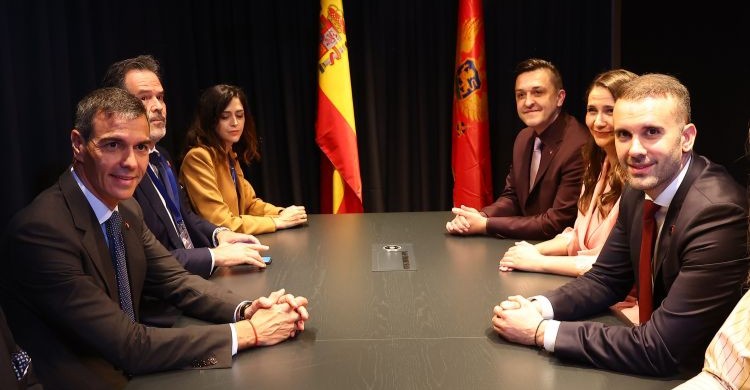
According to Sánchez, the signing of these two agreements represents a step forward in strengthening bilateral relations between Spain and Montenegro, which are celebrating their twentieth anniversary this year. The two agreements were signed by the Minister of Finance of Montenegro, Novica Vukovic, and the Spanish Ambassador to Montenegro, based in Belgrade, Juan José Sanz Aparicio.
The two leaders also discussed the talks for the enlargement of the European Union, and in this regard, the President of the Government highlighted the efforts of the Montenegrin Government, “which today place the country as the most advanced among the candidates to join the bloc,” and the Prime Minister of Montenegro thanked Pedro Sánchez for Spain’s support in the accession process.
“At a time when our country is hosting one of the most important political events in the region, we are sending a clear message that Montenegro is not only a candidate for accession to the European Union, but a country that is already turning European standards into concrete policies and results,” the Podgorica government stated on its website. Montenegro became a candidate in December 2010, and negotiations with the European Union officially began in June 2012.
Sánchez is in Tivat to participate in the plenary session of the EU-Western Balkans Summit. This summit is being held six months after the previous one in Brussels and will allow for an assessment of the progress made by the countries of the region towards their gradual integration into the EU, as well as progress through the Growth Plan for the Western Balkans and advances in security and resilience in an increasingly complex geopolitical context.
The meeting is being led by the President of the European Council, António Costa, and the President of Montenegro, Jakov Milatović. The EU is represented by Costa, the President of the European Commission, Ursula von der Leyen, and the High Representative, Kaja Kallas, and the summit’s theme is “Shared Prosperity and Stability in the EU and the Western Balkans.”
