
Eduardo González
The Prime Minister of Spain, Pedro Sánchez, will travel to Geneva (Switzerland) this Monday, May 18, to participate in the 79th World Health Assembly, the supreme decision-making body of the World Health Organization (WHO).
The Assembly, which meets in Geneva every May with the attendance of delegations from member states, will be held from May 18 to 23. The main function of this body is to determine WHO policies, appoint the Director-General, oversee financial policies, and review and adopt the proposed budget program.
Among the many topics on the agenda are preparedness and response to public health emergencies, the WHO’s work in health emergencies, the health situation in the occupied Palestinian territory, including East Jerusalem, and in the occupied Syrian Golan Heights, and collaboration within the United Nations system and with other intergovernmental organizations.
Sánchez’s participation coincides with the emergence of a hantavirus outbreak on the MV Hondius cruise ship, a Dutch vessel that had sailed from Argentina and was initially bound for Cape Verde after stopping in South Africa. Approximately 150 people of 23 different nationalities were on board, including 14 Spanish citizens. On May 5th, the WHO, in coordination with the European Union, requested that the Spanish government receive the ship in the Canary Islands in compliance with international law and humanitarian principles.
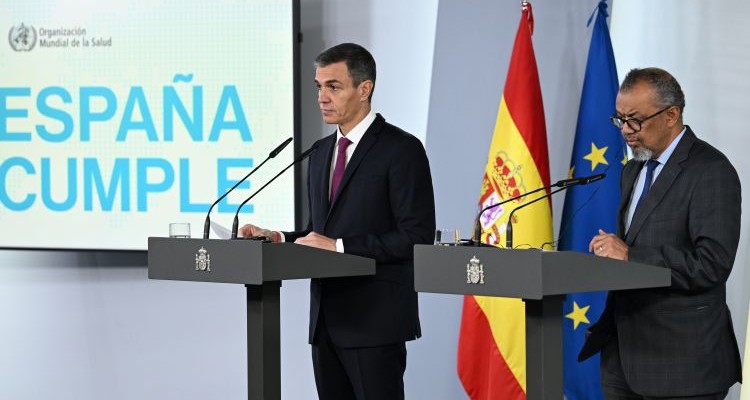
As explained on May 12 in Madrid by the WHO Director-General, Tedros Adhanom Ghebreyesus, when the ship was near Cape Verde, he contacted its Prime Minister, Ulisses Correia e Silva, to request assistance in evacuating the three symptomatic passengers on board. However, after determining that “the situation exceeded Cape Verde’s capacity to manage the disembarkation and repatriation of the affected individuals,” he contacted Sánchez to see if Spain could “manage the disembarkation of the passengers with the support of the WHO.”
In the same press conference, Sánchez explained that, on the afternoon of May 5, the Spanish government “officially” informed the World Health Organization that Spain would receive the MV Hondius and “that it would do so on the coast of Tenerife, which, according to experts from that same organization, was the first suitable port the ship would encounter on its route.”
“As we have said from the beginning of this emergency, it was our legal responsibility, as outlined in Article 44 of the International Health Regulations, to which Spain is a signatory,” he affirmed. Furthermore, “it is our moral obligation to the 150 families of tourists and workers who were experiencing the worst moment of their lives, including fellow Spaniards,” he emphasized.
“We informed the public, activated the European civil protection mechanism, and began working with the World Health Organization, the European Commission, the European Centre for Disease Prevention and Control, the Canary Islands authorities, and the 23 countries whose citizens were on board the cruise ship to design and deploy the reception, care, and repatriation operation,” he recalled. Thanks to this operation, he specified, “more than 120 people of various nationalities have been repatriated via ten special flights.”
According to the Ministry of Health, the specific context of the outbreak—a ship with close and prolonged contact—significantly increased the likelihood of person-to-person transmission. International health authorities have also identified the variant involved as Andean hantavirus, one of the few variants in which human-to-human transmission has been documented. However, both the WHO and the ECDC agree that this type of transmission remains extremely rare and requires very close and prolonged contact, generally with symptomatic individuals. Hantavirus can be highly lethal in certain severe clinical forms, especially respiratory ones.