The Diplomat
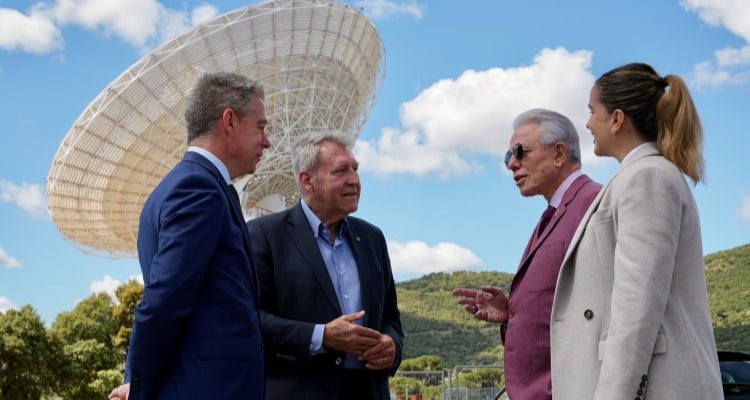
US Ambassador Benjamin León Jr. visited the NASA base in Robledo de Chavela (Madrid) this Thursday, congratulating them on “their essential role in the success of Artemis II,” the first crewed mission around the Moon since Apollo 17 (1972), which was launched on April 1.
According to the Embassy, the ambassador and his wife Mavi visited the Madrid Deep Space Communications Complex (MDSCC) in Robledo de Chavela, “one of the three stations that make up NASA’s Deep Space Network.”
During the Artemis II mission, this NASA facility—operated jointly with the Spanish National Institute of Aerospace Technology (INTA)—”was key for navigation adjustments to the Moon and for ensuring the safe return of the Orion spacecraft and its crew,” according to the Embassy.
“Furthermore, thanks to its six antennas, the complex was at the center of a milestone: the first test of laser communications from space, transmitting large volumes of data at high speed,” it added.
“This advancement represents a qualitative leap compared to traditional radio frequency communications, which will be of great use for future missions, including the Lunar Base that NASA is planning,” it continued.
According to León, preparations for Artemis III “are already underway” and “the completion date” is “estimated for before the end of 2027.” In this mission, he asserted, the Spanish base will once again be “an essential component” for the exploration of “deep space and the scientific advancement of humanity.”
“More than sixty years of cooperation between the United States and Spain have boosted space exploration, as they advance in preparations for Artemis III, the next manned mission to the lunar surface,” concluded the press release, disseminated through social media.