Eduardo González
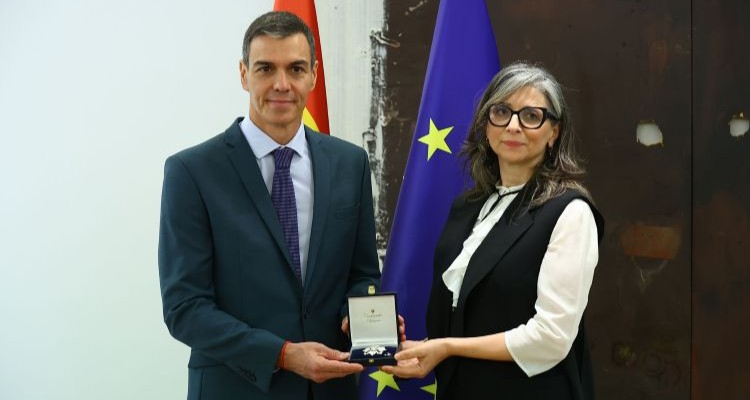
The President of the Government, Pedro Sánchez, awarded the Order of Civil Merit this Thursday to the United Nations Special Rapporteur for the Occupied Palestinian Territories, Francesca Albanese.
Sánchez received Francesca Albanese this Thursday at the Moncloa Palace in Madrid, where they discussed the situation in Palestine and the need for an immediate cessation of violence to allow for the construction of a “lasting peace with dignity and humanity,” according to a statement from Moncloa. They also agreed on the importance of defending the equitable application of International Law and maintaining the independence of multilateral institutions.
During the meeting, the President of the Government presented her with the Order of Civil Merit for her “extensive work documenting and denouncing violations of international law in Gaza.” The Order of Civil Merit was established by King Alfonso XIII in 1926 to reward Spanish or foreign citizens who have rendered distinguished service to Spain or significant collaboration in matters that benefit the nation.
The meeting took place one day after Pedro Sánchez requested that the President of the European Commission, Ursula von der Leyen, immediately activate the Blocking Statute in order to “neutralize” within European territory the sanctions imposed by the United States against Francesca Albanese and against the judges and prosecutors of the International Criminal Court (ICC). The Blocking Statute is a tool that allows the suspension of third-country regulations that affect the interests of the European Union.
According to Moncloa Palace, Spain is attempting to garner the support of other member states to form a coalition to back this request to the Commission. Furthermore, it will promote the inclusion of this issue on the agenda of the European Council meeting of June 18 and 19, 2026, with the aim of ensuring that its Conclusions include an explicit political mandate for the Commission.
Since February 2025, the United States has sanctioned eleven judges and prosecutors of the International Criminal Court in successive rounds, and in July 2025 began applying these measures against Francesca Albanese. The pressure tactics authorized by President Donald Trump include the cancellation of bank accounts and services, travel restrictions, and all kinds of obstacles to prevent them from doing their job: investigating and prosecuting human rights violations.
Traditionally, Regulation (EC) No 2271/1996, known as the Blocking Statute, has served to protect European economic operators against the extraterritorial application of third-country laws that affect the interests of the European Union (it currently applies to certain US laws). In the letter addressed to the Commission, the Spanish Government argues that it is time for this mechanism to “move beyond the commercial logic with which it was created” and serve as a shield against measures that jeopardize the multilateral system based on the UN Charter and International Law.
The letter recalls that the International Criminal Court “has an essential role in the fight against impunity and in ensuring accountability for the most heinous crimes (genocide, war crimes, aggression, and crimes against humanity), and that the UN Special Rapporteurs play a key role in investigating allegations of human rights violations.” Therefore, sanctions not only affect those who impose them, but also “erode the entire normative framework that underpins international relations,” warns Sánchez.
Francesca Albanese was received this Wednesday in Madrid by the Second Vice President and Minister of Labor and Social Economy, Yolanda Díaz, and by the Ministers of Social Rights, Consumer Affairs and the 2030 Agenda, Pablo Bustinduy, and of Youth and Childhood, Sira Rego. She later met with the Minister of Foreign Affairs, José Manuel Albares, to whom she conveyed—as Albares himself explained this Thursday in Congress—that “no government in the world has done more for Palestine than the current Spanish government.”