
The Diplomat
The foreign ministers of the Group of Southern EU Member States (MED9) called on Thursday for “an immediate cessation of hostilities, a sustained de-escalation, and compliance with the ceasefire throughout the Middle East region,” “including Lebanon,” and warned that “if the ceasefire is not maintained, the situation could deteriorate further.”
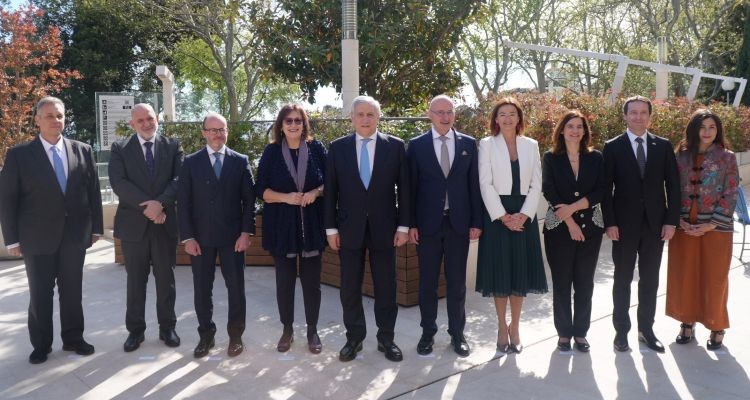
The ministers and their representatives from the MED9 (Spain, Portugal, France, Italy, Greece, Malta, Cyprus, Slovenia, and Croatia) met on Thursday in Split in the presence of the European Commissioner for the Mediterranean, Dubravka Šuica, “at a time of great instability in the Mediterranean region, characterized by the escalation of military conflicts in the Middle East, which have direct repercussions for our security.” Spain was represented at the meeting by the State Secretary for Foreign and Global Affairs, Diego Martínez Belío.
In a joint statement, the ministers welcomed “the ceasefire reached between the United States and Iran” and congratulated “Pakistan and other regional actors for their mediation efforts.”
They also made “a joint appeal for an immediate cessation of hostilities, a sustained de-escalation, and compliance with the ceasefire throughout the region by all parties, including Lebanon, which would allow progress in negotiations toward a lasting and sustainable peace.”
“We are deeply concerned that, regrettably, violence continues on a large scale. This is unacceptable,” they warned. “We also call for full respect for international law by all parties, including the principles of the Charter of the United Nations and international humanitarian law, as well as the international law of the sea,” especially “with regard to maritime security and respect for freedom of navigation, including transit passage through the Strait of Hormuz,” the statement continued.
“We express our deep concern that, if the ceasefire is not maintained, the situation could deteriorate further, with significant repercussions for regional and global peace and security,” the signatory ministers warn.
These events, they assert, “highlight the interconnectedness of the current challenges and the need for a comprehensive and coordinated response, including reducing the impact of the crisis on our regional partners, critical infrastructure, and the civilian population, particularly the most vulnerable, as well as on our humanitarian efforts, including through potential humanitarian corridors.”
“We have expressed our solidarity with regional partners and reiterated the importance of continuing to foster dialogue with our partners in the Mediterranean, the Maghreb, and the Middle East to promote mutual understanding and coordinated actions aimed at addressing all regional issues,” the statement continues.
“In light of these challenges, we reaffirm our shared goal of making the Mediterranean a zone of peace, prosperity, and stability for our citizens and businesses. To this end, we agree to strengthen our commitment to greater regional coordination with the countries of North Africa and the Middle East to highlight the need for a common strategic policy on key issues such as energy and the environment for growth and prosperity,” it adds.