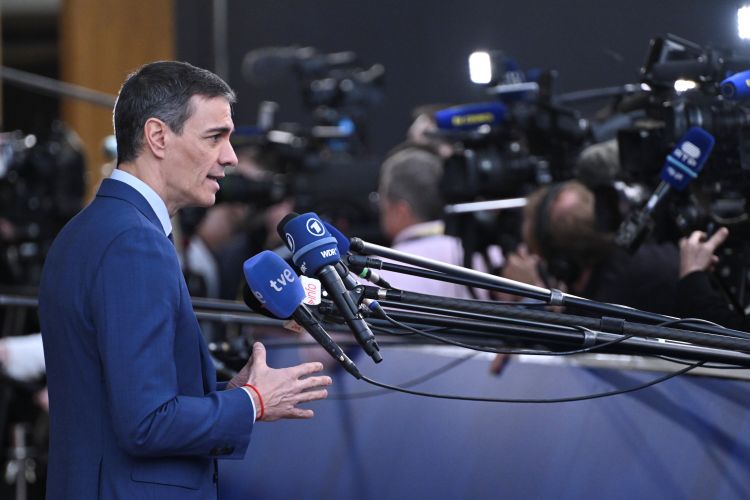
<h6><strong>The Diplomat</strong></h6> <h4><strong>The Spanish Prime Minister, Pedro Sánchez, has called on other European leaders for a “firm and united response” to the war in Iran “that focuses on defending the EU’s real priorities and moves away from belligerent logic.”</strong></h4> Sánchez participated this Thursday in the European Council meeting in Brussels, where the heads of state and government of the 27 member states, along with the President of the European Council, António Costa, and the President of the European Commission, Ursula von der Leyen, discussed “key issues for the future of the Union,” according to a press release from Moncloa Palace. Given the current international context, Sánchez insisted on the defense of the rules-based multilateral system and the international community, and reiterated that Spain has condemned the “illegal” war in Iran from the outset. He also advocated for “a firm and united response from the Council that focuses on defending the EU’s real priorities and moves away from a belligerent approach.” Regarding the economic impact of the war in Iran and the immediate effects already being felt by the population, Pedro Sánchez defended the need to adopt temporary support measures for the most affected sectors and groups. Alongside these temporary measures, he called for a European response that deepens the energy transition, accelerating electrification and decarbonization. Furthermore, he defended the design of the ETS (European Emissions Trading System) as a central instrument of European climate policy, which “has proven its effectiveness since its adoption.” Sánchez also defended the need for a “more ambitious and coherent” Multiannual Financial Framework that promotes strategic European priorities such as competitiveness, innovation, the green and digital transitions, and security, using own resources. The meeting also addressed strengthening the competitiveness of the European economy. In this regard, Spain rejected an approach based on deregulation or the dismantling of climate policies. It also advocated for strengthening the European social model, environmental aspects, and social and territorial cohesion as part of the competitiveness debate and reiterated the need to relaunch the Capital Markets Union, now called the Savings and Investment Union, to address the continent's financial fragmentation. Along these lines, at the Euro Summit held within the framework of the European Council, alongside ECB President Christine Lagarde, President Sánchez called for a greater international role for the euro and the strategic priority of advancing the digital euro to strengthen European financial sovereignty. Separately, the 27 EU member states held a meeting with United Nations Secretary-General António Guterres. During this meeting, Pedro Sánchez emphasized the need to strengthen multilateralism and warned, in these times of concern and turbulence, of the necessity for governments to preserve the principles and values that “have framed decades of peace and prosperity.” Furthermore, the EU leaders also participated in a videoconference with the President of Ukraine, Volodymyr Zelensky, to discuss the situation in the country. During this meeting, Sánchez stressed the need to maintain the dual strategy of continuing to support Ukraine and continue to pressure Russia, and warned that “Ukraine must be part of the European Union.”