The Diplomat
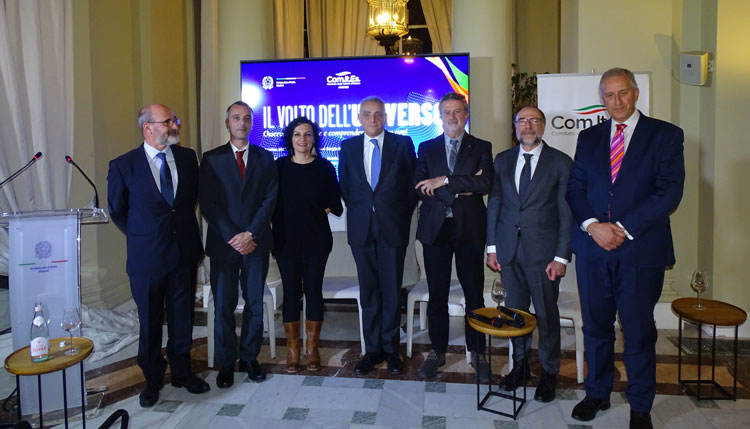
Italian Ambassador Giuseppe Buccino Grimaldi hosted the astrophysics and cosmology event The Face of the Universe. Observe, listen and understand the cosmos today, last week at the residence of the Embassy of Italy, organized by the Scientific Office of the Embassy in collaboration with the Com.It.Es. of Madrid.
In opening the session, the ambassador highlighted the coherence of the topic with the work of the Embassy, aimed at promoting bilateral scientific cooperation between Italy and Spain in the field of basic science, which, according to the statement issued by the Italian diplomatic delegation has given rise to recent mutual support agreements for the study of gravitational waves – the proposal of the Einstein Telescope (ET) in Sardinia (for the design of nuclear fusion reactors) and the IFMIF-DONES accelerator project in Granada. In this regard, the ambassador highlighted the excellence of the participating speakers, who had already collaborated with the Embassy on previous successful initiatives.
After the welcome speech of the president of COM.It.Es., Andrea Lazzari, began the colloquium between the speakers, moderated by Sergio Albani, from COM.It.Es., which was followed by a debate with the public, coordinated by the scientific attaché of the Embassy.
Professor Juan García-Bellido, from the Autonomous University of Madrid, winner of the “Blas Cabrera” Science Prize 2025, described the current state of theoretical models proposed to explain the first moments of the life of the Universe, in particular the theory of “Inflationary universe”. He pointed out that this fascinating idea, which explains existing structures, has not yet been fully accepted due to the technological difficulty of finding a conclusive experimental confirmation.
Professor Nanda Rea, from the Institute of Space Sciences (ICE-CSIC) in Barcelona, said that “Sixty years after its discovery, our understanding of the object it is studying – the pulsars, extremely dense and compact stellar remains that rotate at high speed and are sources of magnetic fields of enormous intensity – remains insufficient. In particular, there is no experiment capable of revealing its internal composition, undoubtedly dominated by neutrons, but in the presence of other particles, which are probably presented in exotic states of matter, different from those known.”
For his part, Professor Eugenio Coccia, director of the Institute of High Energy Physics (IFAE) in Barcelona, then noted that “next-generation gravitational wave detectors, such as ET, could provide important data for these two specific problems and, in general, for many others that are still to be solved.”