
Eduardo González
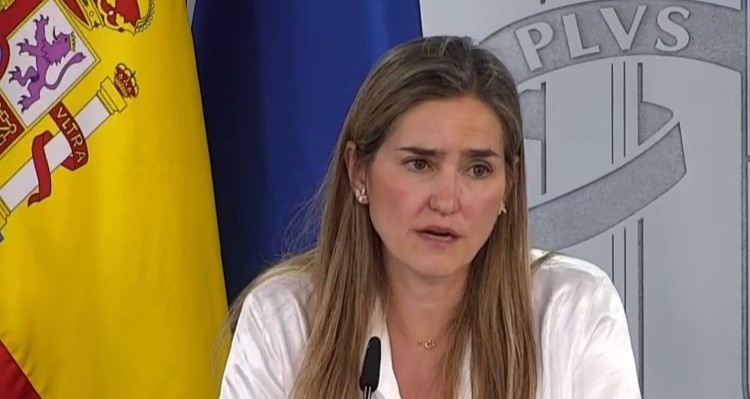
The Third Vice President and Minister for Ecological Transition and the Demographic Challenge, Sara Aagesen, stated this Tuesday that Spain’s “direct exposure” to gas and oil supplies “is limited” and advocated, in any case, for a “more autonomous” European energy system based on domestic resources to avoid dependencies and for the development of renewable energies, because “the sun and wind will never be blocked in the Strait of Hormuz.”
Aagesen appeared this Tuesday at the press conference following the Council of Ministers meeting, where the government spokesperson, Elma Saiz, announced that an extraordinary Council of Ministers meeting will be held this coming Friday, March 20, to “present a comprehensive plan to respond to the consequences of the war.” This plan “will be proportionate, targeted, and focused on limiting the impact of rising fuel and electricity prices” and will have “sufficient flexibility to adapt and adopt measures as the situation evolves.” At the conclusion of this extraordinary Council meeting, Prime Minister Pedro Sánchez will address the media.
For her part, Sara Aagesen sought to convey “a message of calm” to the Spanish people at the press conference, “because our country’s direct exposure to gas and oil supplies is limited.” The war in the Middle East and Iran’s blockade of the Strait of Hormuz, she admitted, are affecting energy market prices, both for oil and natural gas, but, she assured, at levels “far removed from those we saw during the war in Ukraine.”
According to the Vice President, Spain has “a flexible energy system,” with seven gasification plants that “allow us to diversify supply” and with “nine refineries and a large storage capacity compared to our European neighbors.”
Furthermore, she continued, “we are better prepared than years ago” thanks to the “clear boost to renewable energies,” which already account for 57 percent of Spain’s electricity generation mix, which has also allowed us to “cushion the effect of price volatility in electricity markets compared to our European counterparts.” “In fact, if we look at the last two weeks, Spain has registered values 45% lower than many of our European colleagues,” she added.
Furthermore, Aagesen announced that the Council of Ministers on Tuesday approved “an agreement to release part of our country’s strategic reserves, in this case petroleum products, in response to the situation arising from the war in Iran.” She also recalled that on March 11, the 32 member states of the International Energy Agency adopted an agreement to “release 400 million barrels of oil from the emergency reserves of the member states of that organization.” “This is the largest release of reserves in the Agency’s history,” she specified.
The Vice President also emphasized the need for European Union countries to “deepen their efforts toward a more autonomous energy system, one that fosters independence and competitiveness,” based on “domestic resources.” “That has precisely been the policy of this Government since 2018, to focus on where we have the great advantage, which has also been demonstrated in this period of volatility, which is renewable energy,” because “of course, the sun and the wind will never be blocked in the Strait of Hormuz.”