The Diplomat
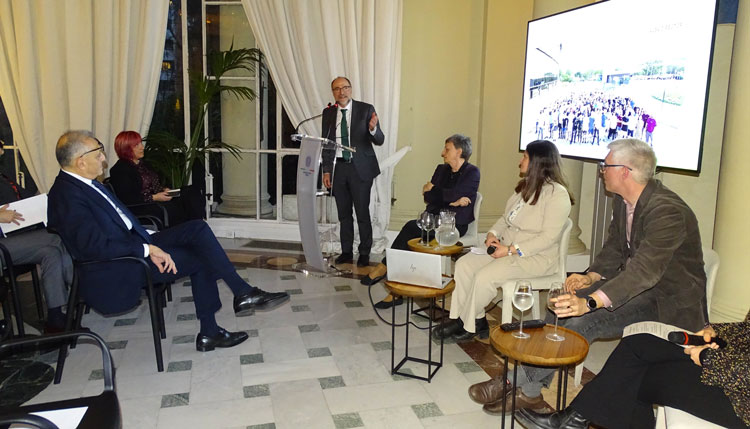
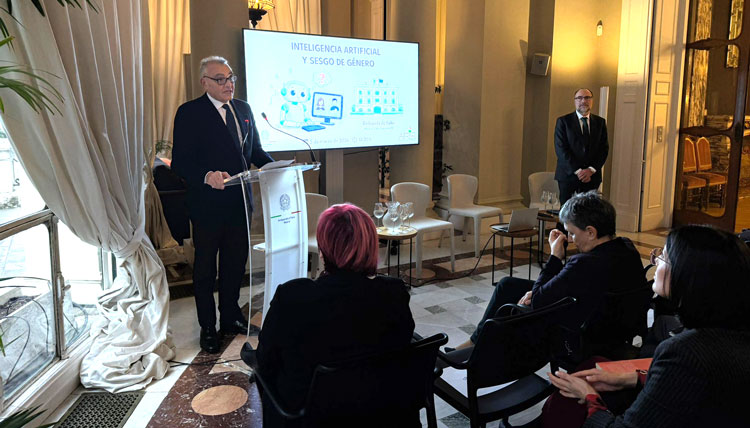
On Thursday, 5 March, a round table discussion on Artificial intelligence (AI) and gender bias took place at the Italian Embassy. It was organized by the Scientific Office of the Embassy in collaboration with the Association of Italian Researchers in Spain (ARIS).
Ambassador Giuseppe Buccino Grimaldi, who expressed his “concern” about the use of AI in the present and future, offered a word of introduction to the event, in which he reiterated his support for ARIS -which has recently resumed its activities and completely renewed its board of directors – “whose initiatives can contribute significantly to giving visibility and representation to the excellent Italian research community in Spain,” he said. Ambassador Grimaldi also noted that the round table fits harmoniously into the line of other scientific events of the Embassy and stressed the topicality of the chosen topic, within the framework of the commemorations of the International Day of Women and Girls in Science and the International Women’s Day.
Following the introduction of ARIS president, Francesca Romagnoli, archaeologist and professor at the Autonomous University of Madrid, two sessions were held. The first, of a scientific nature, was attended by Caterina Biscari, director of the ALBA Synchrotron in Barcelona, and Alessandra Patera, researcher at ALBA, together with the director of the AI Department of the Barcelona Supercomputing Center, Diego Perino, who explained how different types of biases are generated in the development of AI models. The session was moderated by Dr. Elisabetta Broglio, from the Institute of Marine Sciences in Barcelona.
The second session, of an institutional and philosophical nature, moderated by Stefano Bini, professor at the University of Córdoba, addressed directly the issue of gender bias. Alberto Gago, director of the Spanish Agency for the Supervision of Artificial Intelligence; Lucía Ortiz, professor in the department of Philosophy at the Autonomous University of Madrid; and Sara degli Esposti, expert in AI ethics at the Higher Council for Scientific Research (CESIC).
During the debate, examples of the emergence of gender bias were discussed, the severity of the problem in both Europe and the Global South and possible concrete actions to manage this challenge.