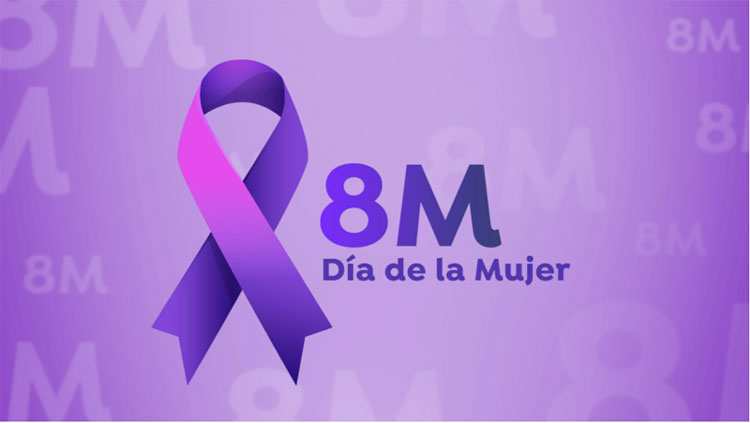
Once again, Casa de América joins the commemoration of the International Women’s Day (8M) with an agenda of activities that highlight the role of women in history, culture, economy and Ibero-American thought. In addition, as a symbol of this commitment, the facade of the emblematic Palace of Linares, headquarters of the institution, will be lit in purple.
The special program will be developed throughout the month of March and will include lectures and presentations that invite to reflect on women’s participation and leadership in different areas.
Next Tuesday, March 10 at 7 p.m., the conference: A monarchist in times of revolution will take place. María Antonia Bolívar, sister of the Libertador (1777-1842), in charge of Inés Quintero, historian of the Central University of Venezuela. This conference will inaugurate the second edition of the cycle ‘Hispanic women: creators of history and culture in Spanish’, organized by the Orellana Circle, Casa de América and the Community of Madrid, and whose dates for the 2026 sessions are already available.
The session will be dedicated to the figure of María Antonia Bolívar, sister of Simón Bolívar, whose life trajectory allows us to analyze the political and social complexities of independence processes in Latin America from a female perspective. María Antonia’s story is transcendent in many ways: she not only violated the conventions of her time regarding the place of women in society by taking sides, defending her political convictions, caring for and managing her patrimony, it also allows us to understand with greater depth and breadth of eyes the complexity and magnitude of the process of Independence, war and the construction of the Republic, from a more emotional, human and also feminine perspective, stripped of the bronze and epic of the patriotic histories and the cult of Bolívar that characterized the emergence and development of our national historiographies.
Likewise, on Thursday 12 March at 4 p.m., the study Women in Platform Economics: Challenges and Opportunities in Ibero-America, prepared by the Ibero-American General Secretariat (SEGIB), UN Women and the International Labor Organization (ILO) will be presented Peace Arancibia, ILO’s senior gender and non-discrimination specialist for Latin America and the Caribbean; Paula Basaldua, UN women’s senior economic empowerment technician; and Almudena Díaz Pagés, head of the gender division at SEGIB.
Finally, on Tuesday, March 17 at 6 p.m., the conference Half the World: the female principle in indigenous Mexico, on the occasion of the exhibition presented at the National Archaeological Museum, which seeks to bring together different analyses about indigenous Mexican women from a social, cultural and anthropological perspective.
This meeting will address topics such as pregnancy and childbirth in Mesoamerica, the practices of female care and rituality, women in mythology and Maya daily life. The event will feature the participation of Andrés Ciudad Ruiz, professor of History of America at UCM; Luis Fernando Núñez Enríquez, archaeologist and professor at UNAM; Patricia Horcajada Campos, coordinator of the Unit of Anthropology of America at UCM; Cristina Vidal Lorenzo, Professor of Art History at the University of Valencia; and Andrés Gutiérrez Usillos, doctor in American History and director of the Museum of America.