Eduardo González
The Archdiocese of Cartagena de Indias has informed the Spanish government that it will not renew, after almost thirty years, the agreement for the use of the historic Santo Domingo Convent as the headquarters of Spanish Cooperation in this Colombian city. The People’s Party has attributed this to the “lack of interest or irresponsible negligence” of the Ministry of Foreign Affairs, while the government has stated that it has “made countless attempts” to secure the renewal of the contract, but has been met “at all times” with the “firm” refusal of the Archdiocese.
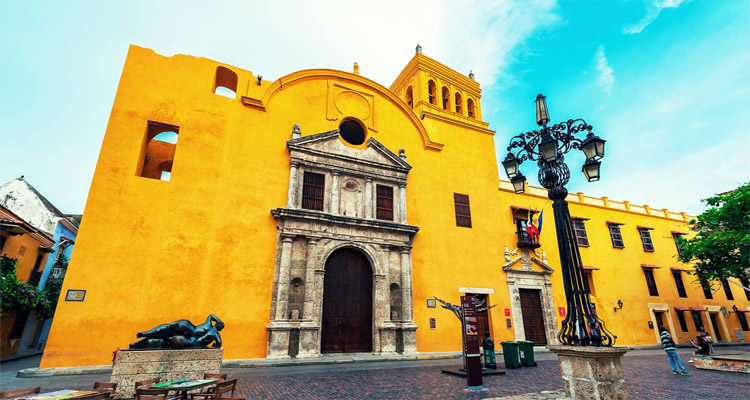
On October 1st, the Archdiocese of Cartagena de Indias informed the Spanish Government by letter of its intention to assume full management and administration of the Convent of Santo Domingo, the building that has housed the Spanish Cooperation Training Center (CFCE) since 1999 under a loan agreement (comodato), whereby one party grants another the temporary use of a property free of charge with the obligation to return it in the same condition.
As a result, the Popular Parliamentary Group in Congress submitted a written parliamentary question to the Government on November 25th, reminding them that the convent is “one of Spain’s most emblematic buildings in the Americas” and that both the restoration of the building and its maintenance “during these 30 years” were financed “entirely” by Spain.
According to the People’s Party (PP), this decision by the Archdiocese means “the loss of the headquarters of one of the most active training centers of the Spanish Cooperation, through which thousands of civil servants and professionals from both sides of the Atlantic have passed.” “The remarkable contribution of the Cartagena Training Center to the consolidation of more efficient public administrations in Latin America was complemented by a high-quality cultural program,” to the point of being considered “an emblem of Spain’s presence in Colombia,” the PP continues.
The PP also asserts that, since the Center’s creation, the collaboration with Colombian ecclesiastical institutions, and especially with the Archdiocese of Cartagena, “was exemplary,” and recalls, as an example, that the Cartagena de Indias Training Center “hosted activities of Pope Francis during his pastoral visit to Colombia in September 2017.”
Therefore, they continue, “it is perplexing that this collaboration has broken down and that the Ministry of Foreign Affairs and the Spanish Embassy in Colombia have been unable to reach an agreement to renew the loan agreement, allowing Spain to continue using the building.”
According to the Popular Party, “it is clear that the terms of the negotiation with the Archdiocese of Cartagena were not conducive to fostering a positive atmosphere between the parties” and that “the Archdiocese of Cartagena was given peremptory deadlines for responses, and our Embassy’s communications conveyed a tone of imposition with a hint of arrogance.”
Furthermore, the Popular Party asserts, “there is no record of any meeting having taken place” between the Minister of Foreign Affairs, José Manuel Albares, and the Colombian ecclesiastical authorities, “which demonstrates either a lack of interest on the part of the Minister or an irresponsible dereliction of duty.”
For all these reasons, the People’s Party (PP) is asking the Government if it is “in a position to reach an agreement that would prevent the regrettable loss of the use of the cloister of the Convent of Santo Domingo” and if there has been any meeting between Albares “or, at least, the Secretary of State for Cooperation and the Archdiocese of Cartagena to seek the renewal of the usage agreement.” Finally, the PP is asking the Government to clarify if it has a plan to ensure the continuity of activities at the Cartagena de Indias center “and Spain’s presence in the Colombian Caribbean with such an emblematic building as the aforementioned cloister,” should an agreement not be reached.
Government response
In its written response, issued on February 9 and published two weeks later in the Official Gazette of the Spanish Parliament (BOCGE), the Government states that the loan agreement between the Archdiocese of Cartagena and the Spanish Agency for International Development Cooperation (AECID) “is coming to an end” and that the Archdiocese of Cartagena has decided, for “pastoral and economic reasons,” to resume its management, pursuant to clause seven of said agreement.
“The Government of Spain has made countless attempts to open negotiations and offer proposals for collaboration with AECID that would allow the Center to continue operating in the cloister of Santo Domingo,” but has been met “at all times” with the Archdiocese’s refusal, which has the “firm intention” of recovering the property for its missionary work and financial support. “Currently, alternatives are being evaluated to allow the Training Center’s activities to continue at another location,” it concludes.