
Eduardo González
One of the collateral effects of the attempted coup of February 23, 1981, was the diplomatic conflict that nearly erupted between Spain and the United States due to the initial words of then-US Secretary of State Alexander M. Haig regarding the events in Spain: “It’s an internal matter.” As some of the documents declassified this Tuesday by the Spanish government reveal, Madrid and Washington exchanged messages in the following days to smooth things over.
“I have nothing to say today, other than to say that we are following the situation as it develops. It is still too early to comment. It is an internal matter,” Haig told a group of journalists on February 23. These words were immediately disseminated by the Spanish media and, as expected, caused great unease in a country bewildered by the news coming from Congress.
As journalist James M. Markham, Madrid correspondent for the New York Times, recalled days later, Haig’s statements generated “strong criticism from both the right and the left” in Spain.
In the days immediately following, Washington made a special effort to correct Haig’s lack of tact, as revealed by declassified documents. The first step was taken on February 24 by the State Department itself with an official statement: “During the last 24 hours, we have followed the events in Spain with the utmost interest and attention,” the text read. “We have observed that the attack on Spanish democracy has come from only a small number of people” and that “the overwhelming majority of the Armed Forces and the people of Spain have remained loyal to the King and the Constitution,” it added.
“Like all friends of Spain, we are pleased by the happy resolution of the crisis and by the strength shown by the institutions and leaders of the new Spanish democracy,” the State Department continued. “The role demonstrated by King Juan Carlos and his leadership of the Spanish nation have contributed outstandingly to the resolution of the crisis and deserve special admiration,” the statement concluded, adding that US President Ronald Reagan had already spoken by telephone with King Juan Carlos.
On February 26, Alexander Haig himself sent a letter to the Spanish Minister of Foreign Affairs, José Pedro Pérez-Llorca: “Mr. Minister, I wish to congratulate you and the Spanish people on the successful resolution of the situation in the Cortes. I have the utmost admiration for the determination with which the problem has been resolved, and I believe that the result reflects the strength of Spain’s new democratic institutions.” Pérez-Llorca replied on March 4 to thank him for “the congratulations in your kind letter of February 26 regarding the satisfactory resolution of the problems of recent days in my country, as well as the terms in which you express yourself regarding the strength of Spain’s democratic institutions.”
On February 27, the United States Ambassador to Madrid, Terence A. Todman, forwarded to the Spanish government both the aforementioned State Department statement “regarding the survival of democracy in Spain” and “the comments made to King Juan Carlos by President Reagan by telephone that same day.” “As you know,” he added, “my government was, as was I, deeply pleased that Spain’s democratic institutions have withstood the strain of such a grueling test.”
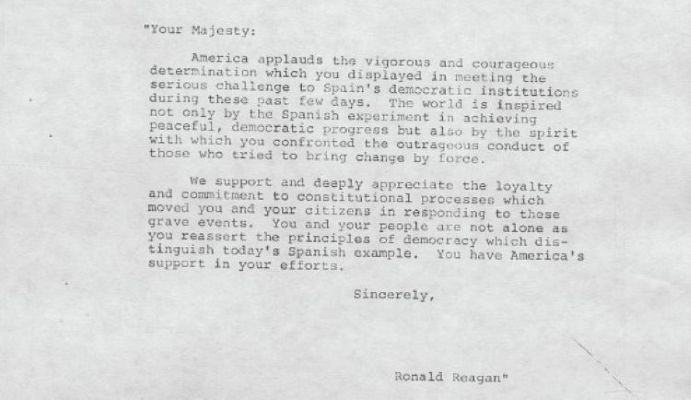
On February 27, Ronald Reagan sent a letter to King Juan Carlos: “Your Majesty, America applauds the vigorous and courageous determination which you displayed in meeting the serious challenge to Spain’s democratic institutions during these past few days. The world is inspired not only by Spain’s experiment in achieving peaceful, democratic process but also by the spirit with which you confronted the outrageous conduct of those who tried to bring change by force. We support and deeply appreciate the loyalty and commitment to the constitutional processes which moved you and your citizens in responding to these grave events. You and your people are not alone as you reassert the principles of democracy which distinguish today’s Spanish example. You have America’s support in your efforts.”
The King’s reaction to this message appears in another document, a “draft reply from the King to Reagan” dated March 10: “I have received your message of February 27 and I sincerely thank you for the complimentary terms in which you express yourself regarding Spanish democratic institutions, and regarding myself, in relation to the events in my country of the 23rd and 24th of that month. I also appreciate your expressions of support for our unwavering defense of democratic principles. It is encouraging for the Spanish people to know that, in their efforts, they have the great American nation on their side.”
Separately, on February 28, Reagan sent a letter to the newly appointed Prime Minister, Leopoldo Calvo Sotelo, to congratulate him on his taking office and to tell him, among other things, that “a strong and cooperative relationship between Spain and the United States is vital” to achieving “a freer and more peaceful world.” “I guarantee our continued support for Spanish democracy,” the letter concluded. Calvo Sotelo responded to Reagan on March 5th with an urgent telegram sent to the Spanish Embassy in the US for delivery to the White House. In the message, the Prime Minister thanked Reagan for his congratulatory message on his appointment “and the terms in which he expressed his support for the democratic institutions of my country.” “It is incumbent upon nations like ours to cooperate closely, alongside other democratic countries, in defense of the common principles that inspire our society. Therefore, I assure you of my intention and that of my government to collaborate with the United States to strengthen our relations as much as possible,” he added.
On March 4th, the US Embassy in Madrid forwarded to the Spanish Government the text of a resolution passed that same day by the US Congress regarding the “illegal takeover of the Spanish Parliament by seditious elements belonging to an armed group,” which constituted “a threat to the survival of democracy in Spain.”
The text praised the King’s “personal appeal” for “the maintenance of constitutional order,” which “indicates the depth of his support for stability and democracy” and the “loyalty of the clear majority of the Armed Forces to King Juan Carlos and to Spanish democracy.” It further stated that the “magnitude of the demonstrations by the Spanish people indicates the broad base of popular support for a democratic constitutional regime in Spain.”
For all these reasons, the House of Representatives celebrated that “the restoration of normal life to the Spanish Parliament after its insulting takeover by military elements is a sign of the strength of democracy in Spain and a source of encouragement to all who love liberty.” “The continuation of democratic political development in Spain represents an important contribution to the foreign policy interests of the United States and the free nations of Western Europe,” the Congressional resolution concluded.