Eduardo González
The Foreign Affairs Committee of the Congress approved on Wednesday, February 25, a non-binding resolution presented by the parliamentary groups Sumar, Euskal Herria Bildu, Republican, and Mixed, urging the Government to reject the latest measures adopted by US President Donald Trump to tighten the blockade of Cuba and to lead a firm stance against this new aggression against the island within the European Union and multilateral organizations.
The non-legislative proposal, approved with 19 votes in favor (the proposing groups and the PSOE) and 18 against (PP and Vox), urges the Government to “publicly denounce and firmly express its absolute rejection” of the declaration of the supposed “national emergency” and the tariff measures adopted on January 29 by Donald Trump to tighten “the economic, commercial, and financial blockade against Cuba,” as they “constitute a violation of international law, an aggression against the sovereignty of Cuba, and a threat to regional peace and stability.”
The text reaffirms “the commitment to the principles of the Charter of the United Nations,” in particular the sovereign equality of States and non-interference in internal affairs, and demands “the immediate, total, and unconditional lifting of the economic, commercial, and financial blockade imposed by the United States against Cuba, in accordance with the resolutions of the United Nations General Assembly repeatedly adopted with the favorable vote of Spain.”
The approved motion also urges the Government to lead a firm stance against this new aggression against Cuba within the European Union and multilateral organizations, and to strengthen cooperation with the island, “especially in energy, food, pharmaceuticals, and all other areas fundamental to the lives of the Cuban population, who are already suffering from this intensification of the blockade.” Separately, a compromise amendment from the PSOE (Spanish Socialist Workers’ Party) is included, rejecting unilateral decisions that violate international law and worsen the living conditions of the Cuban people.
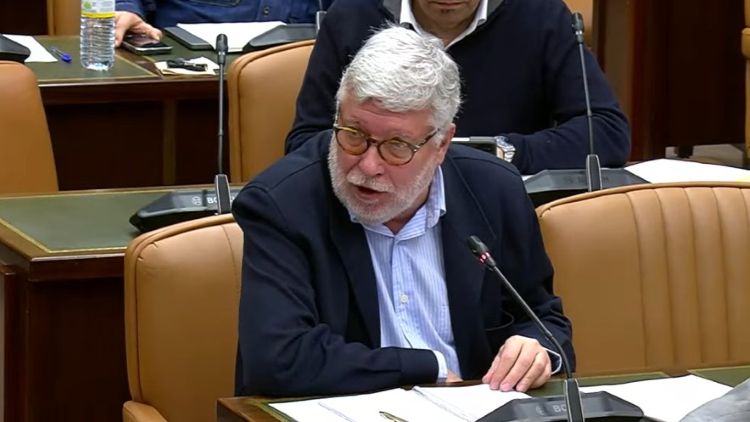
During the debate, Agustín Santos Maraver, of the Sumar party, recalled that the United Nations has already approved 33 resolutions condemning the blockade against Cuba, “one annually since 1992,” and that “Spain has consistently voted in favor” in the name of “international law.”
“Regime change from the outside is not possible,” because “that is the path specifically prohibited by the UN Charter” and because “only Cubans, within Cuba, have the right to decide on the conditions and, if necessary, to protest and exert all the necessary pressure to bring about political change from within Cuba,” warned Santos Maraver.
According to the Sumar MP, at this moment in Cuba, “hospitals cannot function, the water system is not working because it needs energy, agricultural production has not been maintained, and the entire life of the country is strictly dependent on whether the blockade will be broken or maintained.”
Faced with this situation, according to Santos Maraver, there are only two options: to maintain “the tradition, even under the Franco dictatorship, even under the PP governments, of upholding the principle of Cuba’s independence while, of course, defending human rights,” including the rights to “sovereignty and national self-determination,” or “simply” to participate “in a blockade and a boycott,” something “that has not been done before, not even, as I said, under the Franco regime,” he stated.
PSOE and PP
For her part, Obdulia Taboadela, of the PSOE, warned that this proposal, including her group’s compromise amendment, is “not an ideological issue, but a matter of principle; it is about respect for international law, the defense of multilateralism, and the consistency of Spain’s foreign policy.”
According to Taboadela, the “lifting of unilateral coercive measures in accordance with the resolutions of the UN General Assembly” is not a demand exclusive to the left. “Members of the PP and Vox, we didn’t invent this. Spain has repeatedly supported it, even when you were in power,” she asserted.
“The PP has turned foreign policy, like all its other policies, into an exercise in internal opportunism and cozying up to the worst of the far right,” she denounced. “When they govern, they maintain diplomatic, trade, and cooperation relations with Cuba. When they are in opposition, they overreact and compete to see who can be the toughest in their rhetoric,” she lamented.
In her speech, Belén Hoyo, of the People’s Group, lamented that the left had needed “67 years to open its eyes and realize that Cuba is under a dictatorship that has led the country to a serious economic and social crisis, that has exercised brutal repression against its people, and that has systematically attacked human rights and fundamental freedoms.”
“While you continue to whitewash a regime that denies its people, political pluralism, and the alternation of power, we will continue to raise our voices in favor of a free Cuba,” because “being on the right side of history means standing with the democrats, not with those who repress; it means standing with freedom, not with oppression; it means standing with a people who suffer, not with their executioners,” she warned.