
Eduardo González
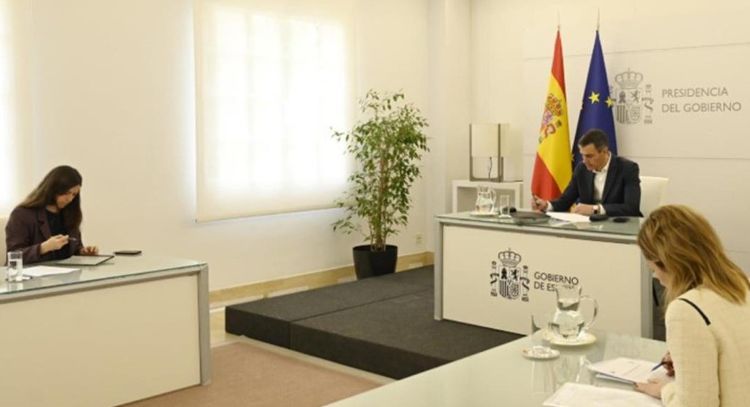
The Prime Minister, Pedro Sánchez, participated this Tuesday, February 24, in the meeting of the Coalition of Volunteers for Ukraine, coinciding with the fourth anniversary of the Russian invasion, where he advocated for maintaining pressure on Russia through sanctions and military support for Kyiv.
During his intervention via videoconference, the Prime Minister emphasized the need to achieve a just and lasting peace within the framework of peace negotiations and warned that the outcome of these talks will also decide the future of Europe, according to a press release from Moncloa.
Furthermore, Pedro Sánchez defended the willingness of the Coalition of Volunteers to offer Ukraine security guarantees once a ceasefire has been achieved. Meanwhile, the Prime Minister advocated for maintaining pressure on Russia through sanctions and military support for Ukraine.
The Prime Minister also warned of the need to achieve a stronger Europe, not only by improving military capabilities but also by deepening integration. In this regard, he supported the swift approval of the €90 billion loan agreed upon by the European Council and stressed the need to guarantee stable financial support for Ukraine and to finance European security alongside other European public goods, creating a secure asset.
Sánchez made these remarks on the occasion of the meeting in Paris of the Coalition of Volunteers, an initiative launched in March 2025 by France and the United Kingdom, which has been joined by 35 countries (mostly European, as well as Canada, Australia, and Japan) to examine progress on security guarantees for Ukraine and analyze the collective strategy towards Russia. Spain has been present at all meetings of this forum. Tuesday’s meeting brought together 27 heads of state and government in person.
Sánchez’s participation in the meeting coincided with Foreign Minister José Manuel Albares’s trip to Ukraine (his fifth visit to the country since the 2022 invasion), where he personally conveyed a “message of solidarity from the Spanish people to President Volodymyr Zelensky and his counterpart, Andriy Sybiha, until Ukraine wins and achieves peace.”
The EU
Meanwhile, European Commission President Ursula von der Leyen and European Council President António Costa also traveled to Kyiv on Tuesday to show their support for Ukraine, as did national leaders such as Danish Prime Minister Mette Frederiksen; Swedish Prime Minister Ulf Kristersson; Finnish President Alexander Stubb; Estonian Prime Minister Kristen Michal; Icelandic Prime Minister Kristrún Frostadóttir; Latvian Prime Minister Evika Silia; and Norwegian Prime Minister Jonas Gahr Støre. The Prime Minister of Croatia, Andrej Plenković, was also present. All of them participated in the Volunteer Coalition meeting via videoconference.
Meanwhile, António Costa, Ursula von der Leyen, and the President of the European Parliament, Roberta Metsola, issued a joint statement on Tuesday, marking the fourth anniversary of the start of the war. In it, they affirmed that the European Union’s primary objective is “a comprehensive, just, and lasting peace for Ukraine, based on the principles of the UN Charter and international law.”
The European leaders expressed their support for “all efforts aimed at achieving such a peace: a long-term peace with dignity and security.” They affirmed that “respect for sovereignty and territorial integrity” remains the cornerstone of the EU’s strategy and stressed the importance of “maintaining transatlantic and global solidarity with Ukraine in today’s complex international and geopolitical environment.”
The statement insists that Russia “has not achieved its military objectives in Ukraine,” as demonstrated by the intensification of its deliberate attacks against Ukrainian civilian and critical infrastructure, including hospitals, schools, residential buildings, and energy infrastructure, amidst a particularly harsh winter.
In this context, the European Union affirmed that it will continue to provide “comprehensive political, financial, economic, humanitarian, military, and diplomatic support to Ukraine and its people” and recalled the agreement reached in December between the heads of state and government, which guarantees €90 billion for Ukraine between 2026 and 2027.
This package is intended to cover Kyiv’s urgent budget and defense needs, enabling it to remain resilient against Russian attacks. Of this €90 billion, €60 billion will be allocated to military needs. Although the Hungarian veto has temporarily blocked the loan, European leaders assured that “the first payment will be made as soon as possible.”
European leaders also emphasized that their support efforts for Ukraine are not limited to the present but are also focused on the future, “when the fighting has ceased.” In this regard, they reaffirmed that the European Union and its Member States, within the framework of their respective competences, “are ready to contribute to strong and credible security guarantees to ensure that Russia can never again attack Ukraine.”
The statement also includes the EU’s commitment to ensuring that “Russia is held accountable for the crimes committed and the damage caused” and underscores the commitment to establish “as soon as possible” a Special Tribunal for the Crime of Aggression against Ukraine and an International Claims Commission for Ukraine, both under the framework of the Council of Europe.
“The future of a secure and prosperous Ukraine lies with the European Union,” the leaders concluded, highlighting the “significant progress” made by Ukraine in the reforms necessary for its accession to the EU, “despite the difficult circumstances.” In this context, they affirmed that Ukraine can count on the European Union’s “full support” both in its accession and in its post-war reconstruction.
Ukrainian President Volodymyr Zelenskyy, speaking remotely at the European Parliament’s extraordinary plenary session on Tuesday to mark the fourth anniversary of the start of the Russian invasion, called for a “clear date” for Ukraine’s accession to the EU. He warned that without such a guarantee, Putin “will find a way to block Ukraine for decades, dividing Europe.” During the extraordinary session, the European Parliament adopted a resolution condemning Russia’s aggression against Ukraine by a large majority.