Eduardo González
Foreign Minister José Manuel Albares warned this Monday, February 23, in Brussels that the European Commission’s presence at the first formal meeting of the Peace Board, the body promoted by US President Donald Trump to monitor the ceasefire in the Gaza Strip, was a “grave error.”
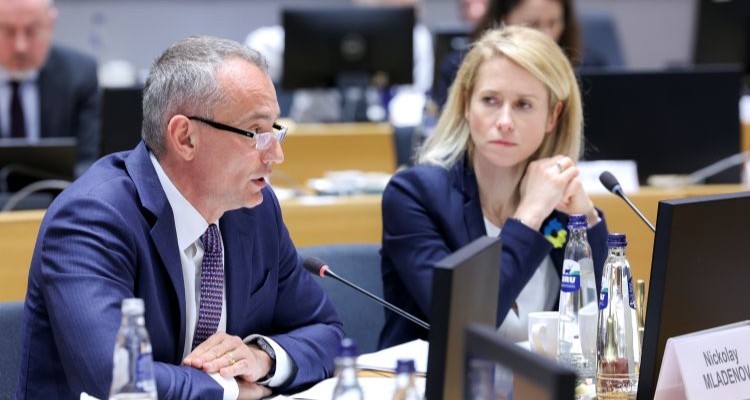
Albares made this statement during the EU Foreign Affairs Council (FAC) meeting, in the presence of his EU counterparts and the High Representative of the Peace Board for Gaza, Nikolai Mladenov, according to a press release from the Ministry of Foreign Affairs.
“The Palestinian National Authority is not even invited” to the Peace Board “and, therefore, we consider it not a useful element for advancing the two-state solution, which is the solution favored not only by Spain, but also by the European Union,” the minister stated earlier upon his arrival at the FAC.
“Therefore, we consider it a mistake, a grave mistake, that the European Commission was present at the last meeting on February 19,” he continued. “It does not represent the position of the European Union, which is that of a two-state solution, and therefore the Commission, on behalf of the European Union, could not attend because it did not have a mandate to do so,” he insisted.
During the FAC meeting, Albares warned that the peace agreement is being systematically violated because there are still “frequent deaths in Gaza and humanitarian aid is trickling in, when it should be arriving en masse.”
For this reason, he asked the European Union to speak out clearly and “take action, both regarding the slow pace of a peace agreement that is not bearing fruit and the slow but inexorable annexation of Palestinian land in the West Bank,” as well as “Israel’s attempt to economically strangle the Palestinian Authority by withholding taxes.”
On January 22nd, Donald Trump presented the so-called “Peace Board” at the Davos Forum. Among those who have joined are Israel, Morocco, Hungary, Bulgaria, Argentina, Qatar, Saudi Arabia, Turkey, Kosovo, and the United Arab Emirates. With the exception of Hungary and Bulgaria, no other EU country has joined the initiative or attended the presentation. That same day in Brussels, Spanish Prime Minister Pedro Sánchez announced that Spain had “decided not to participate in the so-called Peace Board for the sake of consistency.”
Last Monday, Commission spokesperson Paula Pinho stated that the participation of the European Commissioner for the Mediterranean, Dubravka Šuica, in the first formal meeting of the Peace Board reflects Brussels’ intention to “strengthen everything that has been done in favor of Gaza from the beginning.” She also confirmed that the Commission President, Ursula von der Leyen, had been invited, but ultimately chose not to attend and delegated her duties to Šuica “on behalf of the Commission.”
Four days later, Albares confessed, during his speech at the “Europe, and now what?” series, organized at the Palau Macaya in Barcelona by Amics del País, that it had “hurt him to see a European Union Commissioner, who shouldn’t have been there, even as an observer.” The French and Irish governments have also expressed their displeasure at the Commissioner’s presence at the meeting without prior consultation with the other EU member states.
Ukraine
On Monday, Albares defended at the FAC the approval of the twentieth package of sanctions against Russia and the prompt disbursement of the €90 billion loan agreed upon in December so that the funds reach Ukraine as soon as possible. “Besides helping Ukraine win this war, above all we have to help it win peace, so that Ukraine can be a democratic country in the European family and ensure that this aggression is the last aggression it suffers,” he told his EU colleagues.