Eduardo González
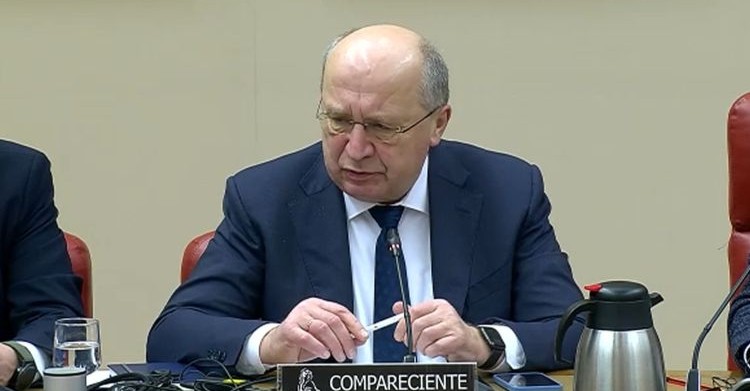
The European Commissioner for Defense, Andrius Kubilius, warned this Thursday in the Spanish Congress that EU member states should increase their defense and security spending to at least 3.5 percent of GDP because “if we cannot guarantee that all countries invest enough to develop their defense capabilities, collective defense will be much more fragile.”
During his appearance before the Joint Committee of the European Union, the Lithuanian politician asserted that Europe is currently facing “two very clear challenges and threats.” On the one hand, he warned, European intelligence services believe that Russia could be “considering, in the coming years, an attack against NATO member states, perhaps in the Baltic, Poland, or Finland. Of course, we have to take this very seriously.”
On the other hand, he affirmed, Europe must invest in its own defense to increase its capabilities. “We must build our capabilities and prepare to assume responsibilities and move beyond this era of the last thirty years, in which we were quite content and comfortable because the United States assumed responsibility for our defense or shouldered it on its shoulders and those of its taxpayers,” he asserted.
In this regard, he noted that the United States has approximately 100,000 troops stationed in Europe, troops that will need to be replaced should Washington decide to withdraw them. “Until now, we have been heavily dependent on certain U.S. services,” Kubilius insisted, warning that, at this time, the real priority is replacing U.S. capabilities and forces rather than considering the creation of a potential European army.
He added that, in the medium term, the United States has already asked NATO members to assume their responsibilities within the framework of “conventional defense” in Europe, although “discussions on nuclear defense are a separate matter.”
In this context, the Lithuanian commissioner stressed the need to increase defense spending to at least 3.5 percent. “The agreement reached at the NATO Summit in The Hague to spend 3.5 percent on actual defense and an additional 1.5 percent on defense-related matters by 2035 is a historic milestone,” but, “it will clearly not be easy” for member states to reach that percentage, Kubilius stated, without mentioning Spain.
“We understand that, but we also need to understand something very simple: our entire defense depends on the principles of collective defense, and if we cannot guarantee that all countries invest sufficient funds in defense to develop their defense capabilities, then this collective defense will be much more fragile,” he declared.
Furthermore, the commissioner warned of the need to create a “European defense architecture.” “We need to be very clear about how we are going to build our European pillar of NATO, strengthening our capabilities, but also our institutions, and assuming much greater responsibility for the entire defense architecture,” he stated.
The other major challenge, Kubilius continued, is “the political will to defend ourselves, to strengthen ourselves.” “This is really where (Russian President Vladimir) Putin is trying to use all sorts of hybrid means to divide us and diminish our political will to defend ourselves,” he warned.