Until the 31st of May, the Real Academia de Bellas Artes de San Fernando de Madrid presents the exhibition Bellezas del mundo flotante (Beauties of the floating world), curated by Daniel Sastre de la Vega, Centro de Estudios de Asia Oriental, Universidad Autónoma de Madrid, and Ricardo Centellas Salamero, Director of the Goya Fuendetodos Consortium, Zaragoza Provincial Council.
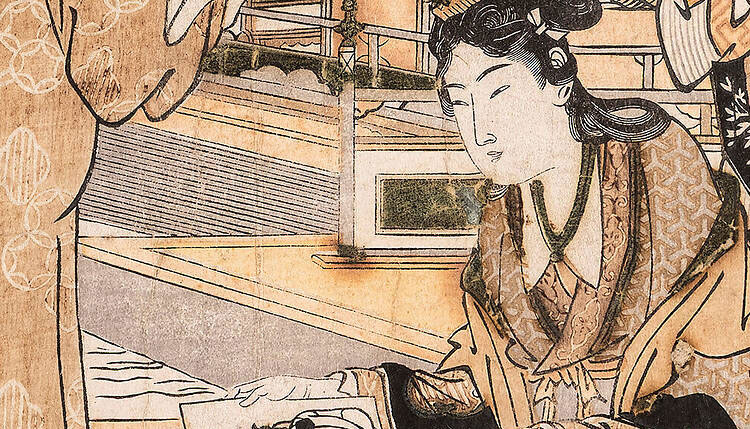
The Pasamar-Onila Collection is unique and singular in the panorama of Japanese engraving collections in Spain for the quality and diversity of its prints of the bijin-ga genre, ‘images of beautiful women’. Parallel to the iconography of kabuki actors, the representation of women, bijin, was the most popular ukiyo-e genre. The exhibition brings together an elaborate synthesis of manifestations of bijin-ga in the classical masters of the golden age of Japanese engraving, between the last third of the eighteenth century and the first half of the nineteenth. In addition to precious prints in ōban format, The most common of the era, it also exhibits a group of unusual hashira-e, ‘images of pillar or column’, vertical diptychs or kakemonos, sophisticated triptychs and an exceptional six-leaf polyptych, in addition to an admirable thematic set.
The suggestive visual creations of the ‘floating world’ make up the most genuine episode of Japanese graphic art. Its seduction transcended the frontiers of the Japanese culture to settle in the collective imaginary of the West, to which contributed the interest that since the middle of the XIX century showed the French impressionists, enthusiastic collectors of prints, an interest commensurate with his persistent experimentation of the effects of light in the realm of representation. The vivid colors of the Japanese print captivated by its luminosity, sensuality and elegance.
The essence of ukiyo-e revolved around the ideal of sophistication, iki, as a model of behavior and formal expression. From this theoretical construction, the scenes and their protagonists, as well as the compositional structures themselves, respond to an idealized conception of the real that translates into the use of stereotypes and canonical representation systems.
In the bijin-ga genre, images refer primarily to high-ranking courtesans from the pleasure districts, particularly those from the Yoshiwara district of Edo, represented alone or in the company of their young kamuro. Now, the ukiyo-e artists not only paid attention to Yoshiwara’s refined geishas, but also appreciated the feminine beauty in the gender scenes, capturing the dignity of women engaged in their daily activities or in the privacy of their home, reading or writing poetry, and also traveling through the famous places of Edo, Mount Fuji, Sumida river, Enoshima island… A world of subtle beauty and elegance, the sublimation of the ephemeral, whose culmination was radical hedonism manifest in the sexually explicit scenes of the shunga genre, literally ‘spring images’.
Beauties of the floating world brings together seventy-seven works by the classical masters of the golden age of Japanese engraving. The starting point are five prints of Suzuki Harunobu (1724-1770) driving the nishiki-e technique to create compositions in polychromy with which to overcome the practice of lighting monochrome designs by hand. The formal languor of Harunobu was assimilated by the delicate figures of Isoda Koryūsai (1735-1790), then challenged with the feminine corpulence of the representations of Torii Kiyonaga (1752-1815), son of a bookseller, and the preciosista style of Kitao Masanobu (1761-1816), pseudonym of the famous poet and playwright Santō Kyōden.