Eduardo González
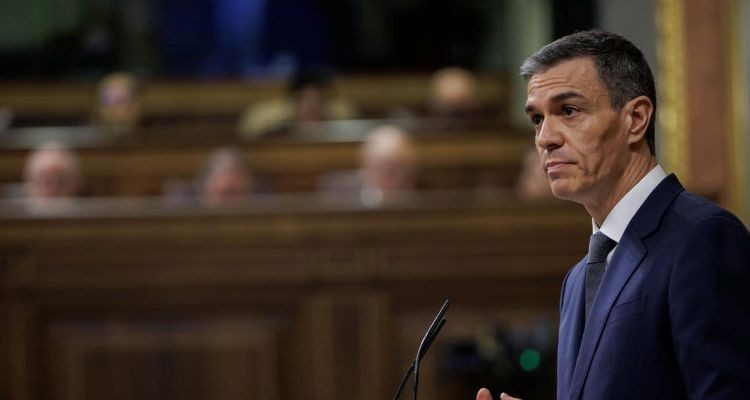
Spanish political polarization once again clouded Wednesday’s plenary session of the Congress of Deputies, where Prime Minister Pedro Sánchez appeared, at his own request, to address the train accidents in Córdoba and Barcelona and to discuss international policy.
As expected, domestic affairs absorbed a good part of the very long debate (more than six hours), which did not prevent Sánchez from giving a “telegraphic” overview of current international affairs.
Venezuela
First, Pedro Sánchez recalled that his government “did not recognize the supposed electoral victory of (Nicolás) Maduro as president” of Venezuela “due to the irregularities committed in the last elections,” but “that does not legitimize what the US administration has done.”
“On the contrary, I believe we cannot recognize or applaud the operation carried out by the United States in Caracas” because it is “contrary to international law,” represents “a very dangerous precedent in the world, and because it doesn’t even seem likely to serve to initiate a democratic transition in that country,” since, “at least as of today, it seems that the objectives and priorities of the US administration are different,” he warned.
Iran and Ukraine
Furthermore, Sánchez reiterated his “absolute and unequivocal condemnation of what the Iranian regime is doing precisely to the Iranian population, and particularly to women,” and lamented the lack of progress in Ukraine, after the “door of hope” that opened in January when, “for the first time in a long time, a real possibility arose of establishing security guarantees that would satisfy the needs of Ukraine and also of Russia, and that would also serve as a basis for creating the just and lasting peace that I believe we all want in Eastern Europe.” “Therefore, we remain attentive, we will continue to support Ukraine in its fight for freedom,” he affirmed.
EU-Mercosur
The Prime Minister also highlighted the agreement between the EU and Mercosur, which “is extraordinary news for Europe, and undoubtedly also for Spain, because we are creating a framework of predictability, security, and respect for an order that, unfortunately, is being unilaterally broken by others.”
He also conveyed to farmers that the Government is “very aware” of “the concerns they may have” and reminded them that the European Parliament approved this Tuesday “agricultural safeguards that will allow the European Union to suspend or hinder the entry of Latin American products if it is considered that they could in any way harm our producers,” and that the European Commission “has provided for compensation mechanisms and extraordinary financial support.”
Greenland
Pedro Sánchez also recalled the “moments of extreme tension” experienced due to the United States’ threats to Danish sovereignty over Greenland. “The territorial integrity of an allied country, and also a member of the European Union, Denmark, has been called into question by none other than an ally, the superpower of the Atlantic Alliance,” he stated.
“Fortunately, the US administration, the Trump administration, has changed its mind,” he continued. “We will see if it doesn’t reconsider that opinion,” he added. “We naturally welcome this reconsideration, but we think it would be a mistake to assume that the problem has disappeared, because the underlying problem remains,” he warned.
“The problem is thinking that international rules are for everyone to follow except one, that their validity is intermittent, that they can be used to threaten and use fear to coerce countries that claim to be allies,” he continued. “We believe that this international governance should not be accepted, and we think that Europe should not accept it either,” he added.
Gaza
Furthermore, Pedro Sánchez recalled that, “after reflecting on the matter for several days and speaking with various European and Middle Eastern leaders,” Spain decided that “it would not join this attempt to privatize the multilateral order with this so-called Peace Board organized by the US administration.”
“Of course, we appreciate the invitation, but we decline it,” because “what we must do is precisely to strengthen and reform the multilateral system and strengthen and reform everything necessary to guarantee security and peaceful coexistence between Israel and Palestine,” he asserted. “This Board, as you know, is outside the framework of the United Nations, has not included the Palestinian Authority, and disregards many of the basic principles that, in our opinion, should govern relations between countries,” he stated.
Social media
On another note, Sánchez defended himself against accusations of “censorship” regarding the measures adopted by the government to curb the power of social media. “Is it censoring freedom of expression to tell these magnates that if there is content that is false, vulgar, hateful, and proven to be false, they should remove it and take responsibility? Is it censorship to tell these techno-oligarchs who manipulate algorithms to spread messages of hate, violence, and pornography instead of the truth to take responsibility? Is that censoring and limiting freedom of expression?” he asked.
“The far right, in fact, is spreading this disinformation, generating this hatred, and also, unfortunately, exploiting our young people,” he denounced. “The scientific and health community itself, the healthcare professionals themselves,” have “reacted positively to this decision. Why? Because we are perfectly aware of what is at stake, and what is at stake is not Mr. Musk’s pocketbook, what is at stake is people’s mental health, and particularly that of our young people,” he asserted.
Sumar
On behalf of Sumar (the junior partner in the coalition government), MP Verónica Martínez Barbero warned that the world is experiencing “an internationally critical moment” due to the threats from “Trump, Putin, and Netanyahu, who want to transform our societies into an authoritarian dystopia,” a “fascism, in every sense of the word, supported by an alliance of spoiled, egocentric technocrats and oligarchs with fragile masculinity.”
Therefore, Martínez Barbero affirmed that “Spain must continue to champion the defense of all life against those who perpetrate genocide in Palestine, an illegal invasion of Ukraine, or death at the hands of ICE in the United States,” and must confront “the owners of the tech companies” who “want to destroy democracy,” some of whom, “like Elon Musk and Pavel Durov, are directly threatening our government and democracy.”
However, she warned, “it’s not enough to just make announcements, it’s not enough to rely on strong rhetoric; we need concrete action.” “This starts with a European technological alliance. Let’s develop the capabilities to achieve our European technological sovereignty. Let’s stop being trapped in the networks of the oligarchs,” she demanded. Furthermore, she stated, “X cannot be the platform of choice for the government’s institutional information, a platform owned by an ally of Trump, who has repeatedly stated that his objective is to destroy European democracies.” “That’s why we ask you, Mr. President, that institutional accounts migrate to secure and transparent alternatives, because X cannot be the platform of choice for institutional information,” she insisted.
Vox
For his part, the leader of Vox, Santiago Abascal, described the measures adopted by the government against the major digital platforms as “online censorship.” “What is your model? The Chinese model? The Brazilian model, which has banned some social networks? The Cuban model? The Iranian model? I believe your model is any model that attacks freedom and keeps you in power for even a second longer,” he added.
Clash between Álvarez de Toledo and Albares
The leader of the PP, Alberto Núñez Feijóo, did not address international issues, but his party’s deputy, Cayetana Álvarez de Toledo, did so in the subsequent debate before the plenary session. In a question to the Minister of Foreign Affairs, José Manuel Albares, she accused the government of portraying itself as the “scourge of the techno-oligarchs” while “acting as a lackey of a techno-dictatorship” and as “China’s Trojan horse in Europe.” Spanish foreign policy is “at the service of socialist corruption,” she added. “They’re all for (Elon) Musk (owner of X), but docile with Delcy (Rodríguez, acting president of Venezuela),” he added.
In his response, Albares reiterated that the PP “never talks about foreign policy, not a word about Gaza, Ukraine, Greenland, Iran, or anything.” “They are not trustworthy for the Spanish people because whenever they try to talk about Spain, it’s to say that European funds shouldn’t come here, to openly boycott Catalan, Basque, and Galician, and to prevent them from becoming official languages in Europe,” he asserted. “You are, at this moment, a great danger to democracy, because you openly applaud the global far right, you and your partners in Vox,” he added.