
Eduardo González
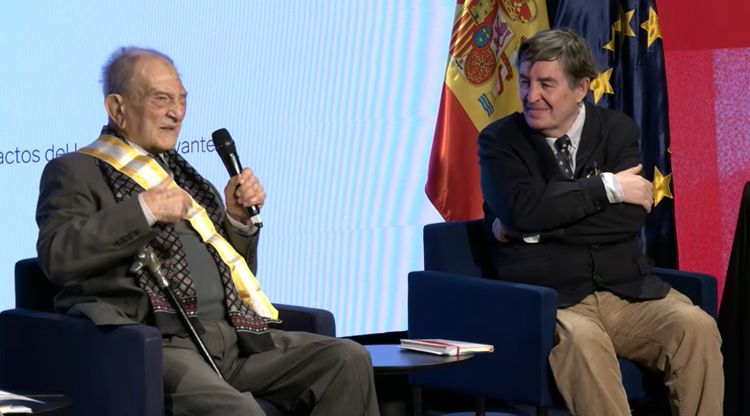
The Cervantes Institute paid tribute this Monday to the historian and first director of the institution, Nicolás Sánchez-Albornoz, who will turn 100 on February 11. Foreign Minister José Manuel Albares awarded him the Grand Cross of the Order of Isabella the Catholic.
“The Cervantes Institute was created by a decision of Parliament, with good intentions, but really without first designing what was wanted and without providing the means for the execution of that plan,” Sánchez-Albornoz recalled during the ceremony, held at the Cervantes Institute headquarters in Madrid, which was also attended by other former directors of the Cervantes Institute such as Juan Manuel Bonet and Fernando Rodríguez Lafuente.
The historian, who was working at New York University at the time, was appointed director of the newly created Cervantes Institute in 1991 by decision of the Council of Ministers and at the proposal of the then Minister of Education and Science, Javier Solana (present at Monday’s event). He remained in the position until 1996.
At that time, he recalled, there was no “sense of professionalism” in promoting Spanish abroad. “The attachés at the embassies were perhaps responsible for bringing over some members of the Spanish cultural community or organizing Spanish courses,” and there was even the case of an ambassador, “whose name I don’t remember, if I ever knew it,” who “signed the students’ approval,” which “was quite a curious situation.” “In other words, there was no sense of professionalism; these were just initiatives,” he explained.
“What there was, though, was an awareness that something had to be done, as institutions abroad, but they weren’t ready to act.” “The law had been passed, but we hadn’t been given a budget or a building in Madrid,” he asserted. Therefore, the Institute was forced to accept its first headquarters in Alcalá de Henares, the same city where he himself had been imprisoned and convicted years earlier for being anti-Franco. “It was a very emotional and somewhat humorous situation,” he explained.
“What we did, thanks to the entire team, was create that foundation” for the “professionalism of the aspirations of Spanish society to project itself abroad,” and the Cervantes Institute “from that moment on was an entity that functioned professionally, and that professionalism has continued to this day,” he added.
Furthermore, Sánchez-Albornoz emphasized the fact that it was the Ministry of Foreign Affairs that awarded him the decoration. “It is particularly meaningful to me because I don’t know if it’s remembered that I have a blood tie, and my father was a Minister of State, as the Ministry of Foreign Affairs was called at that time, and an ambassador,” the honoree stated. “In other words, the foreign service has somehow surrounded me since childhood, and I can only have great affection for the work that the Ministry does abroad,” he added.
García Montero
During the presentation of the event, the director of the Cervantes Institute, Luis García Montero, emphasized that “the course set by Nicolás was based on considering the Spanish language and culture as a point of reference on the international stage, defending the profound fraternity of the Spanish language, and rejecting any kind of imperialism or centralism, while upholding the diversity and values that weave the multicultural and democratic horizons of Hispanicity within the Latin American and Ibero-American perspective.”
This work, he continued, “was in response to the consolidation of Spanish democracy, for which Nicolás Sánchez Albornoz had fought since his father, Claudio, was forced into exile due to the 1936 coup d’état, and he remained in Madrid to fight against the dictatorship.”
Born on February 11, 1926, in Madrid, and the son of historian Claudio Sánchez-Albornoz (Minister of State or Foreign Affairs in 1933, ambassador to Portugal in 1936, and President of the Council of Ministers of the Republic in exile between 1962 and 1971), Nicolás Sánchez-Albornoz was arrested in Madrid in March 1947 along with a group of students for their activities in the University Student Foundation (FEU) and sentenced by the Francoist dictatorship to forced labor in the Valley of the Fallen.
For decades, he remained in exile in Argentina, where he developed much of his academic career. After the military coup led by dictator Juan Carlos Onganía in 1966 in Argentina, he emigrated to the United States (1968), where he taught Spanish and Contemporary Latin American History at New York University. In the spring of 1990, he returned to Spain.
Albares
For his part, Albares recalled that the Grand Cross of the Order of Isabella the Catholic “was instituted to recognize, as we all Spaniards and the Government of Spain recognize you today, exceptional merits to the Spanish nation.” “I believe that few people like you have done so much for the Spanish nation,” he added.
“Today we pay tribute to you, to an essential figure in the intellectual and democratic history of Spain, Nicolás Sánchez-Albornoz Aguain,” the minister stated. “It is a tribute that probably should have been given a long time ago, out of justice to him, but also out of justice to our own democratic memory,” he continued.
“We are living through a time of profound international transformations. There is a breakdown in the international order. There are simultaneous threats. The global far right is once again threatening democratic values,” and, for all these reasons, “following the example of those who defended freedom in the most difficult circumstances, as was the case with Nicolás Sánchez-Albornoz, is the best tribute we can pay them,” he added.