
Eduardo González
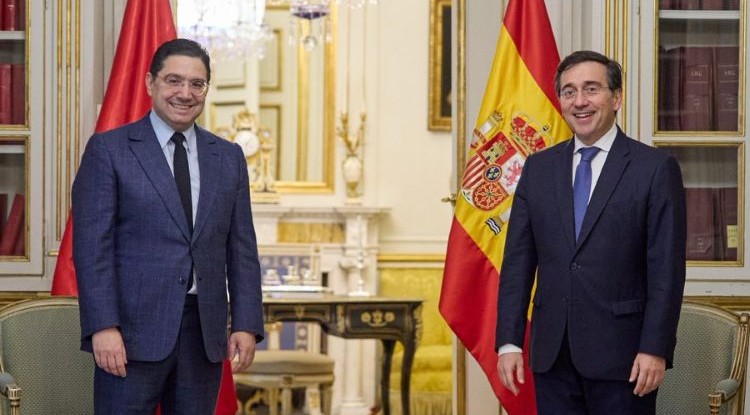
Foreign Minister José Manuel Albares received the UN Special Envoy for Western Sahara, Staffan de Mistura, and his Moroccan counterpart, Nasser Bourita, at the Ministry headquarters in the Palacio de Viana in Madrid on Monday, February 9.
Both meetings took place just two days after Albares also received his counterparts from Mauritania, Mohamed Salem Ould Merzouk, and Algeria, Ahmed Attaf, in Madrid. This comes amid secret negotiations being led by the United States in the Spanish capital to secure, by May, the signing of a framework agreement to end the Western Sahara conflict, as reported by the newspaper ‘El Confidencial’ citing unidentified diplomatic sources.
Amidst all the secrecy surrounding these US-backed negotiations, the Ministry of Foreign Affairs has limited itself, as usual, to publishing a few messages on social media with the customary praise for the excellent state of bilateral relations, and little else.
In the meeting with Nasser Bourita (the fourteenth between the two since March 2022, when the Spanish government made the unexpected decision to accept the autonomy plan for Western Sahara), the tweets posted by the Ministry of Foreign Affairs highlight the positive state of the bilateral relationship (“Our friendship and cooperation are at their best moment in history”), trade exchanges, migration and police cooperation, and cultural relations, as well as the need to promote the agreements signed at the Spain-Morocco High-Range Meeting last December and to move “together towards the 2030 World Cup.”
Secret meeting in Madrid
According to El Confidencial, the US Embassy in Madrid hosted a high-level secret meeting this Sunday, without Spanish participation, between the foreign ministers of Morocco, Algeria, and Mauritania, the head of diplomacy for the Polisario Front, Mohamed Yeslam Beissa, the US representative to the UN, Michael Waltz, and President Donald Trump’s special representative for Africa, Massad Boulos. The meeting, according to the same newspaper, concluded with a simple statement that did not reveal any outcomes. Prior to the Madrid meeting, a first secret meeting was held in Washington two weeks ago, about which little has been reported.
Last fall, Washington decided to take the initiative on this issue and relegate the United Nations to a secondary role. Massad Boulos has warned that the Sahrawi conflict is a “top priority” for the United States, and he himself traveled to Algeria in January to discuss the issue with President Abdelmadjid Tebboune.
In this context, Morocco reportedly presented a new, much broader autonomy proposal for Western Sahara in January than its previous 2007 proposal. This new proposal comes after the fifteenth meeting of the EU-Morocco Association Council concluded on January 29 with a Joint Declaration in which the European side expressed its support for UN Security Council Resolution 2797 (2025), which “fully supports the efforts of the Secretary-General and his Personal Envoy to facilitate and conduct negotiations on the basis of the autonomy plan proposed by Morocco.”
That declaration also acknowledged that “genuine autonomy” could be “the most feasible solution” and welcomed “Morocco’s willingness to engage in good-faith dialogue with all parties involved to clarify the modalities of this autonomy plan and explain how autonomy would be implemented within the framework of Moroccan sovereignty.”
The declaration also acknowledged that genuine autonomy could be “the most feasible solution” and welcomed “Morocco’s willingness to engage in dialogue in good faith with all parties involved to clarify the modalities of this autonomy plan and explain how autonomy would be implemented within the framework of Moroccan sovereignty.” With this declaration, the EU unequivocally endorsed, for the first time, the surprising decision by Spanish Prime Minister Pedro Sánchez to support Morocco’s autonomy plan for Western Sahara in March 2022 “as the most serious, credible, and realistic basis for resolving this dispute.”
However, it appears that the new autonomy proposal presented by Morocco is not entirely satisfactory to the United States, which has called for a constitutional reform to soften Rabat’s centralist policies. Morocco does not seem to be very supportive of this proposal, believing it could encourage other regional demands, particularly in the Rif region.