
The Diplomat
Foreign Minister José Manuel Albares was unable to travel to A Coruña on Thursday to participate in the closing session of the third world summit on the Responsible Artificial Intelligence in the Military domain (REAIM) due to the storm bringing rain and wind to Galicia.
Albares was scheduled to speak at the high-level closing session of REAIM, but the plane carrying him and the Minister of Digital Transformation, Óscar López, had to return to Madrid because of the storm, according to government sources.
Albares was ultimately replaced by the Director General of Foreign and Security Policy at the Ministry of Foreign Affairs, Alberto José Ucelay, who defended in his speech the need to “combine technological progress with the responsible use of Artificial Intelligence.”
It so happens that the Minister of Defense, Margarita Robles, was also unable to speak at the opening ceremony on Wednesday because the plane she was traveling on was forced to land in Santiago de Compostela, instead of A Coruña, due to the same weather conditions.
However, Robles was eventually able to travel to the summit venue, where, in statements to journalists on Wednesday, she defended the usefulness of Artificial Intelligence in the military field, but warned that, “in difficult times, the ethical component is very important.”
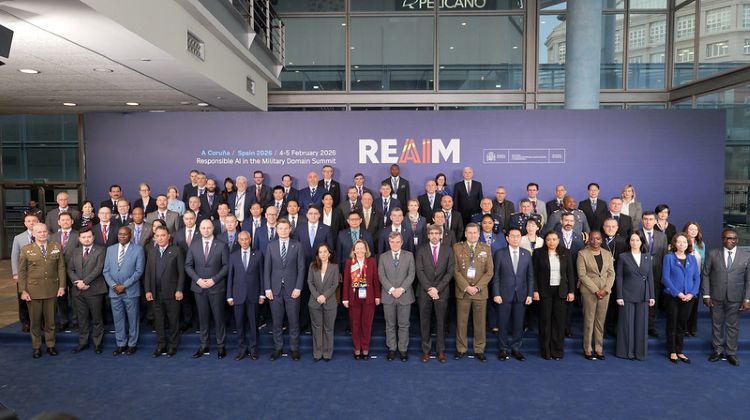
The third REAIM summit brought together representatives from eighty countries, including Ministers of Foreign Affairs and Defense, as well as members of governments, regional and international organizations, the industrial sector, academia, and civil society.
The event was organized by the Ministries of Foreign Affairs and Defense and the A Coruña City Council, with the support of the Ministry for Digital Transformation and Public Administration through the Spanish Agency for the Supervision of Artificial Intelligence (AESIA), and in coordination with the governments of the Netherlands and the Republic of Korea.
The event addressed the progress made at the previous summits in The Hague and Seoul, as outlined in the Call to Action and Blueprint for Action documents. In the three years since the Hague summit, significant technological advancements have been made, and an increasing number of states are developing national guidelines and principles for the use of artificial intelligence in the military sphere to address the challenges and capitalize on the opportunities presented by this technology.