
Eduardo González
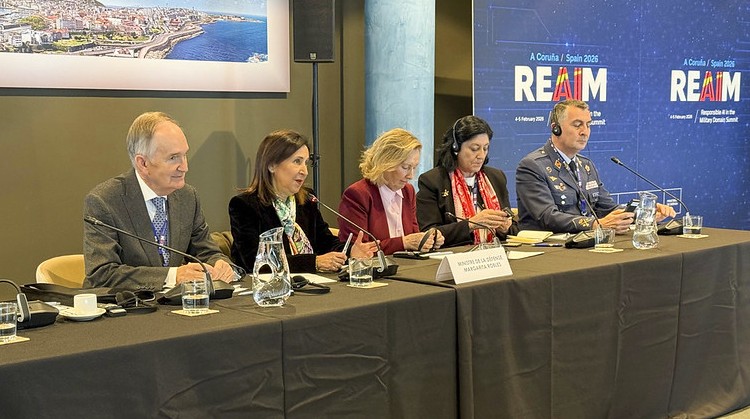
Defense Minister Margarita Robles defended the usefulness of Artificial Intelligence in the military sphere this Wednesday, February 4, but warned that, “in difficult times, the ethical component is very important.”
Robles made these statements to the press in A Coruña upon her arrival at the third world summit on the Responsible Use of Artificial Intelligence in the Military Sphere (REAIM). The minister had planned to participate in the opening ceremony, but could not arrive on time because the plane she was traveling on was forced to land in Santiago de Compostela, instead of A Coruña, due to weather conditions.
“We want to maximize the role of the Armed Forces and we understand that Artificial Intelligence is essential and fundamental in any scenario,” Robles told reporters.
However, she warned, “in difficult times the ethical component is very important,” especially given “what is happening in Ukraine, where the civilian population has been massacred in recent days in Kyiv, or in other war zones.” “We believe in defense, but in the defense of peace and ethical values,” she added.
In addition, Margarita Robles took advantage of her attendance at the summit to hold bilateral meetings with her counterparts from Bolivia, Kenya, North Macedonia, Mauritania, and Cape Verde.
The summit
The third REAIM summit, which concludes on Thursday, brings together representatives from eighty countries, including foreign and defense ministers and members of governments, regional and international organizations, the industrial sector, academia, and civil society. On the second and final day, the Minister of Foreign Affairs, José Manuel Albares, will speak at the high-level closing session.
The event is organized by the Ministries of Foreign Affairs and Defense and the A Coruña City Council, with the support of the Ministry for Digital Transformation and Public Administration through the Spanish Agency for the Supervision of Artificial Intelligence (AESIA).
The event builds upon the progress achieved at the previous summits in The Hague and Seoul, as reflected in the Call to Action and Blueprint for Action documents. In the three years since the Hague summit, significant technological advancements have been made, and an increasing number of states are developing national guidelines and principles for the use of Artificial Intelligence in the military sphere to address the challenges and capitalize on the opportunities offered by this technology.
Chief of the Defence Staff (JEMAD)
The inaugural address, delivered in the absence of the Minister, was given by the Chief of the Defence Staff (JEMAD), Admiral General Teodoro López Calderón, who stated that “Artificial Intelligence is already a fundamental driver of the digital transformation” of Defence, “which will allow us to achieve decisive operational advantages in today’s complex security environment, as it is not only applicable in combat, but also in other areas, such as logistics and force readiness.”
Therefore, he affirmed, “Spain has adopted and expanded the principles of responsible use of NATO’s strategy,” principles that “any system employing Artificial Intelligence within the Alliance must comply with, including those of legality, responsibility, accountability, explainability, traceability, reliability, governance, and bias mitigation.” “It is essential that governance in the use of this promising technology ensures respect for our values and code of conduct in its implementation,” he warned.
“Consequently, we must continue to facilitate the integration of Artificial Intelligence into military capabilities in order to maintain superiority over the adversary, paying particular attention to improving interoperability and protecting ourselves from the use of artificial intelligence by state and non-state actors who are our opponents,” he stated. However, he cautioned, “as the Spanish strategy indicates, Artificial Intelligence must be an enabler, not a substitute for human responsibility, so that people always remain ultimately responsible for the actions undertaken by an AI-based system.”