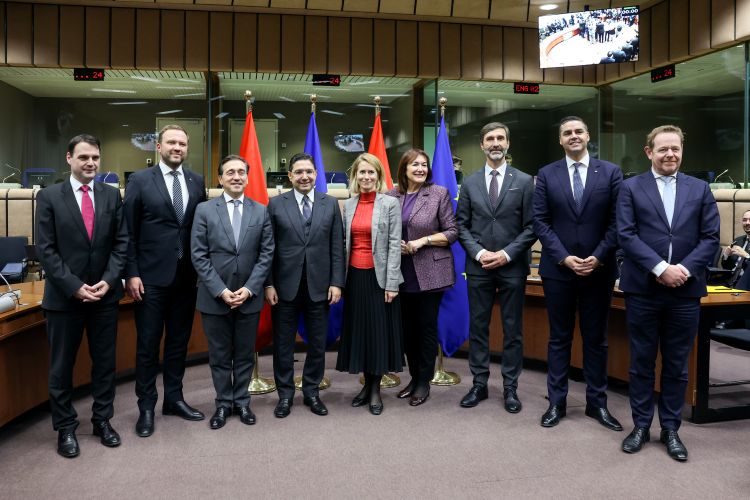
<h6><strong>Eduardo González</strong></h6> <h4><strong>The fifteenth meeting of the EU-Morocco Association Council, held this Thursday in Brussels, concluded with a Joint Declaration in which the European side expressed its support for the latest UN Security Council Resolution on Western Sahara and affirmed that genuine autonomy may be the most feasible solution to the dispute.</strong></h4> The meeting took place on the eve of the thirtieth anniversary of the signing of the Association Agreement between the European Union and Morocco and was attended by the EU High Representative for Foreign Affairs and Security Policy, Kaja Kallas; the Moroccan Foreign Minister, Nasser Bourita; the European Commissioner for the Mediterranean, Dubravka Šuica; and the foreign ministers of the EU Member States. The meeting was held at the end of the EU Foreign Affairs Council (FAC). Upon his arrival in Brussels, Spanish Foreign Minister José Manuel Albares told the press that Morocco is “a key country for the European Union, a partner and friend of Spain,” and that he will continue “working actively, as I have been doing, to ensure that the relationship between the European Union and Morocco remains at its current level, which is the highest level with our partners abroad.” In the Joint Declaration by Kaja Kallas and Nasser Bourita, in addition to “underlining the depth and vitality of the ties that bind our peoples” and reaffirming the willingness of both parties to strengthen the strategic partnership, the European side recalls “the EU’s commitment to resolving the Western Sahara dispute” and welcomes UN Security Council Resolution 2797 (2025), which “fully supports the efforts of the Secretary-General and his Personal Envoy to facilitate and conduct negotiations on the basis of the autonomy plan proposed by Morocco.” In this regard, the EU “welcomes” any “constructive suggestions” from the parties in response to this Moroccan proposal and urges them “to participate in discussions without preconditions and on the basis of the autonomy plan proposed by Morocco to reach a final and mutually acceptable political solution that guarantees the self-determination of the people of Western Sahara.” Despite this reference to self-determination, the text “considers that genuine autonomy may be the most feasible solution and encourages the parties to share their ideas in support of a final, mutually acceptable solution.” Furthermore, the EU “welcomes Morocco’s willingness to engage in good-faith dialogue with all parties involved to clarify the modalities of this autonomy plan and explain how autonomy would be implemented within the framework of Moroccan sovereignty.” During his press conference alongside Bourita, Kallas announced that Thursday's meeting was an "opportunity" to "formally present the EU's new position on Western Sahara," which "reflects the UN Security Council resolution of last October and underscores the EU's continued support for the UN-led process to find a sustainable solution to the Western Sahara issue." With this statement, the EU unequivocally endorses the surprising decision by Spanish Prime Minister Pedro Sánchez to support Morocco's autonomy plan for Western Sahara in March 2022 "as the most serious, credible, and realistic basis for resolving this dispute." This position, which marked a radical shift in Spanish foreign policy, was confirmed during the thirteenth High-Level Meeting (HLM) between Spain and Morocco, held in early December, which was attended only by PSOE ministers and boycotted by members of the Sumar coalition. At that meeting, Pedro Sánchez reiterated “Spain’s position on the Western Sahara issue” and expressed his “satisfaction” with the recent United Nations Security Council resolution that defends the proposed autonomy “under Moroccan sovereignty” as the “most feasible solution” to the conflict. A week later, Albares stated before the full Congress that the Government “firmly and unequivocally” supports the Security Council Resolution, which “fully confirms the Spanish position in accordance with international law and the United Nations.” As has become customary, the debate once again highlighted the stark differences between the PSOE and the other parties, including Sumar, regarding Western Sahara.