
Eduardo González
The 27 member states of the European Union agreed on Thursday to include Iran’s Revolutionary Guard on the EU’s list of terrorist organizations, putting it “on equal footing with Daesh, Hamas, Hezbollah, and Al-Qaeda,” according to EU High Representative for Foreign Affairs and Security Policy Kaja Kallas, speaking after the meeting of the EU Foreign Affairs Council (FAC).
“In Iran, the horrific crackdown on protesters has taken a heavy human toll,” Kallas said. “The EU already has broad sanctions in place, and today the ministers agreed to designate Iran’s Revolutionary Guard as a terrorist organization,” she announced. “This will put them on equal footing with Daesh, Hamas, Hezbollah, and Al-Qaeda,” because “those who act through terror must be treated as terrorists,” she added.
Before the start of the meeting, Foreign Minister José Manuel Albares confirmed that Spain would support “all sanctions against Iran,” including “those related to the inclusion of the Revolutionary Guard on the list of terrorist groups.”
On January 22, the European Parliament condemned the repression and mass killings perpetrated by the Iranian regime against protesters in Iran and called on the European Council to move forward, without delay, with the designation of the Islamic Revolutionary Guard Corps as a terrorist organization.
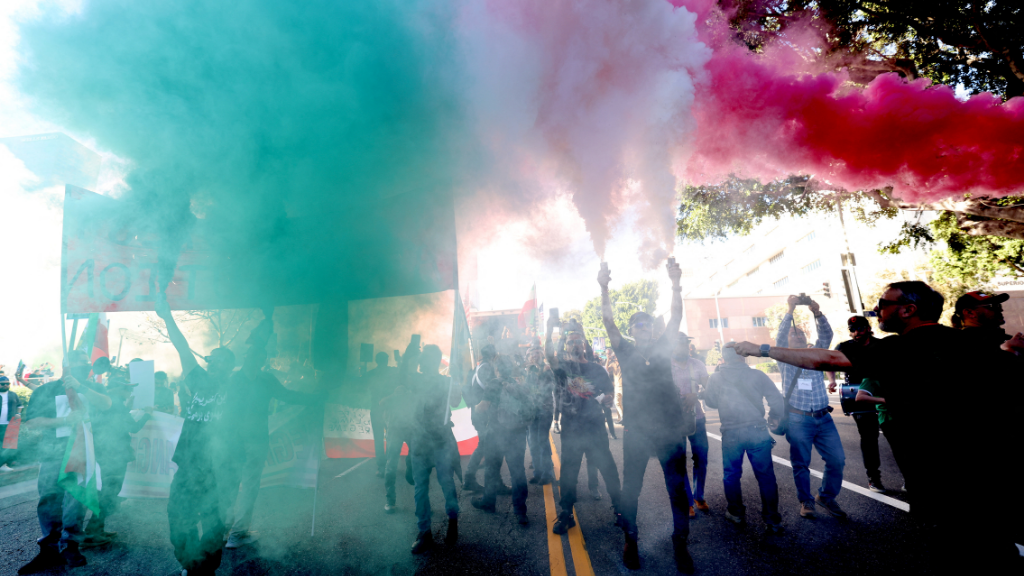
According to international organizations and various human rights reports, tens of thousands of people have died as a result of the repression by Iranian authorities since the outbreak of protests, which began in Tehran on December 28 to demand economic and social improvements and spread throughout the country to demand human rights, dignity, freedom, and the fall of the Islamic Republic regime.
New sanctions
Furthermore, Kallas continued in Brussels, “the ministers have also imposed sanctions on those responsible for the brutal repression of the protests, including the Minister of the Interior,” Eskandar Momeni. “The repression cannot go unanswered,” he warned. “It is the responsibility and obligation of the European Union to use all the instruments at our disposal to stop this repression,” Albares stated. “I have been clear from the outset that this is the way forward, because these are the instruments available to the European Union,” he concluded.
Specifically, the European Economic and Social Council (EEC) has imposed new restrictive measures on fifteen individuals and six entities responsible for serious human rights violations in Iran “following the violent repression of peaceful protests, including the use of violence, arbitrary detention, and intimidation tactics by security forces against demonstrators,” the Council reported in a press release.
The EU, in particular, will impose restrictive measures on Eskandar Momeni, Iran’s Interior Minister and head of the National Security Council, and several members of the Iranian judicial system, including Attorney General Mohammad Movahedi-Azad and Chief Justice Iman Afshari. The list also includes several commanders of the Revolutionary Guard and high-ranking officers of the police and security forces. “All of them participated in the violent repression of peaceful protests and the arbitrary detention of political activists and human rights defenders,” the Council stated.
Also included on the list are Iran’s Audiovisual Media Regulatory Authority (SATRA), the Seraj Cyberspace Organization, the Working Group on Criminal Content Case Determination (WGDICC), and several software companies. These entities, according to the EU, participated in censorship activities, social media trolling campaigns, the dissemination of disinformation and online misinformation, or contributed to the widespread disruption of internet access by developing surveillance and repression tools.
The restrictive measures related to human rights violations in Iran currently apply to a total of 247 individuals and 50 entities. These measures include asset freezes, travel bans to the EU, and prohibitions on making funds or economic resources available to those sanctioned. A ban also applies on exporting equipment to Iran that could be used for internal repression, including telecommunications monitoring equipment.
Iran’s military support for Russia
Furthermore, Kallas reported that the Economic and Social Council (ESC) has adopted “new sanctions against those involved in Iran’s military support for Russia” and has expanded “export controls.” The sanctions have focused particularly on the Iranian state program for the development and production of unmanned aerial vehicles (UAVs).
The list of newly sanctioned entities for supporting Russia includes Khojir Missile Development and Production, a leading entity in Iran’s ballistic missile program, and Sahara Thunder, an Iranian import-export company that acts as a front for the Iranian Ministry of Defense and Armed Forces Logistics. The Council has also sanctioned other private companies that supply critical components to the Islamic Revolutionary Guard Corps (IRGC) or that have ties to entities involved in Iran’s missile program.
Among those newly sanctioned for this reason are businesspeople, CEOs, and shareholders of private companies involved in the development and production of Iranian ballistic missiles and, therefore, involved in Iran’s missile or UAV program. Thursday’s decision brings the total number of individuals and entities sanctioned under this regime to 24. The sanctions regime was last extended until July 27, 2026.
Finally, the Council decided to extend the ban on the export, sale, transfer, or supply from the EU to Iran to include other components and technologies used in the development and production of UAVs and missiles. This applies to special materials and related equipment, including energetic materials and mixtures thereof, materials processing, electronics, computers, telecommunications and information security, sensors and lasers, navigation and avionics, aerospace and propulsion, as well as technologies specifically designed or adapted for the testing, development, or production of drones and missiles.