
Eduardo González
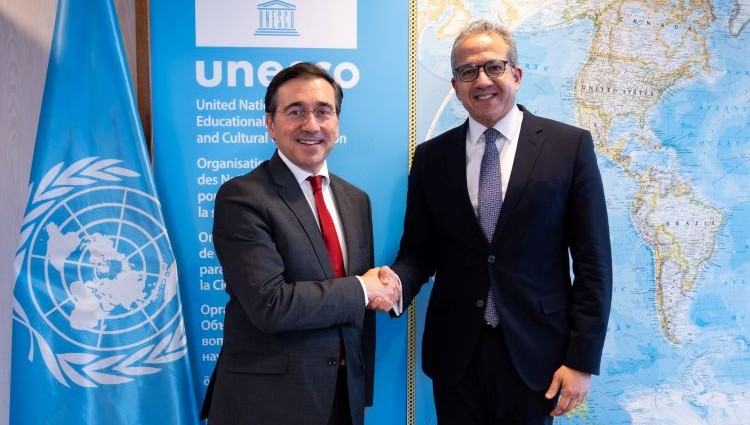
Foreign Minister José Manuel Albares met this Wednesday in Paris with UNESCO Director-General Khaled El-Enany to discuss the future opening of representations for Catalonia and the Basque Country within Spain’s Permanent Delegation to the organization in the French capital, an agreement reached with the governments of both autonomous communities.
On December 15, 2025, Prime Minister Pedro Sánchez announced the government’s intention to request, “in the coming days,” that Catalonia and the Basque Country become “associate members” of both UNESCO and UN Tourism, another United Nations agency, in this case headquartered in Madrid.
“While this process is underway, what we are going to do is initiate a request in both organizations for a slightly broader status so that these two territories can exercise their existing powers in cultural matters,” Sánchez added during his press conference at Moncloa Palace to present the “Delivering” report.
Furthermore, the Prime Minister linked these efforts to the “absolute commitment to fulfilling the agreements reached with Junts per Catalunya,” even while acknowledging that the relationship with this pro-independence party was “broken.”
This past Monday, January 26, Albares signed an agreement with the Catalan Minister of European Union and Foreign Action, Jaume Duch, for Catalonia to have its own representation at Spain’s permanent headquarters to UNESCO in Paris and at UN Tourism in Madrid.
In this context, the main Galician cultural institutions have publicly requested in a manifesto that Galicia, which, “like Catalonia and the Basque Country, is a community with the constitutional status of historical nationality,” be admitted as an associate member of UNESCO, but the president of the Xunta, Alfonso Rueda (PP), simply told the press that “it is not the highest priority.”
On another note, Albares and El-Enany signed an agreement recognizing the Three Cultures of the Mediterranean Foundation as an independent institution. The Three Cultures of the Mediterranean Foundation is a cultural diplomacy institution created in 1999 at the behest of the Andalusian Government and the Kingdom of Morocco, and its headquarters are located in Seville.
The signing took place during Albares’ first meeting with the organization’s director-general, the first of Arab origin in UNESCO’s history, whose election was supported by Spain.
Subsequently, Albares participated in a seminar organized by the magazine “Le Grand Continent”, in which he appealed to “the need to move towards European sovereignty through three key axes: economic, defensive and security sovereignty”, at a time when democracy and international law are threatened “both within and outside our borders: in Greenland, Venezuela, Ukraine and Gaza”.