
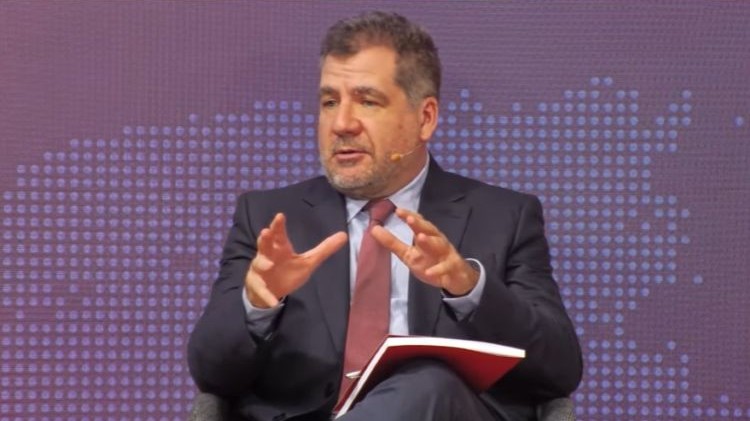
Eduardo González
The Elcano Royal Institute has called for Spain’s strong internal political polarization not to spread to European institutions because, in the current context of weakening pro-European sentiment in the EU due to the “greater influence of conservative and Eurosceptic governments,” it would be “bad for Spain and very bad for Europe.”
This is one of the conclusions of the report “Spain in the World in 2026” by the Elcano Royal Institute, presented this Wednesday, January 28, in Madrid. This is the fourteenth edition of the think tank’s flagship annual report, which analyzes the prospects for the international landscape and the challenges for Spanish foreign policy, and on which the Institute’s entire research team collaborated.
The report comes at a time “marked by the rivalry between the United States and China, the accelerated deterioration of the transatlantic relationship, and Russian aggression,” dynamics that “generate risks that limit Spain’s foreign policy,” and coincides with the 25th anniversary of the Elcano Royal Institute. Therefore, the study includes an assessment of Spain’s position in the world since 2001 and a forward-looking reflection on the country’s challenges and opportunities up to 2050.
Influence and image abroad
According to the report, Spanish foreign policy faces 2026 in “a demanding and volatile international environment, marked by transatlantic tensions and the possibility of a ceasefire in the war in Ukraine.”
“In this context, Spain will seek to reinforce its commitment to defense and promote a diplomacy with its own distinct identity, aimed at strengthening the role of the European Union as a relevant actor on a global scale—in the year that marks four decades since Spain’s accession to the EU—maintaining a pragmatic relationship with China, and reinforcing its focus on priority regions such as the Southern Neighborhood and Latin America, as well as dialogue with the Global South, multilateralism, and the defense of international law.”
This foreign policy, the document continues, will unfold in “a domestic environment of high political polarization and parliamentary weakness.” Despite this, “the main indicators suggest that Spain’s image abroad will remain stable, although weaknesses will persist in the business perception and in the area of innovation.”
Security
Furthermore, the evolution of Spain’s security and defense in 2026 will be conditioned by external factors, such as the war in Ukraine, transatlantic relations, and hybrid and conventional threats from Russia. “Given this scenario, Spain must strengthen its autonomous deterrence capabilities and its contribution to collective defense capabilities, while exploring new strategic partnerships with European and Asia-Pacific allies, with the aim of reducing its exposure to international uncertainty,” the report continues.
According to Ignacio Molina, senior researcher at the Elcano Royal Institute, one of the most relevant “structural elements” in current Spanish foreign policy “is the increase in defense spending and the demand from the United States and European allies for that increase.” “Spain has significantly increased its defense and security spending in recent years, but just when it reaches the goal, when it has achieved the feat of reaching 2%, which was not easy and was a commitment made eleven years ago, the target becomes 3.5% or 5%,” he explained during the presentation. In this context, Spain will be forced to “take a stand on the need to spend more on defense and security” and will have to decide what its contribution will be to “that coalition of volunteers in Ukraine, if a ceasefire is finally reached and there is a deployment of security guarantees to Ukraine.”
China and the US
The report also indicates that, in 2026, Spain’s and the EU’s relations with the US and China will be shaped by the US midterm elections, the evolution of the war in Ukraine, and a likely truce in the strategic confrontation between Washington and Beijing. “Although the US will remain a key player in security matters, the perception of reduced reliability will encourage Europeans and Asians to strengthen their own capabilities and diversify their alliances,” it continues.
For Spain, the scenario points to a consolidation of the bilateral relationship with Washington in the context of the 250th anniversary of US independence and the strengthening of ties with China, including a possible visit by President Xi Jinping. At the same time, the EU and Spain will seek to intensify their presence in the Indo-Pacific by forging closer ties with partners such as ASEAN, South Korea, India, and Japan.
At the same event, Carlota García Encina, lead researcher and one of the authors, stated that despite the lack of “political affinity” between Spain’s left-wing socialist government and the right-wing “Trumpist” government of the United States, the “exclusively bilateral relationship is quite solid,” especially in economic matters.
“The United States is the main investor in Spain. Spanish companies have been investing a great deal of money in the United States for many years, and we have seen this year, despite the lack of political affinity, numerous trips by officials, especially economic ones, to the United States,” she explained. “Therefore, there is a much more robust economic relationship than the exclusively bilateral perception suggests,” she asserted.
Furthermore, according to García Encina, the US détente with China “has also favored this exclusively bilateral relationship,” because “if at any point the Trump administration singled out Spain for perhaps getting closer to China, that ultimately came to nothing,” and, in fact, “trips and meetings between Xi Jinping and Donald Trump” have already been announced. Furthermore, the divergent positions between Spain and the US regarding Gaza and Venezuela do not “really affect this exclusively bilateral relationship.”
“Where I do see a problem is with the 5% issue, and not only because this is a concern of Trump, but because this is a concern of both Democrats and Republicans and of Congress in the United States; it’s not just Trump,” she stated. “The defense budget issue has been brewing for some time” and has even generated “some unease” against Spain among “other allies within NATO, and among Europeans themselves,” she warned.
Europe
The report also highlights that, after the 2025 European elections, the EU faces 2026 with “a weaker pro-European consensus and a greater weight of conservative and Eurosceptic governments, in a context marked by the deterioration of the transatlantic relationship and the continuation of the war in Ukraine.” In this scenario, the EU will focus its efforts on strengthening its security and defense capabilities, supporting Ukraine, negotiating the new Multiannual Financial Framework, and advancing regulatory simplification.
Likewise, geoeconomic tensions, the weakness of Franco-German leadership, Euroscepticism, and the eastward shift of the European axis will hinder progress in strategic autonomy and competitiveness, “but will also open opportunities for a more prominent role for Spain as it celebrates 40 years since joining the EU,” the study continues.
According to Ignacio Molina, the greatest danger for Spain is that it will be infected by the growing Euroscepticism prevailing in Europe. “Our highly polarized domestic politics has traditionally been counterbalanced by the fact that the two major parties are pro-European, and that the PSOE and PP have usually worked together in European institutions,” but “if this traditional counterbalance is also eroded in Brussels and Strasbourg, far from being a counterbalance, it will only further fuel our polarization,” which “would be bad for Spain, but it would also be very bad for Europe,” he warned.
Neighborhood
Furthermore, the study indicates that, by 2026, the eastern neighborhood will consolidate its position as “the main source of tension for European security, with the war in Ukraine, the confrontation with Russia, and instability in the Balkans.” In addition, conflicts in the Middle East, North Africa, and the eastern neighborhood will continue to shape the balance of power and European security, and “the conflicts in Gaza and Syria will maintain high levels of uncertainty.”
In Molina’s opinion, the position of Pedro Sánchez’s government regarding Gaza “has contributed more to Spain and its influence and prestige than it has taken away,” because it has granted Spain “a certain moral authority and a position vis-à-vis the Arab world and the Global South in general” through its advocacy in European institutions for “voices that are underrepresented.” “Having said that,” he cautioned, “we must also consider how to begin rebuilding the relationship with Israel,” because even “in a situation of an unjust ceasefire, with threats, it makes no sense for Spain to consider itself a hostile country toward Israel.”
Latin America
The report also states that increased activism from the White House and Latin America’s growing political alignment with Washington “will reduce the room for maneuver for Spain and the EU,” while China consolidates its economic role in the region. In this context, “Spain must strengthen its pragmatic and institutional diplomacy to avoid a secondary role.”
According to Carlos Malamud, lead researcher, “Spain’s relationship with Latin America in 2026 will be marked by two milestones”: the Ibero-American Summit in Madrid and the ratification of the EU-Mercosur Agreement. In the first case, the capital of Spain will host the XXX Summit in November “with the bad precedent of the XXIX summit held in Cuenca, Ecuador, which was an absolute failure”, hence “Spain has taken on the responsibility” of organizing this new edition “with the attempt to prevent the decline of Ibero-American politics and the Ibero-American system from continuing”.