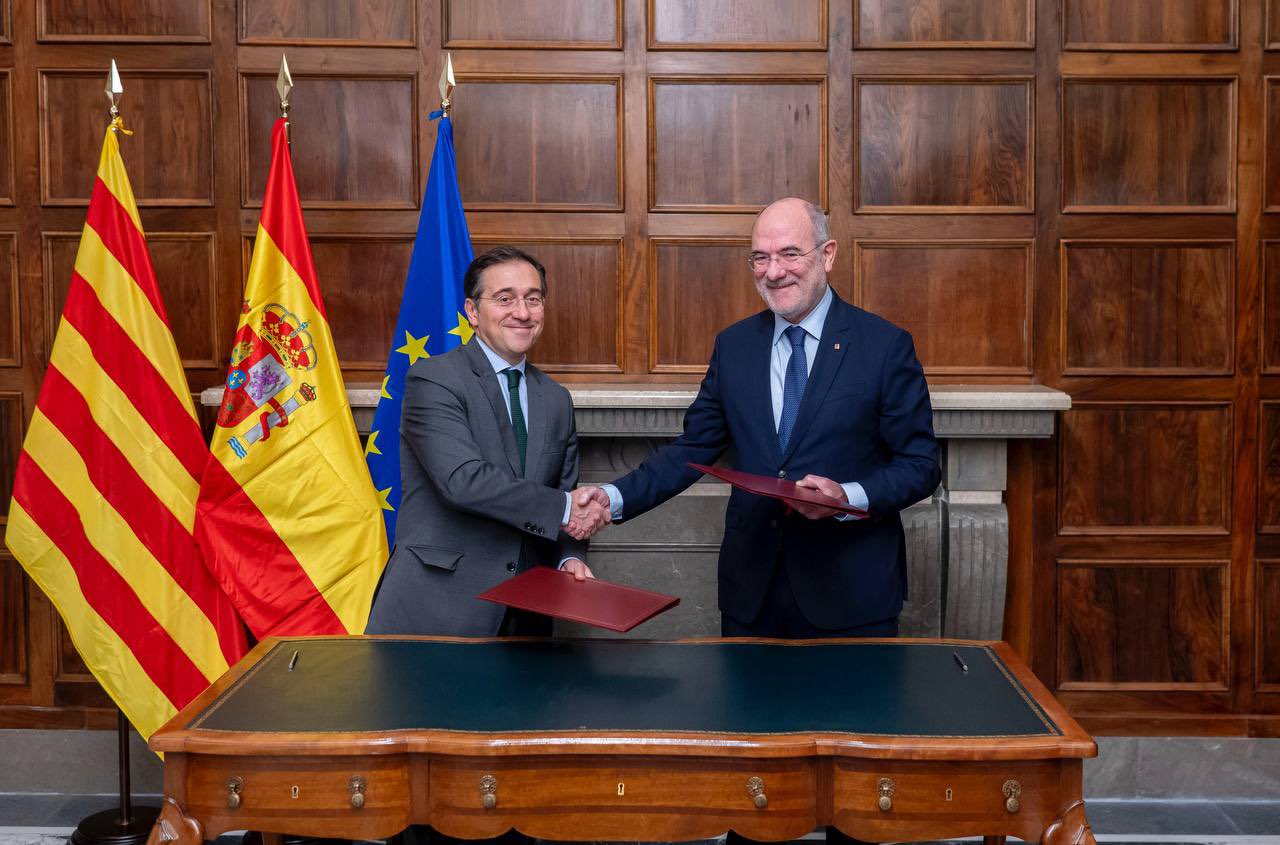
<h6><strong>Eduardo González</strong></h6> <h4><strong>The Minister of Foreign Affairs, José Manuel Albares, and the Catalan Minister of European Union and Foreign Action, Jaume Duch, have signed an agreement for Catalonia to have its own representation at UNESCO and UN Tourism, as reported by the Catalan Government and confirmed by Foreign Ministry sources to <em>The Diplomat</em>.</strong></h4> According to the agreement, signed this Monday, January 26, at the Ministry of Foreign Affairs headquarters on Marqués de Salamanca Street in Madrid, Catalonia will have its own representation at Spain's permanent headquarters at UNESCO and at the Spanish delegation to UN Tourism. "Catalonia will have representation at UNESCO and UN Tourism, two of the major United Nations agencies," the Catalan Government announced via social media. "This was formalized by Minister Jaume Duch and Minister José Manuel Albares with the signing of two protocols between the Government of Catalonia and the Spanish Government," it added. This is the third meeting between Albares and Jaume Duch, former spokesperson and director general of Communications for the European Parliament, since taking office as a minister in the Catalan government led by the socialist Salvador Illa. In their first meeting, held on September 6, 2024, they agreed to "strengthen Catalonia's presence in international forums and reinforce the Catalan language in Europe and the world." In their second meeting, which took place almost a year ago, also at the Marqués de Salamanca Palace, the minister informed the regional minister about the government's recent efforts to achieve official recognition of Catalan in European institutions. <h5><strong>Co-official languages</strong></h5> On Monday, Albares again addressed the government's aim to include Catalan, Galician, and Basque as official languages in the European Union starting in January 2027, despite the absence of this issue at the first General Affairs Council (GAC) meeting of the newly inaugurated Cypriot Presidency of the Council of the EU. In statements to Radio Euskadi on Monday, January 26, Albares asserted that, in the "long two years" he has been working on this matter, "no state has expressed opposition," but "unanimity is needed, and some states have requested more time for certain aspects." "We have worked bilaterally with some of them, who have moved from abstaining to actively supporting it," he added. However, he warned, “at this moment, there is only one reason why Basque is still not an official language in the European Union: the absurd, irresponsible, and reckless efforts of the People's Party (PP) with some of its European partners.” According to the minister, the PP has resorted to “outright lies” to “prevent these countries from taking the step for reasons of ‘petty politicking,’ to put it mildly, between political families in the European Parliament.” “I am addressing the People's Party very directly, urging them to abandon this absolutely obstructionist attitude, which is contrary to the Spanish Constitution,” he continued. “I want them to abandon this barrier and join us in helping,” he added. “In any case, with or without their help, the only thing they can do is delay it a little, because it is literally just a matter of time,” he asserted. <h5><strong>“Spain will never give up”</strong></h5> On this occasion, the first General Affairs Council of the Cypriot Presidency also postponed the matter. However, the Secretary of State for the EU, Fernando Sampedro, declared this Monday upon his arrival at the GAC meeting in Brussels, that “Spain will never give up” on this objective and that “the fact that it is not on the agenda, just as the Multiannual Financial Framework is not, for example, despite being this year's major issue, does not mean it is receiving less attention.” “It is a topic we continue to address, of course, with the Cypriot Presidency and our colleagues,” he continued. Regarding whether the Government has asked the Cypriot Presidency to include it in any of the upcoming GACs, as was done in previous semesters, Sampedro cautioned that this “is a procedural matter that arises when it needs to, but the Cypriot Presidency is very clearly informed that this is a Spanish priority and that we will continue working on it.”