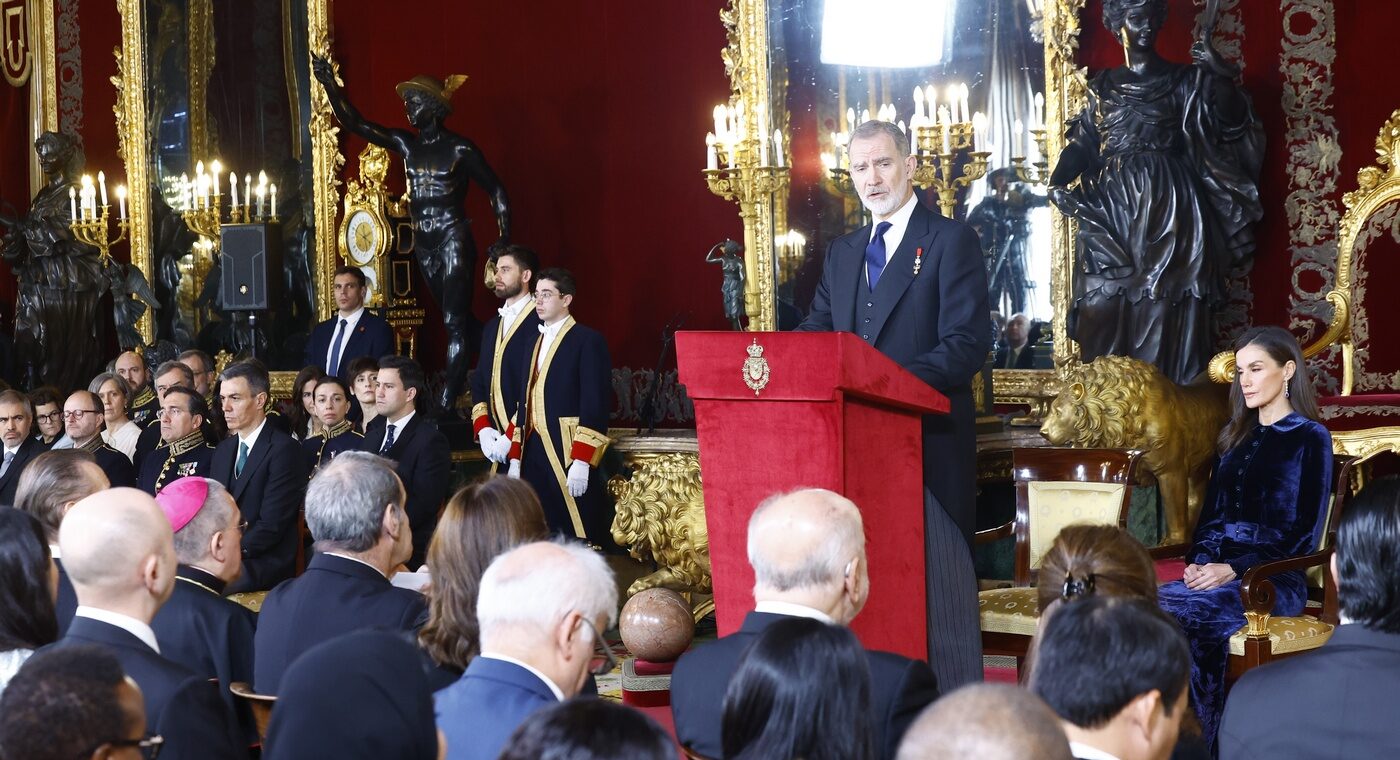
<h6><strong>The Diplomat</strong></h6> <h4><strong>King Felipe VI warned this Friday, January 23, of “the importance of preserving the transatlantic link, which remains essential for global security and stability” and whose “weakening would have direct consequences for the security of all.”</strong></h4> “The Queen and I welcome you to this traditional annual meeting, which this year is being held in a context not merely of transformation, but of a true mutation, of the international order,” the Monarch stated during the annual reception for the Diplomatic Corps accredited to Spain on the occasion of the new year, held at the Royal Palace in Madrid. “Today we are faced with a worrying expansion of confrontation, which is perfectly visible both in protracted conflicts that continue to erode the stability of the affected regions, and in other hotspots of tension whose evolution concerns us and which we are following with particular attention in the current international situation,” the King continued. “I think of Ukraine, the Middle East, the Sahel region, Greenland, and the Arctic region, which affects us all so deeply, but also of the Iranian people, the Venezuelan people, and all the political prisoners who still need to be released,” he added before the Diplomatic Corps, comprised of 126 embassies residing in our country and nearly 800 consulates, 153 career and more than 600 honorary. The response to this situation, he continued, “can only be to strengthen alliances, unity, and cooperation among those of us who share values and principles, among those of us who defend an international framework of norms, institutions, and rights, the fruit of the collective and continuous effort of an international community that must continue adapting it to preserve and improve it,” he warned. “In circumstances such as these, defending a system based on international law and the principles of the UN Charter is a moral and political imperative, and even more so now that we have just commemorated the Charter’s 80th anniversary, a stark reminder of the harsh lessons learned from the horrors of the 20th century,” he continued. “The Charter is not one option among others: it remains the best collective response to global challenges, aware that its effectiveness depends on our ability not only to defend it, but also to evolve it,” the King warned. “This conception of global responsibility is inseparable from our European vocation and our commitment to the common European project. Forty years after our accession, this link remains a central pillar of our foreign policy,” he affirmed. Therefore, he affirmed, “Spain wants to continue actively contributing to a stronger and more united Europe, capable of advancing its open strategic autonomy, strengthening its internal market, attracting investment and talent, increasing its competitiveness, and projecting itself onto the world stage through alliances that bring stability and shared prosperity.” “As a European, Ibero-American, and Atlantic country, Spain’s link with North America is natural and strategic and is firmly articulated in our foreign policy,” the King asserted. “The relationship with the United States has historically been built on the foundation of trust and dialogue,” and therefore, “the commemorations of the 250th anniversary of its independence in 2026 are a particularly relevant occasion to highlight Spain’s decisive contribution to the birth of the American nation and reaffirm the commitment to maintain, based on mutual respect, a constructive and future-oriented relationship,” he added. “Spain also defends the importance of preserving the transatlantic link, which remains essential for global security and stability and which demands, more than ever before, greater adaptability and a responsible approach to shared objectives,” he warned. “Spain maintains its firm commitment to this strategic alliance, fully aware that its weakening would have direct consequences for the security of all—our own and that of all our partners and allies,” he stated.