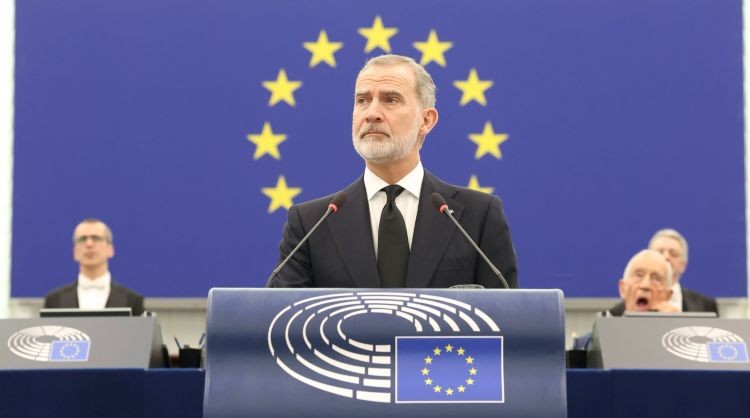
<h6><strong>Eduardo González</strong></h6> <h4><strong>The shadow of US President Donald Trump loomed over the speech delivered this Wednesday by King Felipe VI before the European Parliament on the occasion of the 40th anniversary of Spain's accession to the EU. In his address, he defended the need for a Europe based on “dialogue to resolve conflicts and promote peace, stability, and cooperation” in the face of “geopolitical approaches of another era” and warned of the need to maintain a transatlantic bond “based on respect and loyalty,” without which we would be “headed for a much more dangerous world.”</strong></h4> “I have the honor of appearing before you on the occasion of the fortieth anniversary of Spain’s accession to the European Communities, and I have the immense pleasure of doing so alongside my dear and admired President Marcelo Rebelo de Sousa of the Republic of Portugal, our sister nation,” the Monarch stated at the beginning of his address. “Allow me also to express my extraordinary and heartfelt gratitude, on behalf of all Spaniards, for the outpouring of support we are receiving these days from so many authorities, institutions, and ordinary citizens from so many places, especially from the countries of the Union, following the terrible train accident that occurred last Sunday night in the municipality of Adamuz, in the province of Córdoba,” he continued. “Amid the immense sorrow for so many who lost their lives, for those who were injured, and for their families, these expressions of support and solidarity comfort us and strengthen our European spirit and sentiment, which is our great shared heritage,” he added. In his address, the King emphasized that “membership in Europe has been a decisive factor in Spain’s transformation.” “If we are, today, one of the most solid and advanced democracies in the world, if our economy leads growth in the Eurozone, if our GDP per capita has doubled since joining, if we are at the forefront of telecommunications and generate more than half of our energy from renewable sources, it is thanks, in large part, to the modernization process we have experienced in and with Europe,” he continued. “This process of change has been reciprocal,” he affirmed. “Spain has also contributed to, and even led, European integration in many areas: I am thinking of citizenship, cohesion policy, the development of the social pillar, the area of freedom, security and justice, the recent use of joint debt mechanisms, the Southern Neighbourhood/Mediterranean relationship, and, together with Portugal, the emphasis on the strategic importance of Latin America and the Caribbean,” he added. For all these reasons, he warned, “the situation facing Europe demands the commitment of everyone.” “We cannot take Europe, the European Union, for granted,” he warned. “We Europeans tend to be very critical of the performance of European institutions, the Community institutions,” he reminded everyone. “It is also not uncommon these days to hear comments about the weakness of a united Europe, its outdated idealism, its disconnect from reality,” he continued. “The exercise of criticism is a sign that democracy is working, and it is positive insofar as it helps us progress, but some criticisms jeopardize our principles and values, those without which Europe would revert to a mere geographical concept, and there, in the forgetting of what European integration has meant, lies our greatest threat,” he warned. <h5><strong>“The idea of Europe has never been more necessary”</strong></h5> “Never before, as in these dark times, has the idea of Europe been more necessary, because the Europe we want, the one we fight for, represents the search for reason, and in that search we write our history,” declared King Felipe VI. “This is the Europe that, in turbulent times, remains an ethical and political benchmark: a space of freedoms and social justice, where education and healthcare are rights, where we work for equality, cohesion, and inclusion, where investment, innovation, and job creation are protected and promoted, where citizens can travel, settle, study, work, or trade, with no limits or borders other than those we set for our own life projects, where our languages, cultures, traditions, and so many aspects of our identity are better preserved today,” he stated. “Let us ask ourselves what other regions of the world have this notion of the common good so deeply rooted, so incorporated into their very being, and in the answer we will find the best vindication of a united Europe,” he added. “In foreign policy, this is the Europe that defends rules-based solutions and dialogue as a means to resolve conflicts and promote peace, stability, and cooperation, or the Europe that cannot accept, much less endorse, geopolitical approaches from another era as if they were signs of a new time,” he warned. “These times remind us, all too often, that force without principles is equivalent to barbarism and that mere principles, without actions to back them up, lead to frustration and disillusionment,” King Felipe VI continued. “So let us continue working on our defense, on our strategic autonomy, on strengthening the European pillar within the Atlantic Alliance,” because “it is an urgent necessity and, at the same time, it is the best way to preserve a transatlantic bond based on respect and loyalty that has given us all so much,” he affirmed. “Without that bond, we will be headed for a much more uncertain, much more unstable, and much more dangerous world,” he warned.