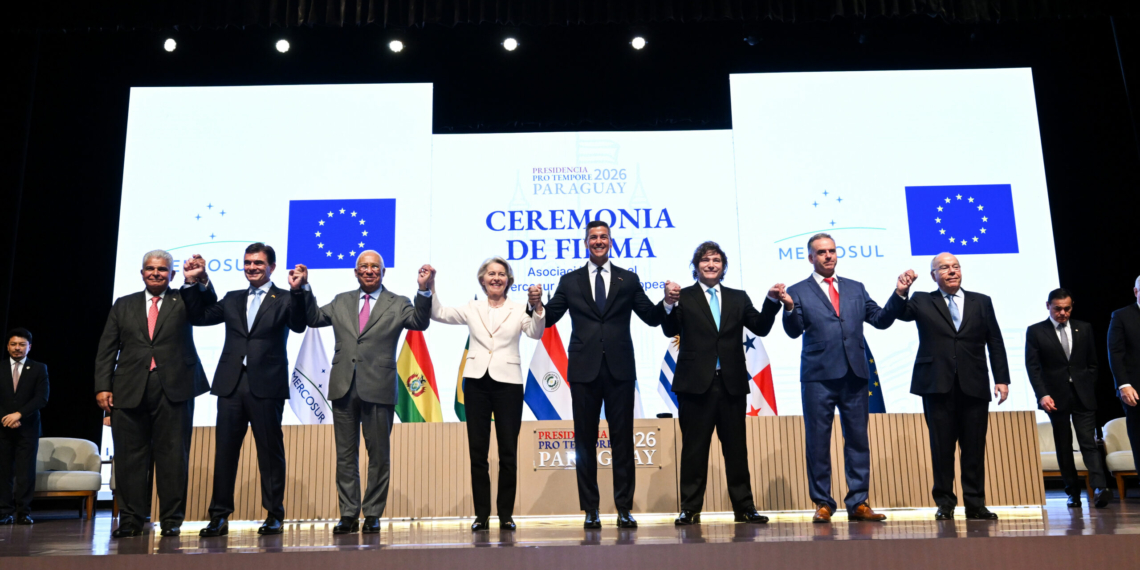
<h6><strong>Ane Barcos/Eduardo González</strong></h6> <h4><strong>The Minister of Economy, Trade and Business, Carlos Cuerpo, celebrated the signing of the trade agreement between the EU and Mercosur, which will help Europe remain “firm in its defense of the rules-based multilateral trading system.”</strong></h4> The signing ceremony for the EU-Mercosur Association Agreement (AMPU) and the EU-Mercosur Interim Trade Agreement took place this Saturday in Asunción, Paraguay, at the José Asunción Flores Grand Theater of the Central Bank, the same venue where the founding treaty of the South American bloc was signed. The signing was made possible after more than two decades of negotiations, and the leaders of both blocs agreed that this treaty not only represents a step towards economic integration, but also an affirmation of their commitment to fair trade and multilateral cooperation in an increasingly interconnected world. “The EU and Mercosur offer hope: Europe will stand firm in defending the rules-based multilateral and trade system,” Cuerpo wrote on social media. “Offering guarantees to protect our primary sector and opening opportunities for our producers,” he added. Last Monday, when it was announced that Paraguay would host the signing of the free trade agreement between the European Union and Mercosur this coming Saturday, after the bloc reached a consensus last Friday, Prime Minister Pedro Sánchez declared that, “while others build walls or become absorbed in their own economies, I believe that the European Union-Mercosur agreement opens a path to creating a free trade area that will undoubtedly be the largest in the world.” For his part, Foreign Minister José Manuel Albares described it as a “great historic step.” <h5><strong>The signing</strong></h5> The event was attended by representatives from both regions. Representing the European Union were the President of the European Commission, Ursula von der Leyen; the President of the European Council, António Costa; and EU Trade Commissioner Maroš Šefčovič. From Mercosur, the presidents of Paraguay, Santiago Peña; Argentina, Javier Milei; and Uruguay, Yamandú Orsi, attended, as well as the president of Bolivia, Rodrigo Paz, and the president of Panama, José Raúl Mulino, whose country recently joined the bloc as an associate member. Representing Brazil, President Luiz Inácio Lula da Silva was not present, although he received von der Leyen in Brasília on Friday. Instead, Brazilian Foreign Minister Mauro Vieira participated in the signing ceremony. European Commission President Ursula von der Leyen stated that this agreement “is not just about bringing countries closer together, but about connecting continents,” highlighting the hard work carried out by all the Mercosur countries to achieve this result. After more than 25 years of negotiations, during which, according to the president, “many hands have worked tirelessly,” the process has withstood changes in government and numerous meetings. Von der Leyen added that “it took one last effort, right up to the very last moment, to bring us together here today.” She emphasized that the agreement represents a new alliance between the two regions, noting that “we are creating the world’s largest free trade area,” a market encompassing almost 20% of global GDP. She stated that this treaty “sends a powerful signal to the world,” reflecting the decision to choose “fair trade over tariffs” and to foster a “productive, long-term partnership.” The president also stressed the geopolitical significance of the agreement, highlighting that “we are creating a platform to work on various global issues,” such as environmental protection and the reform of international institutions. In this regard, she affirmed that “when our two regions speak with one voice on global issues, the world will listen.” Von der Leyen emphasized that “Europe is Mercosur’s second most important trading partner and the largest foreign investor in the region,” and stressed that the agreement will eliminate trade barriers, open up public procurement, and create a “clear regulatory framework” that will favor trade and investment, benefiting both large companies and the “30,000 European SMEs that already export to this large region,” which will contribute to job creation in both blocs. The European president also highlighted the agreement's environmental commitment, mentioning that it includes a chapter on trade and sustainable development, which will allow both regions to support each other in their transition to climate neutrality. She indicated that “Europe will have better access to the raw materials” necessary for its ecological transition, while European investment will contribute to the transformation in the Mercosur countries. For his part, the President of the European Council, António Costa, noted that, although the agreement “is late,” it comes “at the most opportune moment.” He stressed that the objective is to create “spheres of shared prosperity” based on “trust, cooperation, and respect for the sovereignty of our democracies.” He asserted that the intention is not “to dominate or impose,” but to strengthen the links between citizens and businesses to generate wealth in a “sustainable” way, protecting both the environment and labor rights. He emphasized that the purpose of the agreement is to create “networks of trade, rules, and trust,” and not to generate dependencies. Costa reiterated that the agreement sends “a clear message to the world” in favor of “rules-based free trade,” multilateralism, and international law as fundamental pillars of relations between countries and regions. According to him, this agreement is “a firm commitment to openness, exchange, and cooperation,” in contrast to the trends of “isolationism, unilateralism, and the use of trade as a geopolitical weapon.” In contrast to others who “erect barriers, sever ties, and violate competition rules,” the European Union and Mercosur, he said, “build bridges, forge alliances, and agree on rules,” basing their confidence in fair trade as an engine of “prosperity, employment, and stability.” He asserted that the agreement will allow both blocs to face the “increasingly turbulent” geopolitical environment without abandoning their values. <h5><strong>Mercosur</strong></h5> Argentine President Javier Milei highlighted the signing of the free trade agreement with the European Union as “probably the greatest achievement obtained by Mercosur” and stressed the importance of preserving the spirit of the agreement during its implementation. In this regard, he warned that the introduction of restrictive mechanisms such as quotas or safeguards could limit its economic impact. Milei noted that the signing of the agreement does not represent an “end point,” but rather a “starting point,” and affirmed that this agreement confirms Argentina’s commitment to openness, competition, and international integration, with the goal of achieving a more prosperous Mercosur. Uruguayan President Yamandú Orsi emphasized that the agreement represents a “historic responsibility” and an opportunity to improve people’s lives and guarantee citizens’ freedom. He underlined that the agreement is significant not only because it is the world’s largest trade partnership, but also because it reaffirms “a clear decision” to commit to rules in a context of volatility and constant change. Orsi emphasized the importance of agreements, rules, and consensus, stating that this agreement constitutes a call to the world's democracies, demonstrating that agreements are the true means to improve people's lives. He also highlighted that the agreement reflects a commitment to "lasting consensus," "institutions," and the building of an "international order based on rules, predictability, and cooperation." For his part, Paraguayan President Santiago Peña emphasized that the signing of the agreement symbolizes that “dialogue, fraternity, and integration are the way forward,” leaving behind “the darkness of unilateralism.” As host of the event, Peña stressed that this achievement represents a historic milestone, noting that “the path of dialogue, cooperation, and fraternity is the only way.” He recalled that, after more than 25 years of negotiations, both blocs managed to “overcome enormous difficulties,” highlighting their ability to be “pragmatic, flexible, and transcend circumstantial differences and petty interests” to reach a balanced agreement. In a tense international context, Peña emphasized that the signing of the agreement sends a “clear signal in favor of international trade as a factor of cooperation and growth.” Representing Brazil, Foreign Minister Mauro Vieira emphasized that the agreement marks the beginning of a new stage of international cooperation that must develop in a “fair” and “balanced” manner for all parties. She highlighted Brazil's and Mercosur's commitment to the multilateral system, as well as the relevance of the agreement's chapters addressing environmental, social, and labor issues, particularly the section on trade and gender, which promotes public policies for the inclusion and empowerment of women. Vieira stated that the pact reflects a commitment to integration based on "respect for rights and social equity." <h5><strong>The Trade Agreement</strong></h5> The EU-Mercosur Association Agreement aims to generate new economic opportunities for both regions. The elimination of tariffs on exports to the EU will benefit sectors such as agri-food products, automobiles, machinery, and pharmaceuticals, allowing European companies to save approximately €4 billion annually. A 50% increase in EU agri-food exports to Mercosur is also expected. The agreement includes tariff reductions on key products such as wine, olive oil, and dairy products, as well as the protection of 344 EU geographical indications. Mechanisms will also be implemented to protect sensitive EU sectors, such as tariff-rate quotas, a binding safeguard mechanism, and stricter border controls. Once the agreement is signed, both blocs will proceed with their respective ratifications. In the EU, the Economic Partnership Agreement must be approved by all member states, while the International Partnership Agreement will be ratified only by the EU, requiring approval from the European Parliament and a decision by the Council before it can enter into force.