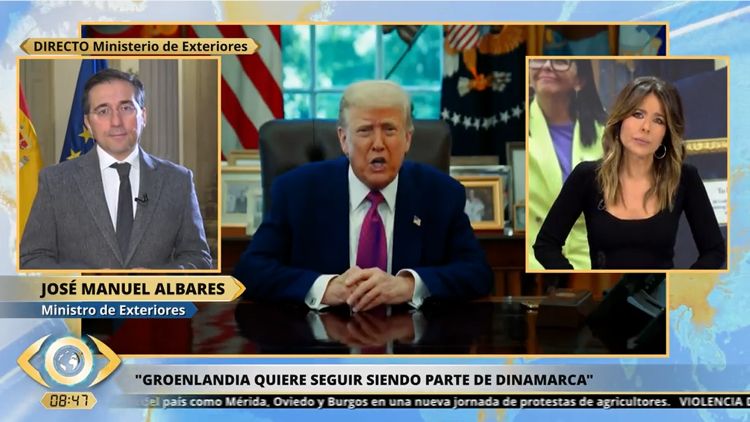
<h6><strong>Eduardo González</strong></h6> <h4><strong>Foreign Minister José Manuel Albares declined to clarify on Friday whether Spain intends to send troops to Greenland in response to US President Donald Trump's invasion threats, referring any decision to “European partners.”</strong></h4> “We are holding a series of meetings with our other European partners who are currently following and showing interest in the situation in Greenland as closely as we are,” Albares stated during an interview on the Telecinco program 'La mirada crítica'. “We are exchanging information and getting a sense of the situation, and once we have all the necessary information, we will make the decisions we need to make,” he added. “In any case, two things are clear,” he cautioned. “The Greenlandic people have already spoken through their democratically elected representatives, and Greenland wants to remain part of Denmark, wants to remain a member state of the European Union, and wants to remain a NATO ally, and that is what we support,” he stated. “Secondly, if any NATO ally believes that improvements can be made to Arctic security, which is also part of Euro-Atlantic security, then of course all the allies can discuss it and find ways to address any existing security gaps,” he added. According to Albares, there is currently no need for “another state to replace the one the Greenlanders want, which is the State of Denmark,” and therefore, “no change of sovereignty is necessary,” since NATO allies themselves have the capacity to meet “any security needs, even if it means increasing the number of troops.” “I believe that, among allies, any disagreements that may exist regarding the level of security or the risks that may exist in the Arctic can be resolved,” she insisted. Defense Minister Margarita Robles was also not very explicit this Thursday about the possibility of sending troops to the island, although she did imply that the possibility of Spain participating in a surveillance mission in Greenland is not ruled out, after several European countries, such as France, Germany, Sweden, and Norway, announced the deployment of military personnel to the Danish autonomous territory. “We are going to be prudent when making decisions and, above all, it is important to respect the existing frameworks, frameworks of great prudence and discretion, to see what solutions are adopted,” the minister told reporters in the halls of Congress. “We are in constant agreement with the other allies and we will see how things develop,” she added. “The countries that have sent personnel have not sent military missions; they have sent reconnaissance missions on the ground, which are not military missions,” Robles clarified to reporters. Regarding whether a possible US invasion of Greenland could mean the end of NATO, Robles warned that it would be “unacceptable and extremely serious.” “But I don’t believe we are in that situation,” she added. For his part, the PP's Deputy Secretary for Regional and Local Policy and Electoral Analysis, Elías Bendodo, expressed his hope this Friday that Prime Minister Pedro Sánchez will inform the party's national leader, Alberto Núñez Feijóo, about Spain's role in the Greenland monitoring mission. He clarified that defining this role "is the responsibility of the Government," and therefore Sánchez "will have the opportunity" to explain it to Feijóo at their meeting this coming Monday. France has decided to send troops to Greenland to participate in joint military exercises with Denmark, after Germany, Sweden, and Norway announced the deployment of officers to the island to address security in the region and prepare for Operation Arctic Endurance, whose objective, according to Danish Defense Minister Troels Lund Poulsen, is “to establish a permanent military presence” on the island. “At Denmark’s invitation, Germany will participate with other European nations, between January 15 and 17, in a reconnaissance exercise in Greenland,” the German government reported. These announcements come after a meeting at the White House between US Vice President JD Vance and Secretary of State Marco Rubio with Danish Foreign Minister Lars Løkke Rasmussen and his Greenlandic counterpart, Vivian Motzfeldt, which concluded with confirmation that US President Donald Trump is prepared to seize the island “for security reasons.” Denmark has warned that it will not accept any violation of Greenland’s territorial integrity or its people’s right to self-determination. “The US ambition to seize Greenland remains undiminished,” declared Danish Prime Minister Mette Frederiksen after the meeting in Washington.