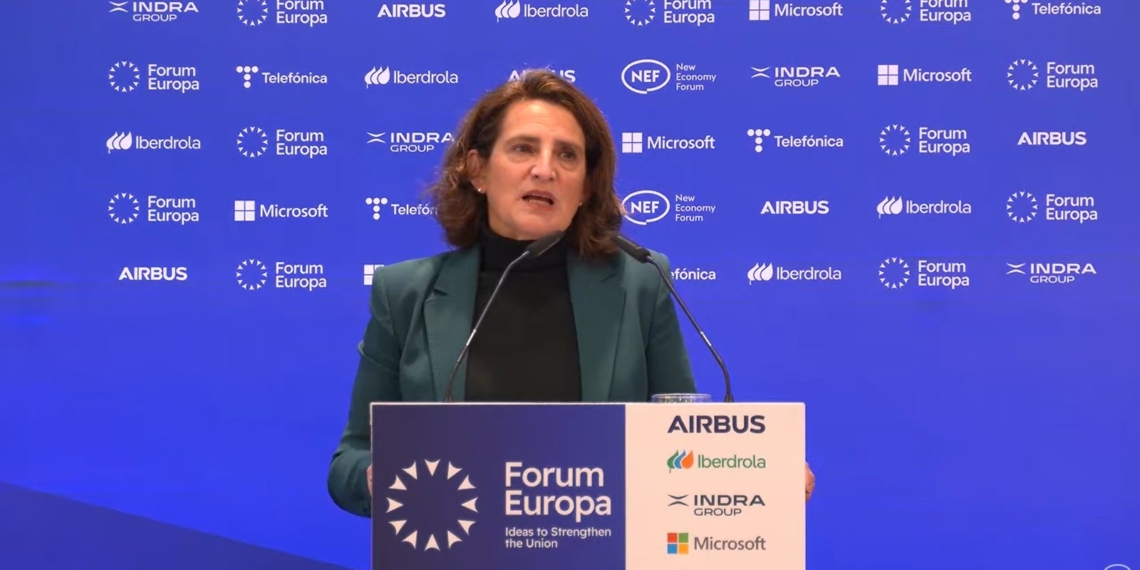
<h6><b>Ane Barcos</b></h6> <h4><strong>The European Commission's Executive Vice-President, Teresa Ribera, urged the European Union on Tuesday in Brussels to forge an alliance with countries that still support a rules-based international order to confront the challenges posed by global actors like the United States, especially in a scenario where Washington seeks to redefine geopolitical balances. “Building alliances with those who still believe that the international order should be based on rules is an important aspect for the remaining months of 2026 and beyond,” she stated during a breakfast organized by New Economy Forum.</strong></h4> Regarding the situation in Venezuela, Ribera argued that any action must comply with international law. “The rule of law, international law, multilateralism, the global order were key assets for anyone, anywhere in the world,” she said. She warned that “forgetting them would not lead us to a better future, quite the opposite,” and advocated for a return to “the handbook of international law.” The Executive Vice-President placed the European priority on upholding three fundamental pillars that, she said, define the European project: the rule of law, the social model, and an open economy. She maintained that 2025 has been a year in which “even the essential principles, the legacy of our parents and grandparents, have been challenged” and that the Union has faced “internal and external threats.” In this context, she asserted that Europe is “an open social market economy” that must “choose the battles to fight and the principles to defend.” “The most challenging aspect has been being serious about enforcing and defending the rule of law, both internally and internationally,” she acknowledged when assessing her first year as part of the European Commission. She linked this obligation to trade, innovation, and the European Union’s external role, which she identified as areas where Europe “can act, build, and continue to do” through the combined work of institutions, governments, and international partners. Regarding the European social model, Ribera pointed out that, compared to the United States, excluding the digital and financial sectors, “we are much more productive than the Americans in basic manufacturing” and attributed this to a regulatory framework that favors efficiency, training, and the green transition. She noted that “85% of Europeans' income comes from their wages, compared to 75% of American citizens” and that European life expectancy is “between 80 and 83 years.” She concluded that this structure translates into quality of life and social cohesion that Europe should preserve. The Spanish politician positioned competition policy as a tool to sustain European strategic autonomy and prevent distortions in a market she described as open, but regulated. She characterized it as “a technical application of the rule of law to prevent abuses by powerful companies” and emphasized that the Commission has the responsibility to ensure “a level playing field based on facts and due process.” She added that this function requires constant updating to integrate the digital and green dimensions and to ensure that external actors comply with the same rules, “including the use of public funding without creating distortions.” Ribera acknowledged the pressure from global actors, “including close partners” like the United States, who are questioning European regulations such as the Digital Markets Regulation. She insisted that the EU must act in a united manner, between institutions and companies, to uphold its regulatory framework. “We are open for business, but this shouldn't be the Wild West,” she warned. Regarding the implementation of the Digital Markets Regulation, she recalled that 2025 was the first year in which the large operators designated as gatekeepers were required to fully comply with their obligations. She noted that the Commission has acted to demonstrate that it is “here to guarantee the application of the law.” She admitted that companies can appeal decisions “in court,” but maintained that the institution has “the right and the constitutional obligation” to preserve a functioning market. She added that digital regulation impacts democracy, access to information, and the provision of public services, making it essential “to ensure that the gatekeepers defined by regulations adopted after years of participatory work are effectively monitored.” The Vice-President emphasized that the ability to act with partners to safeguard a rules-based multilateral order “within and outside Europe” will be crucial for sustaining European prosperity in the coming years.