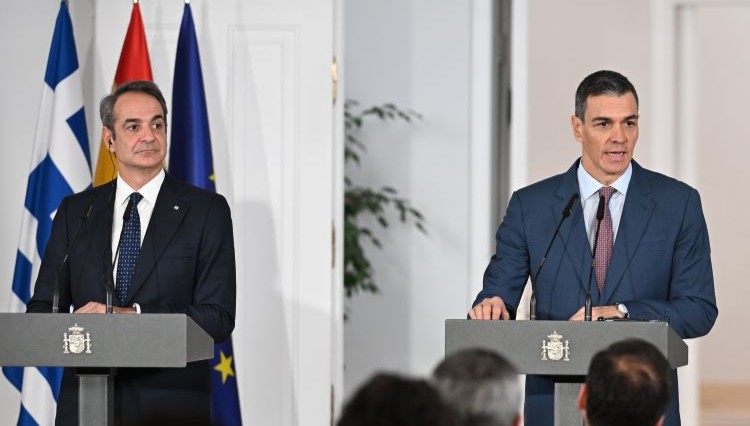
<h6><strong>Eduardo González</strong></h6> <h4><strong>Spanish Prime Minister Pedro Sánchez met with Greek Prime Minister Kyriakos Mitsotakis on Monday, January 12, and they agreed on the need for “a more ambitious European budget” reaching two percent of the EU's Gross Domestic Product (GDP).</strong></h4> “A few years ago, in a different context, that of the euro crisis, many referred to Spain and Greece as the sick men of Europe, and today our countries are a benchmark and a driving force for progress and economic dynamism within the European Union and the eurozone,” Sánchez declared at the joint press conference with Mitsotakis, held at the Moncloa Complex. “This is the strength of the south, of the Mediterranean, and there is no doubt that Spain and Greece share values and interests, and we also share positive economic data,” he added. “After a decade marked by the financial crisis, today Spain leads growth among the major OECD economies, and Greece has gone from suffering the euro crisis to holding the presidency of the Eurogroup, with Spain’s support,” he added. For his part, Kyriakos Mitsotakis agreed with Sánchez that “Greece and Spain are two southern European countries” that, “in recent years, have been growing and recovering dynamically after a long period of crisis” and that share “the same belief that growth must be socially just and translate into tangible benefits for citizens.” “At the beginning of the economic crisis, southern countries were portrayed as the great ‘sick man’ of Europe, needing the support of northern countries to face our major economic problems,” but “that era is long gone,” he continued. “Today, southern European countries, both Spain and Greece, are leading Europe in terms of growth rates, but they are doing so in a fiscally responsible manner, reducing debt as a percentage of GDP and borrowing at lower interest rates than other countries that could have had a much stronger fiscal position in the past,” he asserted. <h5><strong>MFF</strong></h5> In this context, the two leaders agreed on the need for “an ambitious European budget” that would allow for the development of European public goods and the management of common challenges such as migration and climate change. “It is very important to know that both Greece and Spain have defended the need to develop European public goods, such as security, but also innovation, decarbonization, social cohesion, territorial cohesion, and that we maintain what is called strategic autonomy in such fundamental policies as the Common Agricultural Policy,” Sánchez declared. “That is why Spain has always been firmly committed to that two percent allocation in the Multiannual Financial Framework from 2028 to 2034,” he added. In this regard, Kyriakos Mitsotakis affirmed that his country also shares with Spain “this desire for a more ambitious European budget that will allow us to address, at a European level, the major and varied crises we are facing.” “I want to reiterate that Greece was at the forefront, presenting a proposal for a single European financial instrument that can invest in the common procurement of defense, but also in the development of the European defense industry, so that we can put into practice the much-discussed strategic autonomy,” the Greek Prime Minister recalled. “I believe this is a debate that is still ongoing in Europe,” he stated. In the current international context, he warned, “Europe should not be geopolitically naive,” and, in this context, “countries like Spain and Greece can play an important role in shaping this European debate, which is more relevant today than ever before,” he added. The European Union's Multiannual Financial Framework (MFF) for the period 2028-2034 proposes a budget equivalent to 1.26 percent of EU GDP to address growing challenges in areas such as security, the green transition, and competitiveness. However, Spain has proposed doubling the EU budget to two percent of annual GDP to increase joint investments in the green and digital transitions, competitiveness, and defense, both to deter Russia and to meet the demands of the United States. Adoption of the MFF requires unanimity among the 27 member states and approval by the European Parliament. The aim of the discussions is to reach an agreement before the end of 2027.