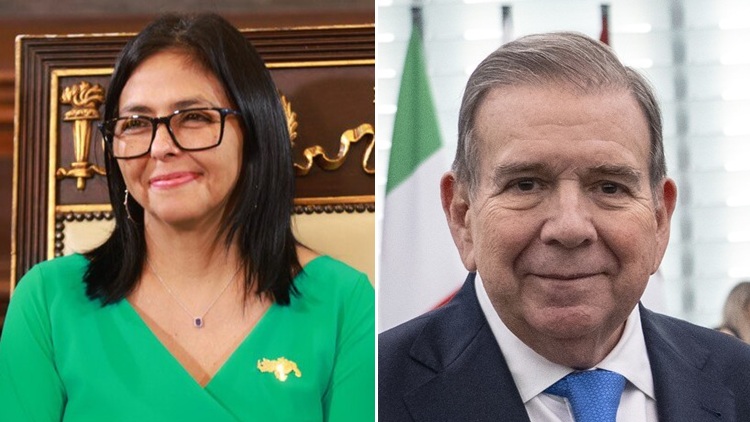
<h6><strong>Eduardo González</strong></h6> <h4><strong>The Spanish government deployed its highest level of diplomatic action this Friday, January 9, to address the situation in Venezuela. On the one hand, Prime Minister Pedro Sánchez spoke with the interim president, Delcy Rodríguez, and with the opposition leader and self-proclaimed “president-elect,” Edmundo González Urrutia, to express his desire to “support the country in this new stage.” On the other hand, Foreign Minister José Manuel Albares held a telephone conversation this Friday with the United States Secretary of State, Marco Rubio, with whom he also discussed the situation in Venezuela.</strong></h4> “Spain supports a peaceful, negotiated, and democratic transition in Venezuela, led by the Venezuelan people themselves,” Sánchez wrote on social media. “We want to support the country in this new stage and help bridge the gap,” he continued. “I have conveyed this to Delcy Rodríguez and Edmundo González,” he announced. “Latin America knows it has Spain’s support, as I reiterated this week to the presidents of Brazil, Chile, Colombia, Guatemala, Mexico, and Uruguay,” he concluded. “I want to inform you that I had a telephone conversation—it lasted 17 minutes—with the President of the Government of Spain, Pedro Sánchez, about the situation in Venezuela,” Edmundo González wrote on social media. “I told him that the release of Venezuelan political prisoners cannot be selective and must be verified; without a doubt, full and unconditional freedom,” he explained. “The international community—and Spain in particular—knows well the difference between tactical gestures and real commitments to democracy and the rule of law,” he warned. “Venezuela needs a real transition, and for that, there must be freedom for all political prisoners, an end to the persecution, disarmament of paramilitary groups, and respect for the popular will expressed on July 28,” he added. According to the Venezuelan government, as reported by the Venezuelan News Agency (AVN), the conversation between Sánchez and Delcy Rodríguez served to “acknowledge the Spanish government’s condemnation of the violent acts” and to address an agenda for strengthening “trade and political relations for the benefit of both populations under a framework of joint work.” In addition to Sánchez, the interim president also spoke with the presidents of Colombia and Brazil, Gustavo Petri and Luiz Inácio Lula da Silva, and before the three leaders, she “reaffirmed that the nation will maintain its defense through diplomatic channels and the Bolivarian Diplomacy of Peace” and that “the government’s strategy prioritizes the institutional path to preserve territorial integrity and political stability in the current regional context,” according to the state news agency. <h5><strong>Albares and Marco Rubio</strong></h5> “I spoke with Secretary Marco Rubio about the situation in Venezuela,” Albares wrote on social media. “Spain is committed to the Venezuelan people in this new phase,” he continued. “We also discussed Ukraine and Gaza,” he added. For his part, U.S. State Department spokesman Tommy Pigott reported that Marco Rubio and José Manuel Albares discussed “U.S. counternarcotics operations in the Caribbean and the need to ensure a proper and sensible transition of power in Venezuela.” <h5><strong>The Spanish Government's Position</strong></h5> Since the assault by US military forces on Venezuela, which took place last Saturday, January 3, on the orders of President Donald Trump and which concluded with the overthrow and kidnapping of President Nicolás Maduro, the Spanish Government has insisted on defending “the validity of an international order based on rules” and on warning that the US intervention represents “a very worrying precedent for peace in the region and the world.” The Prime Minister, Pedro Sánchez, warned on the same day as the assault that, just as “Spain did not recognize the Maduro regime” after the presidential elections of July 2024, it will also “not recognize an intervention that violates international law and pushes the region toward a horizon of uncertainty and belligerence.” The Prime Minister himself insisted this Thursday, before the Conference of Ambassadors, that “Spain will continue to do everything necessary in defense of the Venezuelan people, their sovereignty, and their right to choose a democratic future without external interference.” “Let no one doubt it: we are going to actively support the transition to democracy in Venezuela, drawing on the strength of our country's historical experience, so that Venezuela's future is decided by Venezuelans, not by a foreign country, not by interests alien to those of Venezuelans,” he stated. For his part, Albares declared this past Monday that the armed assault against Venezuela was “an action clearly contrary to international law” and warned that “the use of violent means and force must be completely excluded” from foreign policy, because “it sets a very dangerous precedent for the future.” “Government changes through the use of force do not bring stability, but rather tend to lead to chaos,” he added. <h5><strong>USA</strong></h5> On the same day as the military assault, Donald Trump announced that the United States would remain in Venezuela as long as necessary to “guide the country toward a safe and proper transition.” “We’ve arrived, but we’re going to stay until the proper transition takes place. So we’re going to stay, we’re going to take charge so that the transition is possible,” he declared at a press conference, surrounded by Marco Rubio and Secretary of State Pete Hegseth. When asked about the possibility of opposition leader María Corina Machado becoming president of Venezuela, Trump responded that “it would be very difficult” because “she doesn’t have the support or the respect within the country.” For the time being, Maduro has been replaced by the former vice president and current acting president, Delcy Rodríguez. This past Wednesday, Marco Rubio announced to reporters a “second phase” of “recovery to begin creating a process of national reconciliation within Venezuela and so that opposition forces can be granted amnesty and released from prison or brought back to the country.” Delcy Rodríguez herself announced this Friday, just one week after the US military invasion, that Venezuela and the US have begun preliminary talks to evaluate the reopening of their embassies "within the framework of Bolivarian Peace Diplomacy".