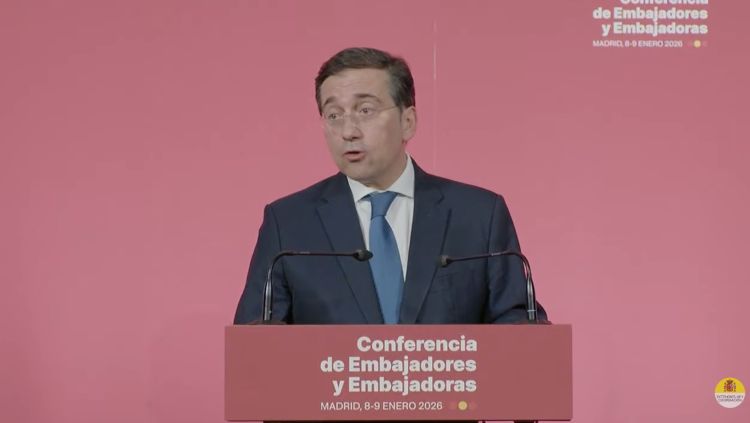
<h6><strong>Eduardo González</strong></h6> <h4><strong>Foreign Minister José Manuel Albares declared this Thursday, January 8, that Europe “must be aware of its strength and decide to take its place among the world’s great powers.” He warned that the EU-Mercosur agreement “must be finalized now” and that, after 25 years of negotiations, “there are no more excuses for delaying it.”</strong></h4> “The rules of the international order are being openly challenged, and the values of peace, dialogue, and security are at risk,” Albares stated during his address to the 10th Conference of Spanish Ambassadors, held at the Ministry of Foreign Affairs headquarters in the Plaza del Marqués de Salamanca in Madrid. “The aim is to dismantle the current world order with no other proposal than a return to the law of the jungle,” he denounced. “We see it in Ukraine, we see it in Gaza, we see it in Venezuela, and we see it with the tensions surrounding Greenland,” he continued. “We cannot resign ourselves. No democrat can resign themselves. We cannot resign ourselves to an order of injustice, arbitrariness, and violence,” he warned. “In Europe, we have witnessed centuries of conflict between neighboring countries that have only left behind the greatest pain and destruction humanity has ever experienced, but upon the ruins of that pain, we built what is today the greatest space of freedom, progress, peace, and social justice that history has ever known,” Albares emphasized. “Those who use violence and coercion as instruments of foreign policy subvert the norms and values with which we have created democracy, multilateralism, international law, and the European Union itself,” and, therefore, “the task of Spanish foreign policy and diplomacy, first and foremost, is to defend and promote these values and these rules,” the minister affirmed. “Contrary to what those who want to weaken and divide our Union maintain, commitment to Europe does not go against national identity or the interests of our country: on the contrary, it strengthens them,” Albares asserted. “A prosperous and strong Europe is absolutely necessary for a prosperous and strong Spain,” he added. Therefore, he warned, “Europe must be aware of its strength and decide to take its place among the great powers of the planet.” “It is time to make Europe a power that acts, not just talks. In this world of aggressors, it is not enough to talk about autonomy; we must move towards genuine European sovereignty—political, commercial, economic, defensive, and in foreign policy,” he stated. “In a world of great powers, weakening Europe is weakening Spain. Dividing Europe is weakening Spain because our values are in Europe, but so are the material and political resources we need. The best guarantee of Spain’s sovereignty is to build European sovereignty effectively and quickly,” he insisted. According to Albares, this “sovereign Europe also needs to develop an ambitious trade policy within a strong and competitive European economy.” Therefore, he warned, it is necessary to move towards “an ambitious financial framework for the period 2028-2034 that contributes to boosting the triple green, digital, and social transition.” <h5><strong>Mercosur</strong></h5> Furthermore, he continued, it is necessary “to promote the Union’s international alliances with other regions,” including Latin America. “The agreement with Mercosur must be concluded now. We have been delaying this negotiation for 25 years; there are no more excuses to postpone it,” Albares warned. The agreement, according to the minister, “will serve to diversify our trade relations” and will help to create “the most important and extensive free trade area in the world, with 700 million people, and would represent annual savings of more than 4 billion euros in tariffs.” “It is an essential step for Europe, for Latin America, and therefore an essential step for Spain, because it is not only a trade agreement, it is also the political commitment of partnership that we offer to that region of the world,” he added. European Union ambassadors are expected to approve the trade pact between the European bloc and the Mercosur countries this Friday, January 9, paving the way for the official signing of the agreement, scheduled for next Monday, January 12, in Paraguay. For now, Italy is expected to withdraw its objections after the European Commission proposed a €45 billion modernization fund for the most sensitive sectors of European agriculture, such as beef, sugar, rice, and citrus fruits, to help them adapt to the new competition. However, opposition to the agreement persists in countries like France and Poland. In recent hours, massive protests by farmers have been registered in several European countries, calling for the rejection of the agreement due to fears that cheaper, lower-quality Mercosur products will affect the competitiveness of the European agricultural sector.