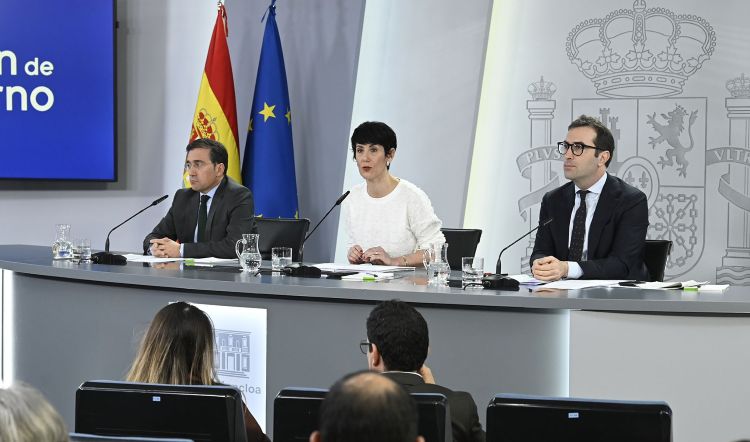
<h6><strong>Eduardo González</strong></h6> <h4><strong>Foreign Minister José Manuel Albares and Economy Minister Carlos Cuerpo assured on Wednesday, January 7, that Spanish companies operating in Venezuela “are calm” and have not reported “any significant impact” since the military attack carried out last Saturday by the United States in Caracas to overthrow and capture President Nicolás Maduro.</strong></h4> “Throughout the weekend, I was in contact with the main Spanish companies operating in Venezuela, and from what they told me, as well as from my own observations and contacts with our ambassador in Caracas, they are calm. I share this assessment, and there is no indication of any concern on their part,” Albares stated at the press conference following the first Council of Ministers meeting of 2026. “In any case, the Spanish companies—and I conveyed this to their presidents when I spoke with them—know perfectly well that they have the support of the Spanish Government in the event of any eventuality,” he added. For his part, Cuerpo assured that, “of course,” his department is “in continuous contact with the companies operating in Venezuela.” “There are about 60 Spanish companies with a presence there, beyond the large corporations such as Telefónica, Repsol, BBVA, Mapfre, and Inditex, and so far, they have not identified any significant impact,” he added. “In any case, of course we will continue to closely monitor the situation alongside them and support them at all times,” he concluded. <h5><strong>The EU and mediation in Venezuela</strong></h5> At the same press conference, Albares insisted on the need for Europe to reaffirm the principles that constitute “the very foundation of the European project” and warned, in that regard, that reaffirming these principles is “also reaffirming the sovereignty of all states, including Venezuela, reaffirming that a country’s natural resources are also part of that country’s sovereignty, and reaffirming that international law prevails in and against all countries of the world.” Last Sunday, the day after the attack on Venezuela ordered by President Donald Trump, Albares acknowledged that he would have liked “a stronger statement from the European Union” on this matter. Regarding mediation in Venezuela, the minister insisted that Spain speaks “with both the government and the opposition.” “In fact, very significant leaders of the Venezuelan opposition, such as Edmundo González and Leopoldo López, reside here in Spain, and we will continue to do so,” he affirmed. “What Spain has offered are its good offices, given that we are an actor that engages with both the government and the opposition if the parties deem it useful,” he continued. “This government will always, but especially when it comes to our sister nations of Latin America, strive to bridge differences and build bridges, never to fan the flames, because, as we have said on many occasions, we want for our sister nation of Venezuela exactly the same as we want for the Spanish people: we want democracy, we want peace, and we want progress and social justice,” he declared. “Of course, we are already in contact with the new authorities and the new government,” he assured. The Prime Minister, Pedro Sánchez, “has made it clear that he will maintain this dialogue, and it will be the Prime Minister who announces when the various steps and actions will take place. However, there is already ongoing communication at the Embassy level with the authorities in Caracas, with the authorities of the new Venezuelan government,” he continued. “Last Saturday, at my own request, I called Edmundo González to discuss the potential developments and the situation of both the Spanish community in Venezuela and Venezuelans in Spain,” he added. “We speak with both the Venezuelan government and the opposition, and we will continue to do so,” he insisted. <h5><strong>Zapatero</strong></h5> Albares also took the opportunity to defend the mediation efforts of former Socialist Prime Minister José Luis Rodríguez Zapatero in Venezuela, which have been repeatedly criticized by the People's Party. "Obviously, he is not acting on behalf of the Spanish Government nor with a mandate from the Spanish Government, but he is carrying out work that the Spanish Government certainly recognizes and values," he stated. "I want to remind everyone that former Prime Minister Rodríguez Zapatero's actions began in 2015 at the request of the Venezuelan opposition—and the archives are there for anyone who wants to check—and that "it was, moreover, a different government in Spain at that time," he pointed out. This mediation, he asserted, "has been recognized on numerous occasions by the Venezuelan opposition and even, at other times, by the People's Party itself." "Check the archives: there are the statements from then-President Mariano Rajoy thanking former Prime Minister Zapatero for all his work in securing the release of Leopoldo López," he added. “Those were different times, when the People’s Party probably didn’t try to use the Venezuelan people as a crude tool for attrition in national politics,” he lamented. Albares also recalled that Zapatero, “as Prime Minister, defended the dignity of the Spanish State and of another former president (José María Aznar) precisely against the President of Venezuela, Hugo Chávez, whom he asked to respect that former president.” “I ask all political forces to respect this former president,” because “when we talk about a former president, the dignity of the Spanish State is also at stake,” he added.