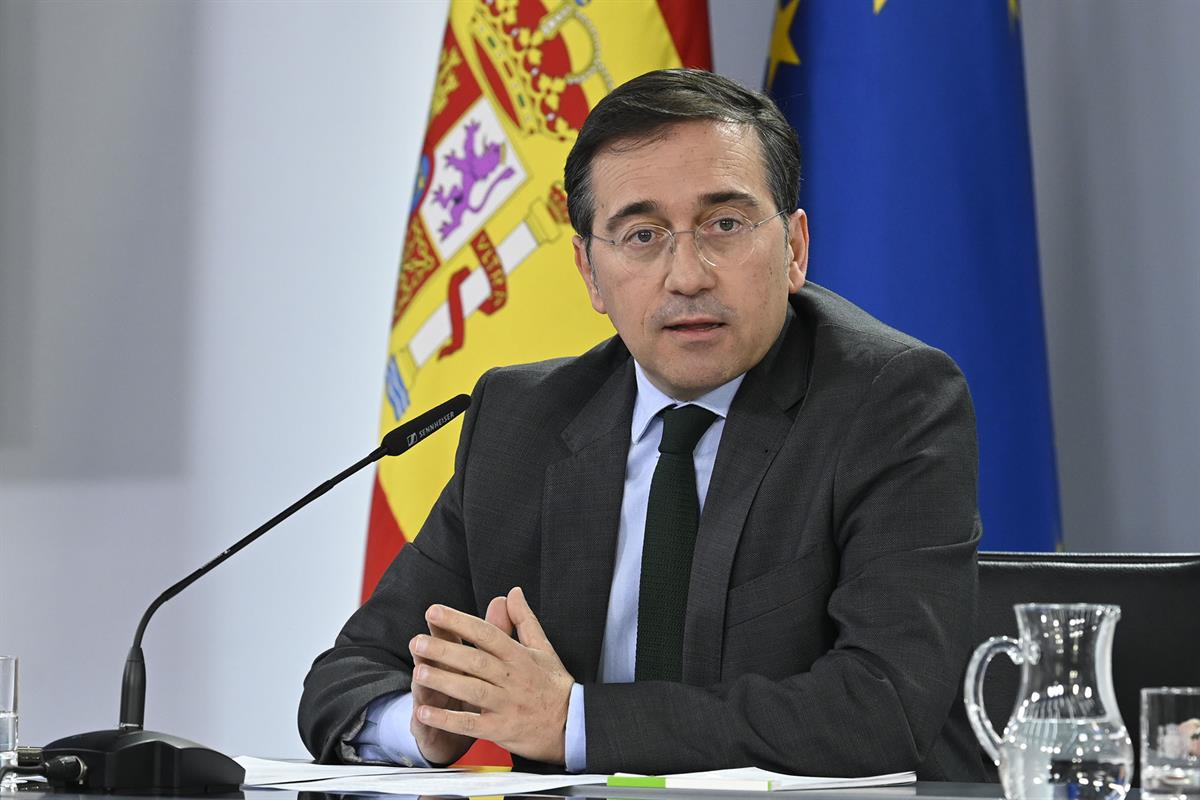
<h6><strong>Eduardo González</strong></h6> <h4><strong>Foreign Minister José Manuel Albares stated this Wednesday, January 7, that “at this time there is no plan” for the possible deployment of troops to Ukraine, one day after Prime Minister Pedro Sánchez explicitly raised for the first time the possibility of Spain participating with armed forces in Ukraine if a peace agreement were reached.</strong></h4> “At this time there is no plan as such,” Albares declared at the press conference following the first Council of Ministers meeting of 2026. “What exists is an outline of ideas that were discussed yesterday in Paris for a possible peace plan,” he added, referring to the meeting of the Coalition of Volunteers in the French capital, in which Sánchez participated and where a preliminary agreement was reached to define the security framework to be deployed once a ceasefire is declared. “At this moment, unfortunately, and it's not for lack of trying on the part of Europeans and Ukrainians, there isn't even a ceasefire yet,” Albares noted. “There is a party responsible for this war of aggression, which is Russia, and they have to speak out, they also have to say what they think about a peace plan, and at the moment they are giving no indication of wanting one, but there are certainly some initial ideas,” he added. “In any case, anything done regarding security in Ukraine will always respect international law, especially when it involves Spain and the European Union, and one of the things that international law always respects is the deployment of troops at the request of the country itself,” Albares explained. “In that sense, a United Nations mandate is no longer necessary because it is already included within international law,” he clarified. In any case, he insisted, “we are still a long way from having a plan.” “As such, there is an outline of ideas for a peace plan,” but, “at this time, as we speak here, Russia continues with its war of aggression,” he concluded. Any military deployment must be authorized by the Congress of Deputies. For this reason, Sánchez announced in Paris that, starting next Monday, he will begin a round of talks with most of the parliamentary groups to explain his proposal and gather support. The parties to the left of the government are traditionally reluctant to any military deployment abroad, so the Executive may be forced to seek the support of the People's Party (PP) to secure any eventual parliamentary authorization. <h5><strong>PP, Sumar, and Podemos</strong></h5> In this regard, the PP's Deputy Secretary for Finance, Housing, and Infrastructure, Juan Bravo, stated this Wednesday, after the party's Steering Committee meeting, that his party will attend the meeting with Sánchez to contribute “proposals,” but he did not clarify whether the party led by Alberto Núñez Feijóo will support the deployment of troops. “The important thing is not whether the PP supports it,” but whether the government's partners do, he told the press. According to Bravo, the government still “hasn't called us” and, “until we have information, we're not going to comment.” For his part, Enrique Santiago, a member of parliament for Sumar and spokesperson for United Left (IU) in Congress, warned this Wednesday that sending Spanish troops to Ukraine “is only possible” after a peace agreement, with a United Nations mandate and the backing of Congress. He asserted that his party will not support this possibility “at any time” if there is “the slightest risk of ending up in a conflict.” Likewise, the Secretary General of Podemos, Ione Belarra, reiterated her rejection of sending Spanish troops to Ukraine because “the Armed Forces are not meant to provide private security for the United States.” She asked Sánchez that if he wants support, he should seek it among “the Trumpist right” of the PP and Vox. “We don't want to contribute to the escalation of the conflict, nor to fuel a war,” she added.