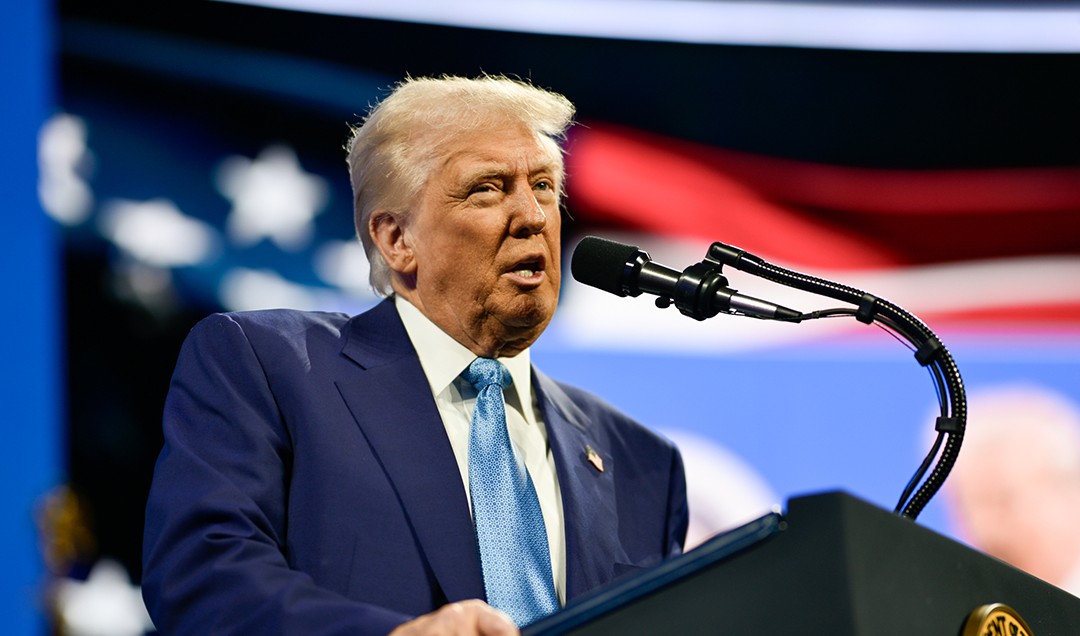
<h6><strong>Eduardo González</strong></h6> <h4><strong>The Plurinational Parliamentary Group Sumar has asked the Government what diplomatic actions it has taken before the European Union and the UN to condemn US President Donald Trump's decision to order the closure of the airspace of "a sovereign country like Venezuela."</strong></h4> In a written parliamentary question submitted on December 11 by MP Enrique Santiago Romero of the United Left party, Sumar recalls that on November 29, Donald Trump announced via social media that the airspace over Venezuela and surrounding areas should be considered "completely closed." “Once again, we are faced with a unilateral declaration by the United States government that violates international law, threatening the sovereignty of Venezuelan airspace and Venezuela's territorial integrity, without the backing of the United Nations Security Council or the International Civil Aviation Organization (ICAO),” denounces the junior partner in Pedro Sánchez's coalition government. In this regard, Sumar recalls that the 1944 Chicago Convention establishes in its Article 1 that each State possesses “full and exclusive sovereignty over the airspace above its territory” and that the Charter of the United Nations, in its Article 2.4, prohibits the use of force or the threat of its use against the territorial integrity or political independence of any State, except with the authorization of the Security Council or in legitimate self-defense. “Several governments, such as Colombia and Cuba, have already reacted publicly to the US declaration, stating that it constitutes a flagrant violation of international law and a dangerous precedent for regional stability,” asserts the party led by Vice President Yolanda Díaz. “These types of unilateral measures, contrary to international law, set a dangerous precedent that erodes essential principles of the international order, such as the sovereign equality of states, the prohibition of the threat or use of force, as well as the legal framework governing civil aviation,” and, furthermore, “may compromise the safety of international civil flights, including those operated by European and Spanish airlines transiting the region on transatlantic routes,” it continues. In addition, it warns, “this declaration, in practice, amounts to the imposition of a new unilateral sanction on Venezuela that will cause serious economic and commercial harm, as well as being a further step in the escalation towards US military intervention or invasion of Venezuela.” Therefore, it adds, “allowing the US to impose air restrictions in violation of international law, as in the case of Venezuela, could open the door to dangerous global destabilization, to which the international community should react firmly.” “In keeping with its long-standing position of defending international law, dialogue and multilateralism for the peaceful resolution of disputes, the Government of Spain should adopt the appropriate diplomatic measures, within the EU and UN framework, in defense of International Law, to respect the sovereign equality of States and prevent military intervention against Venezuela, as well as the possible escalation in the region,” it continues. Therefore, Sumar asks what the Government's "assessment" is "regarding the potential scope of the declaration by the President of the United States to close the airspace of a sovereign country like Venezuela," and what diplomatic actions "it has undertaken, or plans to undertake, to clearly express its rejection of this unilateral declaration and to defend respect for the international legal order." It also asks whether the Government plans to issue, "like other countries, a public statement condemning the unilateral declaration by the United States of a total closure of airspace over Venezuela," and whether it plans to convey, "within the EU and the UN, its condemnation of this unilateral measure by the United States, as well as its condemnation of any interference or intervention against the sovereignty of Venezuela, in defense of international law." Sumar also asks the Government whether it has considered "the potential economic, commercial, and security impact of this measure, also affecting the interests and operations of Spanish airlines operating in the region via transatlantic routes," and whether it intends to adopt any measures in this regard. Furthermore, the Mixed Parliamentary Group, at the request of the Galician Nationalist Bloc (BNG), the Republican Parliamentary Group, and the Euskal Herria Bildu Parliamentary Group, has submitted a non-binding motion for debate in the Foreign Affairs Committee. This motion urges the Government to "reject the continued escalation of threats by the United States Government towards Venezuela, Colombia, and other countries in the region" and to "address the United States Government, international organizations of which it is a member, and the entire international community to demand an end to the unlawful actions that violate the sovereignty of nations and respect for international law."