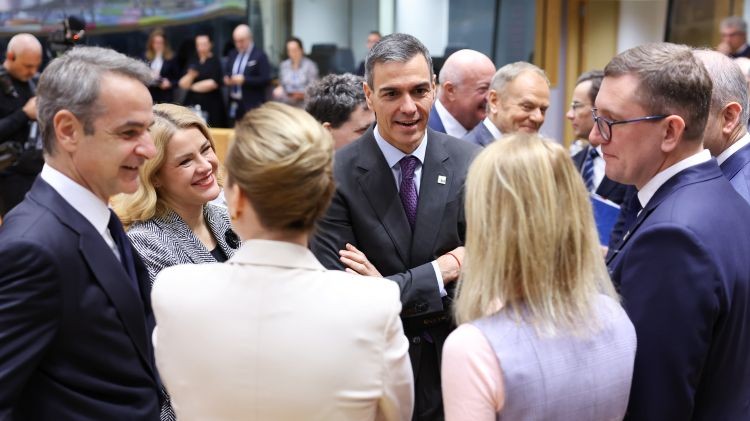
<h6><strong>Eduardo González/Ane Barcos</strong></h6> <h4><strong>The Spanish Prime Minister, Pedro Sánchez, declared early this morning that it is “just” that Russia, as the “aggressor,” pay for Ukraine’s recovery, after the European Council approved a €90 billion loan to Kyiv in Brussels for the period 2026-2027.</strong></h4> The European Council reached an agreement early Friday morning, after more than 16 hours of negotiations, to grant Ukraine a €90 billion loan for the period 2026-2027, financed through common EU borrowing and backed by the EU budget. The Council also committed to further studying the option of using frozen Russian sovereign assets as the basis for a future reparations mechanism. The heads of state and government agreed to this support with the aim of covering Kyiv's budgetary needs, including those related to defense, as they had committed to at the October summit. The debate focused on two options put forward by Brussels and was left until the end of the agenda, allowing delegations to maintain contacts on the sidelines of the summit to try to bridge their differences. On the one hand, they discussed the creation of a reparations loan backed by the profits from Russian assets frozen in the EU since the beginning of the war. On the other, they considered the possibility of resorting to joint borrowing by taking advantage of the European budget's margin. The proposal based on Russian assets generated the greatest difficulties. Brussels insists that Russia must bear the cost of the damage caused to Ukraine, but Belgium, where most of these assets are held, expressed reservations from the outset and demanded broad guarantees against legal and financial risks. This opposition led several leaders to indicate that they would not support the plan until these aspects were clarified. Faced with this impasse, the leaders opted for the path of common borrowing. The agreement allows the EU to raise up to €90 billion on the capital markets between 2026 and 2027, backed by the EU budget. The instrument will be implemented through enhanced cooperation, so that any mobilization of budgetary resources as collateral will not impact the financial obligations of the Czech Republic, Hungary, and Slovakia, countries that oppose continuing to finance Kyiv. In its conclusions, the European Council reiterated that, in accordance with EU law, Russian assets must remain frozen until Moscow ceases its aggression and compensates Ukraine, and called on the Council and the European Parliament to continue the technical and legal work to establish a reparations loan based on the balances associated with these assets. <h5><strong>Pedro Sánchez</strong></h5> In the press conference following the Council meeting, Sánchez announced that, “after a long session and weeks of work at all levels, we have finally reached an agreement whereby the European Union will urgently and immediately provide a loan of 90 billion euros for the next two years, financed through joint debt and guaranteed by the European budget.” “As I also had the opportunity to convey personally to President (of Ukraine, Volodymyr) Zelensky this morning (Thursday) in a bilateral meeting we held, the European Union must financially support Ukraine, and it must do so for moral reasons, for reasons of justice, and also because it is legal, because there is international law that supports this decision,” he added. Pedro Sánchez also recalled that, in addition to this emergency mechanism, the Council recently approved the historic decision to permanently freeze Russian assets and that progress will be made toward implementing the reparations loan based on this measure. In this regard, the Prime Minister asserted that “it is only fair that the aggressor pay for the damage caused.” At the end of the summit, the President of the European Council, António Costa, explained that the agreed loan will allow Ukraine to meet its urgent financial needs and that Kyiv “will only repay it when it receives reparations.” Until then, Russian assets will remain frozen, and the Union reserves the right to use them to repay the loan, in full compliance with European and international law. The approved text also links financial support to strengthening European and Ukrainian defense industries and to Ukraine's commitment to the rule of law and the fight against corruption. With this agreement, the EU establishes the framework for its support to Ukraine for the coming years while keeping open the option of Russia assuming the cost of the war. <h5><strong>MFF and Palestine</strong></h5> The 27 member states also addressed the Multiannual Financial Framework, the European Union's budget for the 2028-2034 period. The Prime Minister advocated for an ambitious European budget, reaching 2% of the Member States' GDP, and emphasized its direct impact on citizens' interests. He therefore insisted on providing the Union with the necessary resources to develop European public goods, promote innovation, lead the green and digital transitions, strengthen social and territorial cohesion, and bolster the social pillar through housing policy. Regarding Palestine, Pedro Sánchez stated that the European Union must actively participate to support peace and the participation of the Palestinian Authority in the process, condemned the expansion of illegal settlements in the West Bank, and demanded that humanitarian aid enter quickly and in sufficient quantity.