
Eduardo González
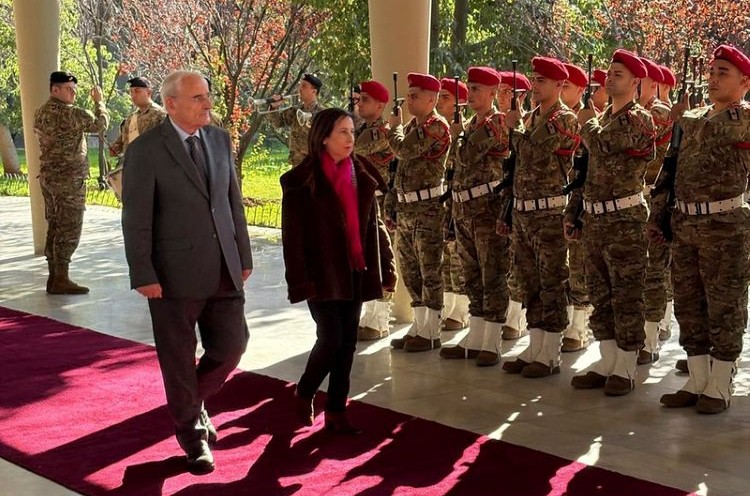
The Minister of Defense, Margarita Robles, assured her Lebanese counterpart, Michel Menassah, in Beirut that Spain is determined to continue supporting peace in Lebanon despite the possible withdrawal of the UN mission (UNIFIL) at the end of 2026.
Robles was received by Menassah on Wednesday, December 17, during the second day of her working visit to Lebanon. During the meeting, the Lebanese Defense Minister expressed his concern to the minister about the future of the mission and thanked the nearly 700 Spanish soldiers serving in the Multinational Brigade East, which comprises some 3,500 personnel from seven different countries (India, Nepal, Indonesia, Serbia, El Salvador, Brazil, and Spain).
Following the ceasefire agreement of November 24, 2024, between Lebanon and Israel, and despite the unstable calm prevailing in the region, the UN adopted a resolution last August establishing the end of UNIFIL operations by December 31, 2026, and the withdrawal of forces throughout 2027.
Regarding this matter, the Minister of Defense stated that, should this termination occur, Spain intends to maintain its support for the Lebanese Government and the Lebanese Armed Forces until the appropriate conditions are met.
“It is a difficult time, which is why we must remain firmly committed to peace, supporting the United Nations and Lebanon,” the Minister affirmed. “Formally, there is a situation of peace, but deaths continue to occur every day,” Robles warned, referring to the frequent violations of the ceasefire agreement.
In this regard, the minister stated that the main concern is ensuring the Lebanese Armed Forces (LAF) receive adequate training and education, and assured that “Spain, within its capabilities and as we always do in peacekeeping missions, will be helping and supporting them.”
Robles visited one of the positions monitoring the so-called ‘Blue Line,’ which separates Lebanon and Israel, and again thanked the soldiers of BRILIB XLIV, under the command of Brigadier General Antonio Bernal, for their dedication and commitment during these difficult times for the region. For his part, the Chief of the Defence Staff, Admiral General Teodoro López Calderón, urged the soldiers “not to let their guard down.” Separately, the Minister of Defence presided over a delivery of medical supplies destined for the civilian population.
UNIFIL
On Tuesday, the first day of her visit to Lebanon, Margarita Robles met with the Spanish contingent at the ‘Miguel de Cervantes’ base in Marjayoun. The members of the 44th Interim Brigade of Lebanon (BRILIB XLIV) have been deployed in the country since the end of November for a six-month period, under the command of Brigadier General Antonio Ramón Bernal.
Spain leads the Multinational Brigade East in the region and, until last June, commanded the United Nations Interim Force in Lebanon (UNIFIL). The Spanish contingent, which at its peak numbered 1,100 troops, has maintained between 600 and 700 personnel since 2012. It is Spain’s largest peacekeeping mission, with almost 700 troops, the vast majority of whom come from the 12th Brigade ‘Guadarrama’ (BRI XII).
The UN mission in Lebanon is tasked with monitoring the cessation of hostilities between Hezbollah and Israel and supporting the Lebanese Armed Forces in the south of the country and along the demarcation line between the two states, the so-called Blue Line. It also guarantees humanitarian access to civilian populations and the safe and voluntary return of displaced persons, in collaboration with the Lebanese Armed Forces.
Spain has participated in the UNIFIL mission since 2006, with the objective of contributing to the implementation of United Nations Resolution 1701 to maintain international peace and security and to assist the Lebanese government in restoring its authority in the region. The bulk of the contingent in Operation Libre Hidalgo is based at the Miguel de Cervantes base, and there are also Spanish personnel at the mission’s headquarters in Naqoura. In addition to the UN mission, Spain has deployed two mobile training teams in Lebanon, one permanently based in Sidon, where it works alongside the French contingent, and the other temporarily based in Beirut.