
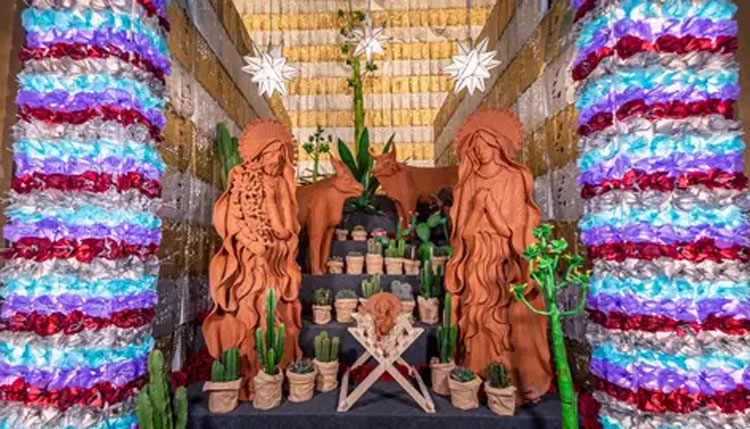
Until next January 11, Fundación Casa de México celebrates Mexican Christmas with a program of activities for the whole family and an exhibition of nativity scenes from Mexico that highlights the popular art of Mexico.
The main birth consists of ten large-format clay pieces over 170 cm high, made by the renowned family of pottery craftsmen Soteno. The tour is complemented by more than twenty nativity scenes of different popular art techniques, from various regions of the country. The wide variety of techniques, symbolism and raw materials come together in the knowledge of the work of Mexican craftsmen.
The Soteno family is originally from Metepec, State of Mexico, internationally recognized for its work in pottery. The family is famous for its pieces like the “trees of life” and for helping to turn Metepec into one of the most important pottery centers in Mexico. The family’s pottery workshop is located on the outskirts of Metepec, on the highway to Ixtapan de la Sal.
It is an art in constant change, but which is itself a mirror of family history. The craft is learned in the family and passed on from generation to generation. Craft families live up to the values of communality in teaching, sharing and contributing. In this way, popular art is configured not only as part of the Mexican artistic heritage, but the craft itself can be considered an important part of the intangible cultural heritage of Mexico.
The work of craftsmen is necessarily linked to the place where it is produced. Thus, the artist feeds on what surrounds him, letting the landscape and its context influence the work. This is why every piece of folk art is unique, varying the production of the same according to the territory in which it is produced, since it determines, in many cases, the techniques, style or materials used.
The vast Mexican territory is home to abundant and very diverse types of fauna and flora that provide craftsmen with high-quality raw materials. In this way, it is possible to identify different craft branches according to the raw material that has been used: clay, wood, stone, textiles, metals, paper, leather or vegetable fibers, among others.